Periodization is the structure behind serious training plans — the deliberate way you change what you do over weeks and months so progress keeps coming and you peak when it matters. Here's what it means, the vocabulary (macro, meso, micro), the three main models, and whether you actually need it.
Periodization is the planned variation of training variables — volume, intensity, and exercise selection — over time to keep progressing and to peak when it matters. Rather than repeating the same workout indefinitely, you organize training into a macrocycle (the whole plan, often a season or several months), built from mesocycles (blocks of roughly 3–6 weeks, each with one focus), which are in turn built from microcycles (usually a single week). The three classic models are linear, undulating (DUP), and block. Beginners rarely need it; it earns its keep for intermediates, advanced lifters, and anyone training toward a specific date.
Periodization is planned variation. Instead of running one workout on repeat, you decide in advance how the key variables — volume (total work), intensity (how heavy, relative to your max), and exercise selection — will shift across the calendar so demand keeps rising just ahead of your capacity and so peak form lands on the day you need it. The vocabulary is borrowed from sport science and stacks in three tiers: a macrocycle is the whole plan (often a competitive season or several months); a mesocycle is a block within it, typically 3–6 weeks, given a single emphasis like hypertrophy or strength; and a microcycle is the smallest planning unit, usually one week, that sets the day-to-day loading. Underneath all of it sits the same engine as any good plan — progressive overload — periodization is just how you organize that overload over the long run.
Periodization grew out of Soviet sport science in the mid-20th century, when coaches were systematizing how athletes should be prepared across an Olympic cycle. Leo Matveyev is credited with formalizing the classic ("traditional") periodization model, laying out how volume and intensity should be phased across a season to arrive at peak condition on schedule. His framework was later carried into Western coaching and textbooks largely through Tudor Bompa, whose writing popularized periodization for coaches and athletes outside the Eastern Bloc. Decades of refinement since — including the block model discussed below — build on that original foundation.
There are three widely taught models. They differ mainly in how often the training emphasis changes — across a whole macrocycle, within a single week, or in concentrated multi-week blocks. Each has its own dedicated guide.
| Model | How it varies training | Best for |
|---|---|---|
| Linear | Progress across the macrocycle from higher volume + lower intensity toward lower volume + higher intensity | Novices and peaking for a single date; simple to run |
| Undulating (DUP) | Vary intensity and rep ranges frequently — daily or weekly (e.g. heavy, moderate, light within one week) | Intermediates; trains multiple qualities at once |
| Block | Sequence concentrated blocks that each focus on a few compatible qualities (accumulation → transmutation → realization) | Advanced lifters and athletes with competition dates |
Honestly, most beginners don't. If you're new, simple linear progression plus progressive overload — just adding a little weight or a rep most sessions — will carry you a long way, and adding a formal periodized structure on top of that early on mostly adds complexity without adding results. Periodization starts to matter once the easy progress dries up: for intermediates and advanced lifters, whose bodies no longer adapt session to session, planned variation is how you keep multiple qualities moving and avoid stalling. It matters even more when you're peaking for a date — a meet, a season, a test — because that's the whole point of the concept: to arrange your training so you arrive at your best on the day it counts, not two weeks before or after. When you do stall, a planned deload is often the built-in reset that lets the next block land.
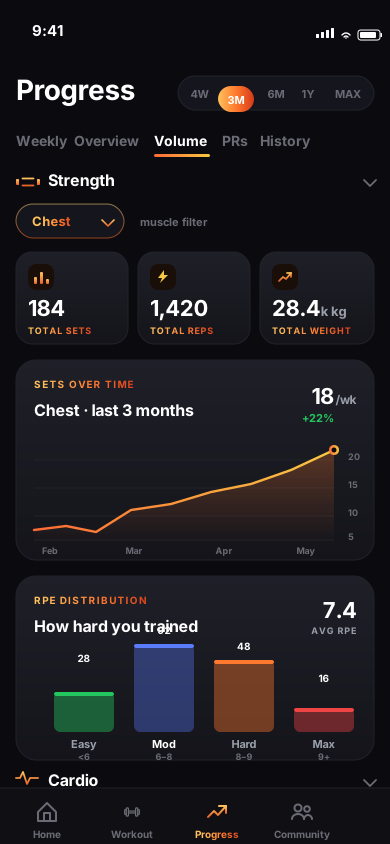
LiftHero tracks whatever you log — every set, rep, weight and RPE — so you can follow a periodized plan and actually see it play out across mesocycles. Log each set as you lift; over weeks the app charts weight and volume per exercise, so you can watch a hypertrophy block build volume and a strength block push intensity, and confirm you're peaking rather than stalling. To be clear about what it is and isn't: LiftHero is the measurement layer, not a decision engine. It logs any set you record free and unlimited; saving a full multi-week plan is the optional Hero upgrade. It does not auto-generate or auto-progress your program — you (or your coach) design the periodization, the app records what you do. Pair it with a structured plan like 5/3/1 and log every set.
It's planning how your training changes over time — deliberately varying volume, intensity and exercise choice across weeks and months so you keep progressing and peak when it counts, instead of doing the same thing forever.
A macrocycle is the whole plan (often a season or several months). A mesocycle is a block within it (roughly 3–6 weeks) with a single focus. A microcycle is the smallest unit, usually one week of training.
The three classic models are linear (progress from high volume/low intensity toward low volume/high intensity), undulating or DUP (vary intensity and reps daily or weekly), and block (sequence concentrated blocks each focused on a few qualities).
Not really. Beginners progress well on simple linear progression plus progressive overload — just adding a little each session. Formal periodization matters more for intermediates and advanced lifters, and for anyone peaking for a date.
It grew out of Soviet sport science. Leo Matveyev formalized the classic periodization model, and Tudor Bompa later popularized periodization in the West through his coaching texts.
No. LiftHero logs and charts whatever sets you record so you can follow and track a periodized plan; it does not auto-generate or auto-progress the program for you.
Log sets, reps, weight, RPE and PRs across every block — free on iOS.
Download on theApp StoreFree to start · No interruptive ads · 14-day Hero trial
This guide is educational and not medical advice. Consult a qualified coach or medical professional before starting or changing a training program.
By Meitar Lazimi, founder of LiftHero · Last updated July 9, 2026.