Block periodization is the model advanced athletes reach for when spreading their training thin stops working. Instead of chasing everything at once, you attack a couple of qualities hard for a few weeks, then hand the baton to the next block — accumulate, transmute, realize — timing the last block to land on the date. Here's how it works and who it's for.
Block periodization sequences concentrated blocks that each focus on a few compatible qualities. The classic three are accumulation (volume, work capacity, hypertrophy), transmutation (converting that base into strength), and realization or peaking (power and a taper to arrive fresh). Rather than training everything at once, each block develops a couple of qualities hard, and the residual fitness carries into the next block. It's credited to Vladimir Issurin and is best for advanced lifters and athletes with competition dates, where concentrated loading and precise peaking matter more than variety. Beginners don't need it.
Block periodization is built on a simple observation: at the elite level, trying to develop every quality at once spreads the stimulus too thin to move any of them. So instead you concentrate — each "block" (a mesocycle of a few weeks) trains only a couple of compatible qualities, hard, and then you move on. The trick that makes the sequence work is residual training effects: the fitness you build in one block doesn't vanish the moment you stop emphasizing it, so it lingers and supports the next block's focus. Chain the blocks in the right order and each one stands on the residuals of the last, culminating in a peak on your target date. It's still governed by progressive overload; block periodization just concentrates that overload into focused windows. The model is credited to Vladimir Issurin, who formalized it out of Soviet sport science.
A block sequence typically runs three concentrated mesocycles, each handing residual fitness to the next.
| Block | Focus | Typical loading |
|---|---|---|
| Accumulation | Volume, work capacity, hypertrophy | Higher volume, moderate load — build the base |
| Transmutation | Convert the base into strength | Reduced volume, heavier load |
| Realization | Power, speed, peaking | Low volume, high intensity, taper to arrive fresh |
Accumulation lays down the raw materials — work capacity and hypertrophy. Transmutation turns that base into the target quality, usually maximal strength. Realization expresses it: power, speed and a taper so accumulated fatigue clears and your best day lands on the date. After it, you deload and start a fresh accumulation block.
Fix the date, then chain the three blocks backward from it so realization ends on the day. The loop:
Then deload and start the next sequence from a new accumulation block. Within any block you can still autoregulate day to day with RPE, and the broader progression methods guide covers the loading tactics you'll use inside each one.
Block periodization earns its complexity at the top end. It's built for advanced lifters and athletes with competition dates — people whose bodies no longer respond to training everything at once and who need concentrated loading to push any single quality forward. The precise, backward-planned peaking is its whole reason for being, so it fits sports and strength meets where being at your best on one specific day is the goal. It is not where a beginner should start: novices progress fine on simple linear progression and progressive overload, and the concentrated-block structure only pays off once the easy gains are gone. Compared with the long single ramp of linear periodization or the constant variation of undulating (DUP), block sits at the advanced, competition-focused end of the periodization spectrum.
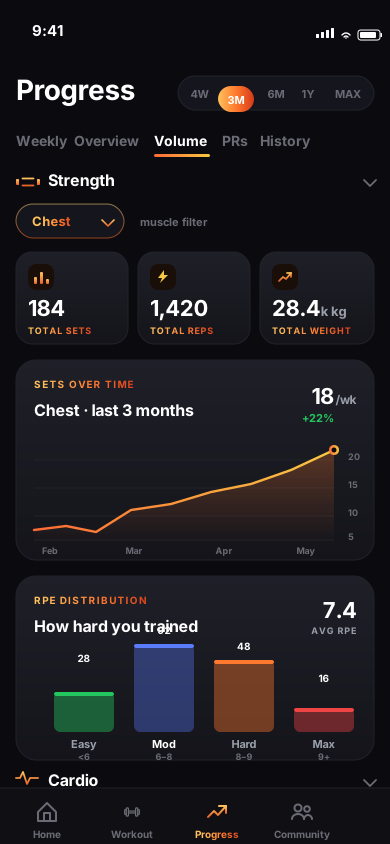
LiftHero records whatever you log — sets, reps, weight and RPE — so you can run a block sequence and see each block's signature in the data: volume climbing through accumulation, load climbing through transmutation, intensity peaking as volume tapers in realization. Log each session and the app charts weight and volume per exercise, so you can confirm you're actually peaking on schedule. To be clear: LiftHero is the measurement layer, not a decision engine — it logs any set free and unlimited, saving a full multi-block plan is the optional Hero upgrade, and it does not auto-generate or auto-progress your program. You (or your coach) design the blocks; the app records what happens. Log every set through every block.
A model that sequences concentrated blocks, each focused on a few compatible qualities: accumulation (volume, work capacity, hypertrophy), transmutation (strength), and realization or peaking (power, taper). Residual fitness from one block carries into the next.
Accumulation builds base qualities like work capacity and hypertrophy; transmutation converts that base into the target quality, usually maximal strength; realization expresses it with power work and a taper to peak on the date.
Vladimir Issurin is credited with developing and popularizing modern block periodization, building on Soviet sport science and the residual-training-effects concept.
Advanced lifters and athletes with competition dates. Concentrating on a few qualities per block suits people who no longer respond to spreading their training thin, and it's built around peaking on schedule.
Both sequence phases toward a peak, but block periodization uses shorter, more concentrated blocks that develop a couple of qualities at a time and rely on residual training effects to carry fitness forward, rather than one long ramp like linear periodization.
No. It's aimed at advanced athletes. Beginners progress fine on simple linear progression and progressive overload; block periodization adds complexity that only pays off once the easy gains are gone.
Log sets, reps, weight, RPE and PRs through every block — free on iOS.
Download on theApp StoreFree to start · No interruptive ads · 14-day Hero trial
This guide is educational and not medical advice. Consult a qualified coach or medical professional before starting or changing a training program.
By Meitar Lazimi, founder of LiftHero · Last updated July 9, 2026.