Jim Wendler's 5/3/1 is one of the most trusted strength programs ever written — slow, simple, and built to last. Here's how it actually works in plain English, who it's for, and how to run it free in LiftHero.
In short: 5/3/1 is a strength program built on four main barbell lifts. Every weight comes off a Training Max (about 90% of your true one-rep max), and each session works up to a top set you push for as many reps as possible. Across a cycle you run a week of 5s, a week of 3s, and a week of 5/3/1 singles, then add a little to your Training Max and repeat. It trades fast, fragile progress for slow, repeatable progress that holds up over years. LiftHero includes a 5/3/1 Boring But Big template, free on iOS.
5/3/1 is a strength-training system created by powerlifter Jim Wendler and described in his book 5/3/1: The Simplest and Most Effective Training System. It organizes your training around the four big barbell lifts — back squat, bench press, deadlift, and overhead press — and a single, deliberately patient idea: progress your Training Max, not your ego.
Instead of testing a new one-rep max every week, you work off a Training Max set a touch below your real strength. That keeps each session doable, lets you push the last set hard, and leaves room to keep adding weight cycle after cycle. It's the opposite of burning out in six weeks.
Boring But Big — usually shortened to BBB — is the most popular way to add size to 5/3/1. After your main work, you do five sets of ten reps of a main lift at a lighter percentage of your Training Max. It's monotonous on purpose: high-rep, repeatable volume that drives muscle and work capacity without interfering with your heavy top sets. LiftHero ships a 5/3/1 Boring But Big template you can start in a couple of taps.
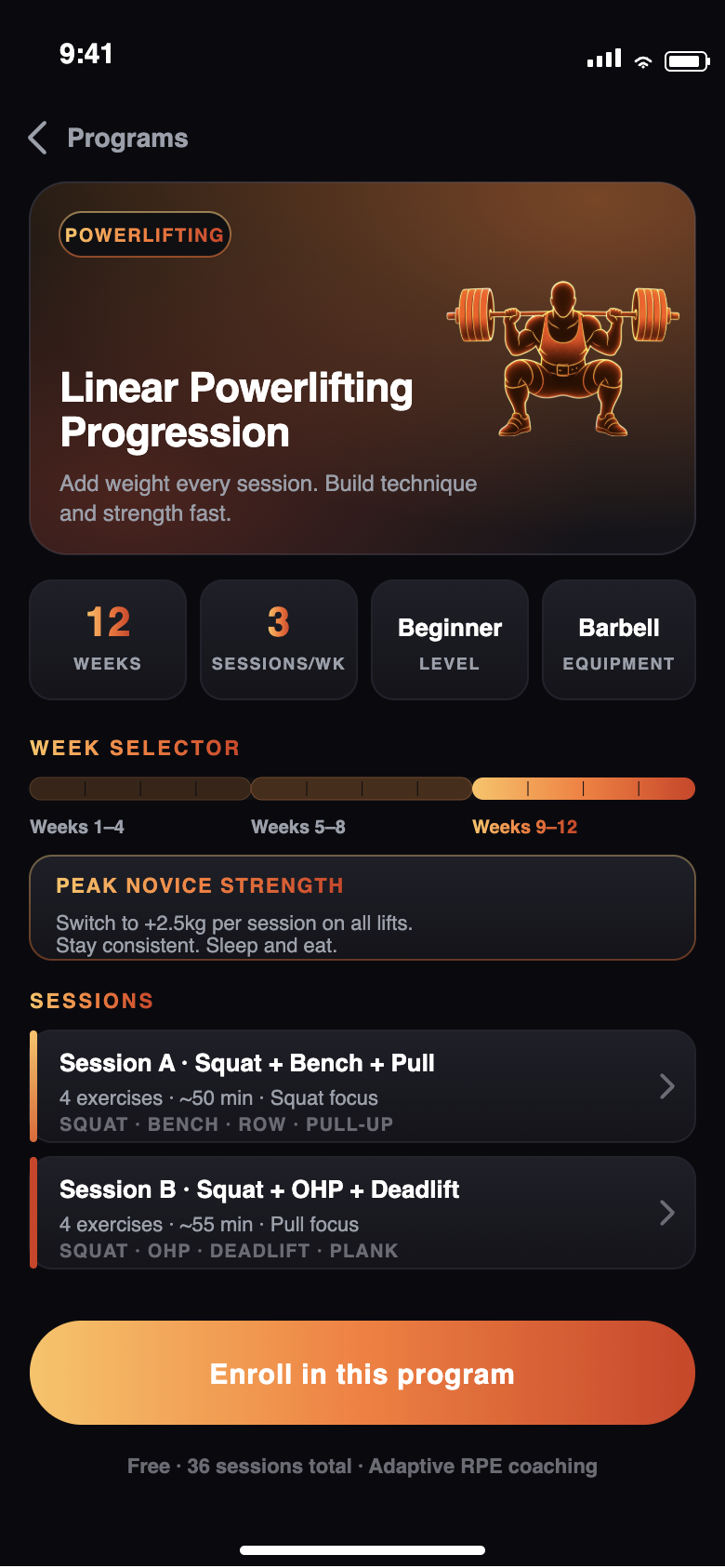
5/3/1 shines for early-intermediate and intermediate lifters — people who've learned the main lifts and have stopped adding weight every single session. If you're a true beginner, a simple linear program like Starting Strength will usually add weight faster at first; come to 5/3/1 when those linear jumps stall. It's also a great long-haul program for lifters who want structure without living at their max. Prefer a hypertrophy-focused split instead? See the Push Pull Legs routine.
The 5/3/1 Boring But Big template — plus Starting Strength, Texas Method, Madcow and more — built into LiftHero.
Download on theApp StoreFree to start · No interruptive ads · 14-day Hero trial
A strength program by Jim Wendler built around four main barbell lifts. Every weight is based on a Training Max (about 90% of your true one-rep max), and each session works up to a top set pushed for as many reps as possible. You progress by adding a little to your Training Max each cycle rather than maxing out weekly.
It refers to the main rep targets across the three working weeks — a week of 5s, a week of 3s, and a week built around 5/3/1 singles — with weights rising as the rep targets fall. The last set each day is an AMRAP.
A working number set to roughly 90% of your true one-rep max. All your 5/3/1 percentages come off it. Keeping it slightly conservative is the whole point — sessions stay repeatable and you keep room to grow.
A 5/3/1 supplemental template: after your main lift, five sets of ten reps of a main movement at a lighter percentage of your Training Max, to build size and work capacity. LiftHero includes a 5/3/1 BBB template.
It's best for early-intermediate and intermediate lifters. True beginners often add weight faster on a simple linear program like Starting Strength first, then move to 5/3/1 when those gains slow.
Yes — LiftHero includes a 5/3/1 Boring But Big template free on iOS. It tracks your Training Max, walks you through each session, and logs your AMRAP sets so you can watch progress over months.
5/3/1 is a training system created by Jim Wendler. LiftHero is not affiliated with, endorsed by, or sponsored by Jim Wendler or Jim Wendler LLC. LiftHero's implementation is an independent adaptation of the publicly described methodology and does not reproduce the original's proprietary percentage tables. Every built-in program is credited on the Program Credits page. This guide is educational and not medical advice — consult a qualified professional before starting any program.
By Meitar Lazimi, founder of LiftHero · Last updated July 1, 2026.