Undulating periodization flips the classic idea on its head: instead of slowly shifting emphasis over months, you change intensity and reps constantly — a heavy day, a moderate day, a light high-rep day, sometimes all in the same week. Here's what it is, how DUP and WUP differ, what the research actually says, and how to set one up.
Undulating (non-linear) periodization varies intensity and rep ranges frequently — daily (DUP) or weekly (WUP) — instead of shifting slowly across a whole cycle. A single week might hold a heavy low-rep day, a moderate day, and a lighter high-rep day, so strength and hypertrophy are trained at once rather than in separate phases. It's popular with intermediates who've stalled on plain linear progression. Research generally shows it's comparable to linear periodization, sometimes favorable for strength — not clearly superior for everyone. You progress each day on its own track and autoregulate with RPE when a session feels off.
Undulating periodization — also called non-linear periodization — is defined by frequent change. Where linear periodization shifts emphasis slowly across a whole macrocycle, undulating shifts it constantly: intensity and rep ranges rise and fall from session to session or week to week, so the training "undulates" rather than marching in one direction. The practical payoff is that you keep several qualities trained at once — heavy work maintains strength while lighter, higher-rep work drives hypertrophy — instead of parking one quality for weeks while you focus on another. It's still built on ordinary progressive overload; undulating just distributes that overload across different rep schemes within a short window.
"Undulating" comes in two common granularities, differing only in how often the rep scheme changes.
| Variant | How often the scheme changes | Example |
|---|---|---|
| DUP (daily) | Every session within the week | Mon heavy (3–5), Wed moderate (6–8), Fri light (10–12) |
| WUP (weekly) | Held for a full week, changed week to week | Week 1 strength, Week 2 hypertrophy, Week 3 power |
DUP rotates the emphasis session to session — a heavy day, a moderate day and a light high-rep day inside one week. WUP holds a rep scheme for a whole week and swaps it the next. Both keep multiple qualities alive; DUP just does it on a tighter cycle, which is why the term "DUP" is the one most lifters use in practice.
Train the same main lift three times a week and give each session a distinct job. The loop:
Then progress each day on its own track — add small load or reps within that day's range over the weeks — and autoregulate with RPE when a session feels heavier than it should. Because you're hitting the lift more often, spacing and honest effort ratings matter; schedule a deload when fatigue accumulates. For a broader menu of ways to advance the load, see the progression methods guide.
Not clearly, and it's worth being careful here. The research generally shows undulating and linear periodization produce comparable results, with some studies leaning toward undulating for strength outcomes — but the picture is mixed and the differences, where they appear, tend to be modest. It would be dishonest to claim one is decisively superior for everyone. What undulating reliably offers is variety and simultaneous training of multiple qualities, which is why it appeals to intermediates who've outgrown plain linear progression and want strength and size moving in the same week. If your only goal is to peak on a single date, the tidy ramp of linear periodization may fit better; if you want to keep everything trained at once, undulating is a strong choice. Many advanced lifters end up blending ideas from both and from the block model.
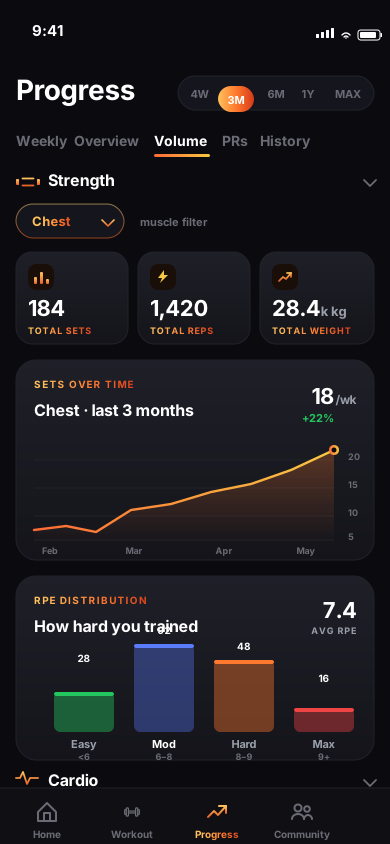
LiftHero records whatever you log — sets, reps, weight and RPE — which is exactly what a DUP week needs, because you're progressing three different rep schemes on their own tracks. Log each session as you lift and the app charts weight and volume per exercise, so you can confirm the heavy, moderate and light days are all trending up rather than blurring together. To be clear: LiftHero is the measurement layer, not a decision engine — it logs any set free and unlimited, saving a full weekly plan is the optional Hero upgrade, and it does not auto-generate or auto-progress your program. You design the undulation; the app records it. Log every set, on every day.
A non-linear model that varies intensity and rep ranges frequently — daily (DUP) or weekly (WUP) — rather than slowly across a whole cycle. A single week might hold a heavy low-rep day, a moderate day and a lighter high-rep day.
DUP (daily undulating periodization) changes the intensity and rep scheme from session to session within a week. WUP (weekly undulating periodization) holds a scheme for a full week and changes it week to week.
Research generally shows undulating and linear periodization produce comparable results, with some studies favoring undulating for strength. It's not clearly superior for everyone — both work; undulating just keeps several qualities trained at once.
It's popular with intermediates who want to train strength and hypertrophy in the same week and who've stopped progressing on plain linear progression. It also suits people who prefer varied sessions.
Train the same lift about three times a week and rotate a heavy low-rep day, a moderate day and a lighter high-rep day, progressing each day on its own track and autoregulating with RPE.
Because you train a lift more frequently, spacing and autoregulation matter. Use RPE to hold back on rough days and schedule a deload when fatigue builds so the frequent heavy exposures stay sustainable.
Log sets, reps, weight, RPE and PRs across every day — free on iOS.
Download on theApp StoreFree to start · No interruptive ads · 14-day Hero trial
This guide is educational and not medical advice. Consult a qualified coach or medical professional before starting or changing a training program.
By Meitar Lazimi, founder of LiftHero · Last updated July 9, 2026.