Progressive overload is the single principle behind almost every strength and muscle gain — do a little more than your body is used to, over and over. Here's what it means, the ways to progress, how to apply it, and how to know it's actually working.
Progressive overload is the principle of gradually increasing the demand on your muscles over time so they keep adapting and getting stronger or bigger. In practice it means doing a little more than your body is used to — most often adding weight, but also adding reps, sets, or improving control (tempo, range of motion) on the same lift. You don't add load every session; you progress when the current workload starts to feel manageable, usually via double progression (add reps within a target range, then add weight and reset). Tracking each set over weeks is what tells you whether you're actually overloading or just repeating the same workout.
Progressive overload means steadily increasing the challenge you place on a muscle so it has a reason to keep adapting. The framing is simple: do slightly more than last time — a heavier bar, an extra rep, one more set, a cleaner range of motion — instead of repeating an identical workout week after week. The idea is rooted in the overload principle and the SAID principle (Specific Adaptation to Imposed Demand): your body adapts to the specific stress you give it, and only to that. The classic illustration is Milo of Croton, the wrestler who reportedly carried a growing calf every day until it was a bull — a tidy story for the core idea that gradually rising demand builds capacity.
Muscles adapt to the stimulus you give them, and then they stop. If every session asks for the same weight and the same reps, your body has no reason to build more strength or size — it has already met that demand. Progress stalls not because you're doing something wrong but because you stopped asking for more. Progressive overload is how you keep the demand climbing just ahead of your current capacity. It applies to both goals: for strength, the overload is mostly heavier load over time; for hypertrophy, it's rising volume — more reps and sets accumulated at challenging weights. Either way, adaptation follows demand, and demand has to keep moving.
Adding weight is the most obvious lever, but it's only one of several. Any of these variables can be increased to overload a muscle — and rotating through them keeps progress going when the bar won't move.
| Variable to progress | How you increase it | Best for |
|---|---|---|
| Load (weight) | Add small increments (e.g. 1.25–2.5 kg upper, 2.5–5 kg lower) | Strength; the most direct overload |
| Reps | Add reps at the same weight within a target range | Hypertrophy; safest first lever (double progression) |
| Sets / volume | Add a working set to a muscle group over a block | Hypertrophy; drives weekly volume up |
| Tempo / control | Slow the eccentric, add pauses, remove momentum | Technique + stimulus without adding load |
| Range of motion | Move through a fuller, controlled ROM | More stimulus at the same weight; joint health |
| Density / rest | Do the same work in less rest, or more work in the same time | Conditioning + work capacity |
| Frequency | Train a lift/muscle more times per week | Advanced; raises total weekly volume |
The most reliable way to overload without guessing is double progression — you progress two variables in sequence, reps first and then weight. It keeps the jumps small and earned, which is exactly what you want on compound lifts. The loop:
When you stall — same weight, same reps, for a few weeks — that's your cue to deload or back off: cut load or volume for a week to shed fatigue, then resume the loop. Stalling isn't failure; it's information that you need recovery before the next round of overload.
Slower than most people want to. Realistic rates depend on the lift and your experience. Lower-body compounds (squat, deadlift) tolerate bigger jumps — often 2.5–5 kg — while upper-body and isolation work progresses in smaller steps of 1.25–2.5 kg, sometimes less. Beginners can often add a little most sessions in a near-linear fashion, riding the fast early adaptation of "newbie gains." Intermediates progress over weeks, not days, and eventually need reps, volume, or better technique to move the needle. Chasing weight every single session backfires: the load outruns your ability to control it, form breaks down, and you plateau or get hurt. Add weight only when the current weight moves well for all sets.
Progressive overload tells you what to increase; RPE tells you when it's smart to push. RPE — Rate of Perceived Exertion — is a 1-to-10 read on how hard a set felt, and it's the autoregulation tool that keeps overload sustainable. On a strong day a set comes in easy, so you add load; on a wrecked day the same weight feels like an RPE 9, so you hold or pull back rather than forcing a jump you can't recover from. Used together, RPE stops progressive overload from becoming a blind march upward — you keep the demand climbing, but only when your body can actually absorb it. The two concepts are siblings: read the full RPE guide for the effort side of the equation.
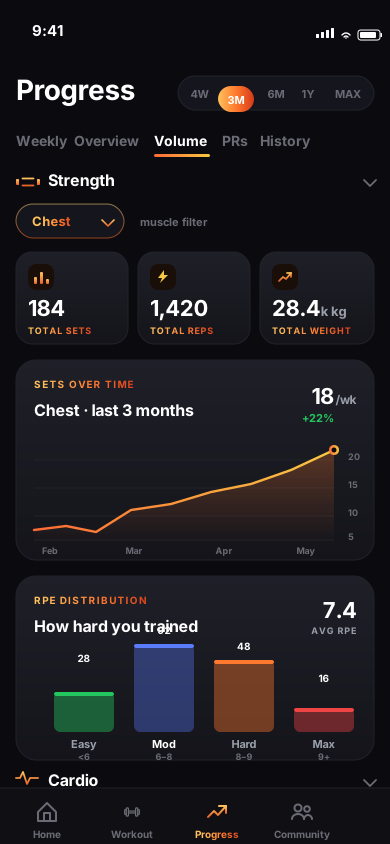
LiftHero tracks progressive overload — it logs your sets, reps, weight and RPE over time, surfaces the trend, and detects personal records, so you can apply overload deliberately and actually see whether it's working. Log each set as you lift; over weeks and months the app charts your weight and volume per exercise, so a real upward trend is easy to distinguish from a plateau where you've just been repeating the same workout. To be clear about what it is and isn't: LiftHero is the measurement layer, not a decision engine. It does not auto-add weight and does not auto-generate or adapt your program — you decide the progression, the app measures it. Pair it with a structured plan like 5/3/1 or Push Pull Legs and log every set as you go.
Gradually doing a bit more over time — more weight, reps, or sets — so your muscles keep adapting. Do slightly more than last time, consistently.
Most simply with double progression: keep a rep range, add reps each week, and once you hit the top of the range on every set, add weight and drop back to the bottom.
No. Weight is the most obvious lever, but adding reps, sets, better tempo, fuller range of motion, or shorter rest all count.
Beginners can often add small amounts most sessions; intermediates progress over weeks, not days. Add load only when the current weight moves well for all sets.
Yes — progressing reps and total volume over time is a primary driver of muscle growth, not just maximal strength.
Log weight, reps, sets and effort (RPE) per exercise and review the trend over weeks. Without a record you can't tell real overload from repeating the same workout. LiftHero tracks this per set and flags personal records.
Progressive overload is what you increase over time; RPE is a way to gauge effort so you know when it's safe to push. See the RPE guide.
No. LiftHero logs and charts your sets, reps and RPE and detects PRs so you can apply progressive overload deliberately; it doesn't auto-generate or auto-progress your program.
Track sets, reps, weight, RPE and PRs in one place — free on iOS.
Download on theApp StoreFree to start · No interruptive ads · 14-day Hero trial
This guide is educational and not medical advice. Consult a qualified coach or medical professional before starting or changing a training program. Guidance here reflects widely accepted resistance-training principles (ACSM position stands, the training-volume work of Brad Schoenfeld, and Stronger By Science / Greg Nuckols); LiftHero is independent and not affiliated with those authorities.
By Meitar Lazimi, founder of LiftHero · Last updated July 1, 2026.