Once straight sets stop being enough, intensity techniques are how advanced lifters squeeze more out of a set — pushing past failure or packing more quality work into less time. Here's the full rundown of the main methods, when they help, what they cost you in fatigue, and how to track them.
Intensity techniques are advanced set-extension methods that push a muscle past normal failure or pack more quality work into less time — used mostly for hypertrophy and to break plateaus. Instead of ending a set at failure, you extend it: drop the weight and keep going (drop sets), rest briefly and squeeze out more reps (rest-pause, myo-reps), or break the set into short bursts to hold quality at a heavier load (cluster sets). Others — supersets and giant sets — stack exercises to raise density. They all add significant fatigue, so they belong mostly on isolation or final sets, in the hands of lifters who already have a solid base.
Intensity techniques (sometimes called intensifiers or advanced training techniques) are ways to make a single set — or a single session — do more work than a normal straight set would. A straight set ends when you hit or approach failure and rack the weight. An intensity technique keeps that set going a little longer or a little denser: you might strip the load and continue, pause and grind out a few more reps, or fold two exercises together back-to-back. The point is to accumulate more effective, near-failure reps, which is a primary driver of muscle growth, without simply adding more separate sets and more total time. Because they intentionally push past the point where you'd normally stop, they also generate more fatigue — which is exactly why they're used deliberately, not by default.
It's easy to lump these together, but they operate on different timescales. Progressive overload and the various progression methods are long-term load management — the plan for how weight, reps and volume climb across weeks and months so your body keeps adapting. Intensity techniques are within-set or within-session intensifiers — tools that make one set harder or more productive right now. Overload is the strategy; intensity techniques are one tactic inside it. You still need a progression plan underneath: an intensity technique gives you extra quality reps today, but tracking those sets over time and gradually raising the demand is what turns effort into results. Use effort tools like RPE to keep the added intensity honest and recoverable.
Each technique extends a set in a slightly different way and suits a slightly different goal. Here's how the common ones compare — follow the links for a full guide on each.
| Technique | How it works | Best for |
|---|---|---|
| Drop sets | Hit failure, immediately reduce load ~20–30% and keep going, sometimes for several drops | Hypertrophy; extra volume + metabolic stress on a final set |
| Rest-pause | Go to/near failure, rest ~10–20s, do a few more reps at the same load, repeat | Hypertrophy and strength-endurance; more reps at a given load in less time |
| Cluster sets | Break one set into mini-clusters with short intra-set rest (~15–30s) at a heavier load | Strength and power; more quality reps while keeping bar speed high |
| Supersets | Perform two exercises back-to-back with little or no rest between | Time efficiency; raising session density |
| Myo-reps | One activation set near failure, then several short rest-pause mini-sets | Hypertrophy; high effective-rep density in little time |
| Giant sets | Three or more exercises for one muscle group performed back-to-back | Hypertrophy and conditioning; heavy metabolic stress |
| Partials | Continue with partial-range reps after full-range reps fail | Extending a set once full reps run out |
| Negatives / eccentrics | Emphasize a slow lowering phase, often with a spotter on the lift | Overloading the eccentric; usually needs a partner |
| Pre-exhaust | Fatigue a muscle with an isolation move before the compound | Making the target muscle the limiting factor |
| Forced reps | A partner helps you complete a few reps past failure | Squeezing out extra reps; requires a trusted spotter |
Full guides on the six core intensity techniques — how to do them, the benefits, and the mistakes to avoid.
Intensity techniques earn their place in specific situations, not as a default. Use them mostly on isolation or machine exercises — leg extensions, curls, lateral raises, cable work — where a fast load change or a push past failure carries little risk. They fit best during a hypertrophy block, where accumulating extra effective reps is the goal, and they're a reasonable tool to break a plateau when straight-set progress has stalled. They're a poor fit on heavy compound lifts like the squat, deadlift or bench, where fatigue is already high and form breakdown near failure is genuinely risky. And they're generally not for beginners: if straight sets and simple progression are still driving progress, adding intensifiers mostly adds fatigue without much extra return.
Every intensity technique buys extra work at the price of extra fatigue, and that fatigue is systemic, not just local. Push several muscle groups past failure in one session and you'll feel it in your recovery, your sleep, and your performance on the next few workouts. The rule of thumb is to use them sparingly: reserve them for the last set of one or two exercises per session rather than sprinkling them across everything, and lean on isolation work where the recovery cost is contained. Treat them as a spice, not the main dish. If your straight-set numbers start sliding week over week, that's the signal you're overspending on intensity — pull back and let recovery catch up. Autoregulating with RPE helps you judge when there's room to push and when there isn't.
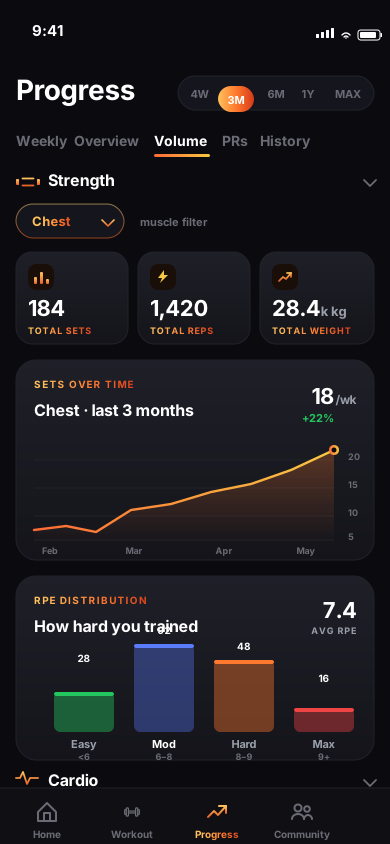
LiftHero logs any set you perform, including these techniques — every drop, mini-burst and cluster — free and unlimited. Record the extended set as you do it, and the app charts the extra volume alongside your straight sets so you can actually see the added work and watch fatigue across the week. Building a full custom program around these methods is the optional Hero upgrade; the free tier already tracks everything you log. To be clear about what it is: LiftHero records what you log — it doesn't auto-generate programs or decide your intensity for you. Pair it with a structured plan and a progression strategy, apply an intensity technique deliberately, and log every set so the trend is honest.
Intensity techniques are advanced set-extension methods that push a muscle past normal failure or pack more quality work into less time. Common examples include drop sets, rest-pause, cluster sets, supersets, myo-reps and giant sets. They're used mostly for hypertrophy and to break plateaus.
No. Progressive overload and progression methods are long-term load management — increasing weight, reps or volume across weeks. Intensity techniques are within-set or within-session intensifiers that squeeze more effective work out of a single session. They complement overload rather than replace it.
Generally no. Beginners make excellent progress with straight sets and progressive overload alone, and intensity techniques add fatigue that can outpace recovery. They're best reserved for intermediate and advanced lifters with a solid base who are chasing more volume or breaking a plateau.
Mostly on isolation or machine exercises, on the final set, during a hypertrophy-focused block. They aren't ideal on heavy compound lifts where fatigue and form breakdown carry more risk. Use them sparingly — a couple of exercises per session at most.
Sparingly. Because they add significant fatigue, applying them to every set or every session tends to outrun recovery. Reserve them for a handful of exercises, mostly final sets, and back off if your performance on later sessions starts to drop.
Drop sets, myo-reps and rest-pause are all popular for hypertrophy because they accumulate extra effective reps near failure with metabolic stress. Cluster sets lean more toward strength and power by keeping quality reps at a heavier load. The best choice depends on your goal and the exercise.
Log drops, clusters, myo-reps and every straight set in one place — free on iOS.
Download on theApp StoreFree to start · No interruptive ads · 14-day Hero trial
This guide is educational and not medical advice. Intensity techniques add significant fatigue — use them sparingly, mostly on isolation or final sets, once you have a solid training base.
By Meitar Lazimi, founder of LiftHero · Last updated July 9, 2026.