Supersets are the simplest way to pack more work into less time — two exercises run back-to-back, then rest. Here's what a superset is, the three main types, the real benefits, how to set one up, and when to keep them off your heavy compounds.
A superset is two exercises performed back-to-back with little or no rest between them — you rest only after finishing both, then repeat the pair. The three main types are antagonist (opposing muscles, like biceps then triceps), same-muscle (pre-exhaust or post-exhaust the same muscle), and unrelated pairings done purely to save time. The main payoff is training density and time efficiency: you do more work per minute. Antagonist pairings can even slightly help performance, while same-muscle supersets ramp up fatigue and metabolic stress. Just don't superset two heavy compounds that fight for the same stabilizers or your breathing.
A superset is two exercises performed one after the other with little or no rest in between. You do a set of exercise A, move straight to a set of exercise B, and only then take your rest before repeating the pair. That minimal transition is the whole idea — it compresses two sets' worth of work into roughly the time one would normally take. Supersets are a form of intensity technique: a way to increase the demand of a session without simply adding load. The extension to three or more exercises is called a giant set.
Not all supersets do the same job. The pairing you choose decides whether you're saving time, chasing a pump, or trying to keep strength intact.
| Type of superset | How it's paired | Best for |
|---|---|---|
| Antagonist | Opposing muscles, e.g. biceps curl then triceps pushdown | Density with little strength loss; each muscle rests while the other works |
| Same-muscle (pre-exhaust) | Isolation first, then a compound for the same muscle | Fatiguing the target muscle before the big lift |
| Same-muscle (post-exhaust) | Compound first, then an isolation for the same muscle | Finishing a muscle off; extra metabolic stress |
| Unrelated / time-saving | Two lifts that don't overlap, e.g. calves + a core move | Squeezing in extra work without slowing the session |
Antagonist supersets are the most forgiving because the resting muscle recovers while its opposite works. Same-muscle supersets — pre-exhaust and post-exhaust — deliberately stack fatigue on one muscle, cranking up metabolic stress at the cost of the weight you can handle. Unrelated pairings are pure logistics: bolt a small movement onto your rest window to save time.
The headline benefit is training density and time efficiency — you get more work done per minute, which is why supersets are a go-to when the clock is tight. Beyond that, the payoff depends on the pairing. Antagonist pairings can even slightly help performance: light activity in the opposing muscle can leave the working muscle a touch fresher than a fully passive rest, so you often lose very little strength. Same-muscle supersets ramp up fatigue and metabolic stress, giving you a strong pump and a lot of accumulated work in a short window. Supersets don't replace progressive overload as the driver of growth — they're a tool for fitting quality volume into less time.
The mechanics are simple, but the setup matters — if you're hunting for equipment between exercises, it stops being a superset. The loop:
Manage effort with RPE so the first exercise doesn't wreck the second — leaving a rep or two in reserve on the opener usually gives the best total quality across the pair.
Reach for supersets when you're time-crunched, when you want extra metabolic stress on a muscle, or when you're stacking isolation and accessory work. Antagonist pairings and machine or dumbbell isolations are the safest, highest-value places to use them. The clear caution: don't superset two heavy compounds that compete for the same stabilizers or your breathing — pairing squats with deadlifts, for example, means each lift is fighting for the same fatigued midsection and gas tank, and form and safety degrade fast. Keep supersets mostly for isolation, machines, or lighter compound pairings, and save true maximal-strength work for straight sets with full rest.
A superset is two exercises; a giant set is the three-or-more extension of the same idea, usually run back-to-back for one muscle group. Supersets belong to the same family as other intensity techniques — such as rest-pause, drop sets, and cluster sets — all of which manipulate rest and exercise order to raise the demand of a set. Which one fits depends on your goal, your equipment, and how much fatigue you can afford to carry into the next exercise.
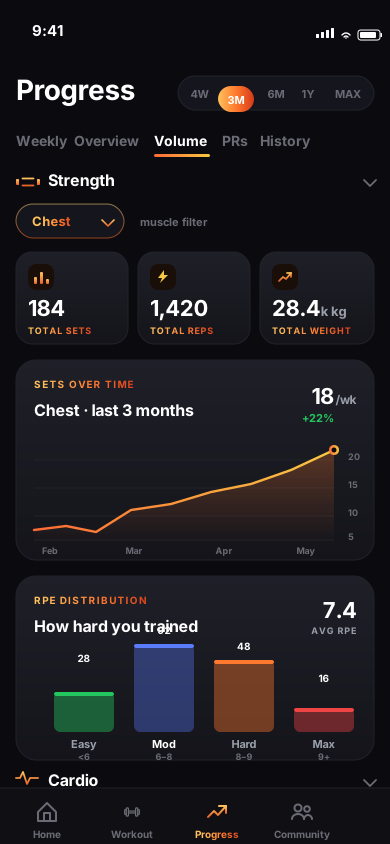
LiftHero logs any set you perform, including supersets — you record each exercise's weight and reps as you go, and the app charts the trend over time so you can see whether your paired work is actually progressing. Logging is free and unlimited, so you can track every superset, giant set, or straight set without a cap. To be clear about what it is and isn't: LiftHero records what you log — it doesn't auto-generate programs or decide your pairings for you. Building a custom superset-based routine is the optional Hero upgrade; the free tier still logs every set you do. Pair it with a plan like Push Pull Legs and log each exercise as you run the pair.
A superset is two exercises performed back-to-back with little or no rest between them. You rest only after completing both, then repeat the pair. It raises training density and saves time.
The main types are antagonist (opposing muscles like biceps then triceps), same-muscle or compound (pre-exhaust and post-exhaust), and unrelated pairings that pair two unrelated lifts purely to save time.
Supersets are mainly a time-efficiency tool. They pack more work into less time and can raise metabolic stress, but the primary driver of growth is still progressive overload and total quality volume over weeks.
Antagonist pairings (e.g. biceps then triceps) let each muscle rest while the other works, so performance often holds up well and you lose little strength — making them one of the easiest supersets to run without hurting the workout.
Avoid supersetting two heavy compounds that compete for the same stabilizers or your breathing, like squats and deadlifts. That compromises form and safety. Keep supersets for isolation, machines, or lighter compound pairings.
A giant set is the three-or-more-exercise extension of a superset, usually run back-to-back for the same muscle group. See the giant sets guide.
Log any set — supersets included — with weight, reps, RPE and PRs in one place. Free and unlimited on iOS.
Download on theApp StoreFree to start · No interruptive ads · 14-day Hero trial
This guide is educational and not medical advice. Intensity techniques add significant fatigue — use them sparingly, mostly on isolation or final sets, once you have a solid training base.
By Meitar Lazimi, founder of LiftHero · Last updated July 9, 2026.