Learn

What Are Myo-Reps?

Myo-reps are a way to squeeze a lot of effective, high-recruitment reps into very little time. Here's what they are, who created them, how to run a set step by step, why they work, and the exercises where they belong.

Myo-reps are a time-efficient hypertrophy method: you perform one "activation set" to near failure — getting the muscle to high fiber recruitment — then rest very briefly (a few breaths, about 3–5 seconds) and do short "mini-sets" of a handful of reps each, with the same short rests, stopping when rep quality drops. Because the muscle stays near maximal recruitment across every mini-set, you pack more effective reps into less time. Popularized by Norwegian coach Børge Fagerli, myo-reps are a structured cousin of rest-pause. They work best on machines and isolation lifts, where taking a set to near failure is safe.

What are myo-reps?

Myo-reps are a time-efficient hypertrophy method built around one hard activation set followed by a cluster of short mini-sets. The logic: the most stimulating reps of any set are the last few, when the muscle is fatigued and forced to recruit its highest-threshold fibers. A myo-rep set front-loads that fatigue with a near-failure activation set, then uses very brief rests to keep returning to those effective reps without the muscle recovering all the way. The result is more high-recruitment reps in a fraction of the time of doing multiple full straight sets. Myo-reps are one of several intensity techniques that manipulate rest and effort to raise a set's stimulus.

Who invented myo-reps?

Myo-reps were popularized by Norwegian coach Børge Fagerli. He formalized the method — the near-failure activation set, the very short rests, and the defined mini-sets — as a structured, repeatable way to accumulate effective reps near maximal recruitment in minimal time. That structure is what distinguishes myo-reps from looser "just do a few more after a short rest" approaches: there's a clear protocol for the activation set, the rest length, the mini-set size, and the stop signal. Credit for the named, systematized method belongs to Fagerli.

How do you do myo-reps?

The protocol is tight and deliberate. Pick something you can push safely, then run the loop:

  1. Pick a weight and an exercise you can push safely. A machine or isolation movement and a load you can take to near failure without danger, usually in a moderate rep range.
  2. Do the activation set to near failure. One set close to failure drives the muscle to high fiber recruitment — this is the foundation every mini-set builds on.
  3. Rest very briefly. A few breaths — roughly 3–5 seconds — just long enough to buy back a few more quality reps.
  4. Perform a mini-set. A short set of a handful of reps at the same weight, with tight form.
  5. Repeat mini-sets until quality drops. Keep alternating brief rests and mini-sets, and stop the moment rep speed or form clearly deteriorates.

Because each mini-set starts already fatigued, effort (RPE) stays high throughout — the stop signal is rep quality, not a set number. When the reps get slow or ugly, the set is done.

Why do myo-reps work?

Myo-reps work by keeping the muscle near maximal recruitment for more effective reps in less time. In a normal straight set, only the final reps recruit the highest-threshold fibers; the early reps are mostly a ramp to get there. The near-failure activation set reaches that high-recruitment state once, and the very short rests then let you stay near it — each brief mini-set delivers another cluster of those effective reps without paying the full cost of a fresh warm-up. Compared with doing several full straight sets, myo-reps concentrate the stimulating reps and cut the dead time. They remain a tool layered on top of progressive overload and sensible weekly volume, not a replacement for them.

Myo-reps vs rest-pause

Myo-reps are a structured cousin of rest-pause. Both extend a set past the first point of near failure by using very brief rests, so you keep hitting effective reps. The difference is the structure: myo-reps prescribe a clear activation set, a defined rest length, and mini-sets of a set size with a rep-quality stop rule, whereas rest-pause is often looser — pause, push again, repeat. If you like a repeatable protocol you can log and progress, myo-reps give you the framework; if you want a simpler ad-hoc extension of a heavy set, rest-pause fits. They sit alongside other intensity techniques like drop sets and cluster sets.

When and where to use myo-reps (cautions)

Myo-reps are best on machines and isolation exercises, where taking a set to near failure is safe — no spotter needed and no heavy bar to control as fatigue sets in. Leg extensions, curls, pressdowns, lateral raises, and machine presses are ideal. The cautions: because every mini-set runs near failure, myo-reps are very fatiguing and add a lot of systemic and local stress, so use them sparingly — usually on one or two exercises per session, often the final movement for a muscle. Avoid them on heavy free-weight compounds like squats, deadlifts, and barbell presses, where near-failure reps under fatigue invite form breakdown and injury. Build a solid training base before layering them in.

How to track myo-reps (and how LiftHero helps)

LiftHero logs any set you perform, including myo-reps — record your activation set and each mini-set as you go, and the app charts the trend so you can see whether the technique is driving real progress. Logging is free and unlimited, so every activation set and mini-set is captured without a cap. To be clear about what it is and isn't: LiftHero records what you log — it doesn't auto-generate programs or decide when to run myo-reps for you. Building a custom routine around them is the optional Hero upgrade; the free tier still logs every rep. Pair it with a structured plan and log each set as you lift.
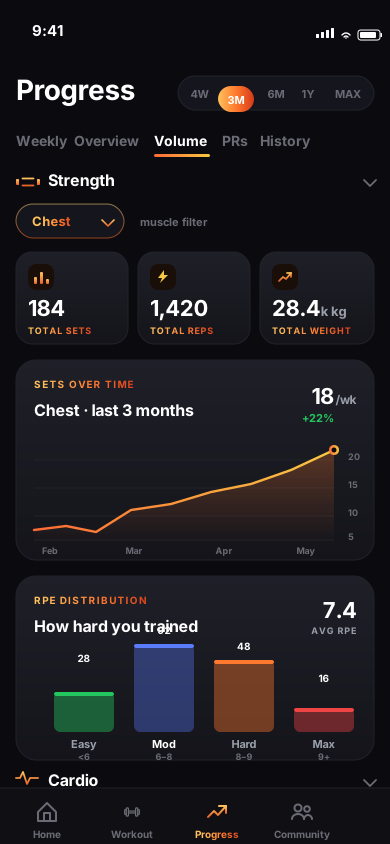
LiftHero progress chart tracking weight lifted over time
LiftHero charts weight and volume per exercise over time, so your myo-rep work shows up as real progress or a plateau.

Frequently asked questions

What are myo-reps?

Myo-reps are a time-efficient hypertrophy method: one activation set to near failure, then short mini-sets of a handful of reps each with very brief rests, stopping when rep quality drops. They keep the muscle near maximal recruitment for more effective reps in less time.

Who invented myo-reps?

Myo-reps were popularized by Norwegian coach Børge Fagerli. He formalized the method as a structured, time-efficient way to accumulate effective reps near maximal recruitment.

How do you do myo-reps?

Take one activation set to near failure, rest very briefly (a few breaths, about 3 to 5 seconds), then perform short mini-sets of a few reps each with the same short rests. Stop when your rep quality clearly drops.

How are myo-reps different from rest-pause?

Myo-reps are a structured cousin of rest-pause. Both use brief rests to extend a set past the first point of near failure, but myo-reps prescribe a clear activation set and defined mini-sets rather than an open-ended cluster. See the rest-pause guide.

What exercises are best for myo-reps?

Machines and isolation movements are best, because you can safely take them to near failure without a spotter and without form breaking down under fatigue. Avoid myo-reps on heavy free-weight compounds.

Are myo-reps good for building muscle?

Myo-reps are a recognized time-efficient hypertrophy technique. By keeping the muscle near maximal recruitment across several mini-sets, they pack effective reps into little time, but they still sit on top of progressive overload and sensible volume.

Track your myo-reps in LiftHero

Log any set — myo-reps included — with weight, reps, RPE and PRs in one place. Free and unlimited on iOS.

Download on theApp Store

Free to start · No interruptive ads · 14-day Hero trial

This guide is educational and not medical advice. Intensity techniques add significant fatigue — use them sparingly, mostly on isolation or final sets, once you have a solid training base.

By Meitar Lazimi, founder of LiftHero · Last updated July 9, 2026.