Giant sets are the big-circuit way to bury a muscle group in volume when you're short on time. Here's what a giant set is, how it differs from a superset, how to program one step by step, when it earns its place, and the fatigue cautions that come with it.
A giant set is three or more exercises performed back-to-back for the same muscle group (or region) with minimal rest. Running that many movements in sequence drives high volume and metabolic stress in little time — a big time-saver, but very fatiguing. A typical example is a three- or four-exercise chest or shoulder circuit. The relationship to supersets is simple: a superset is two exercises, a giant set is three or more. Program one by picking a muscle, choosing three to four exercises, ordering them hardest to easiest, and running them with almost no rest between movements — best used for specialization, time-crunched sessions, or finishers, not heavy strength work.
A giant set is three or more exercises performed back-to-back for the same muscle group or region with minimal rest. Where a straight set works a muscle once and rests, a giant set stacks several movements into one continuous block, only resting after the whole circuit is done. That structure floods the target muscle with work and keeps it under tension across different angles — a leg-extension, leg-press, and walking-lunge sequence, for example, all hammering the quads before you rest. Giant sets are one of the more aggressive intensity techniques, prized for cramming volume into a short window.
The difference is just the count. A superset is two exercises performed back-to-back; a giant set is three or more. A giant set is essentially a superset scaled up into a longer circuit — and where supersets are often antagonist pairings, giant sets are usually built around a single muscle group to maximize the local volume and pump. The trade-off scales with the count too: more exercises in a row means more fatigue and more metabolic stress, so a giant set hits harder than a superset but demands more recovery. Both belong to the same family as rest-pause, drop sets, and cluster sets.
Programming a giant set is about sequencing and setup — the goal is to keep transitions fast so fatigue does the work. The loop:
Because fatigue climbs fast across the circuit, keep loads moderate and lean on RPE to gauge when form is about to slip — the stop signal is quality, not ego.
The main draw is efficiency: a giant set drives high volume and metabolic stress in little time. By running three or more exercises back-to-back for one muscle, you accumulate a lot of work and a strong pump in a fraction of the time it would take as separate straight sets — a genuine time-saver for a busy session. The variety of angles within the circuit also means the muscle gets worked more completely than a single exercise could manage. Like every intensity technique, though, giant sets are a way to fit quality volume into less time, not a shortcut around progressive overload — you still need to be progressing the loads or reps over weeks for the volume to translate into growth.
Giant sets earn their place in three situations: specialization on a lagging muscle you want to bury in extra volume, time-crunched sessions where you need to get a lot done fast, and as an end-of-session finisher to cap a muscle off. The cautions are real, though. Giant sets are very fatiguing, so as the circuit goes on, form can break down — keep the loads moderate and stop a set when reps get sloppy. And they are not for heavy strength work: the accumulated fatigue makes near-maximal loads unsafe and unproductive, so keep giant sets on isolation and machine movements. Use them sparingly, mostly once you already have a solid training base.
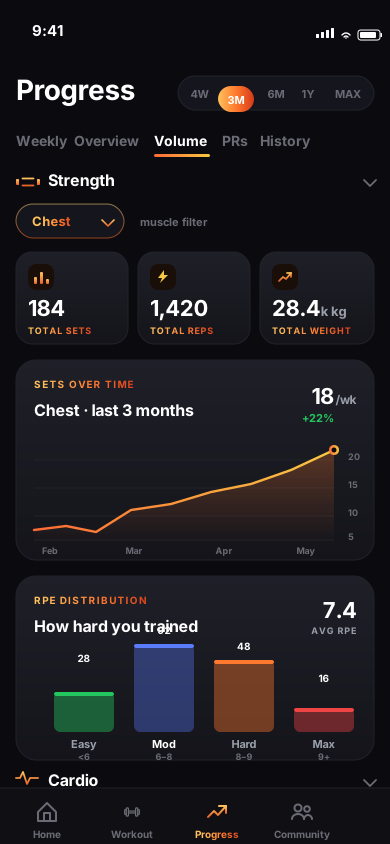
LiftHero logs any set you perform, including giant sets — record each exercise in the circuit as you go, and the app charts the trend so you can see whether the extra volume is actually driving progress. Logging is free and unlimited, so a four-exercise giant set is captured set by set without a cap. To be clear about what it is and isn't: LiftHero records what you log — it doesn't auto-generate programs or build the circuit for you. Designing a custom giant-set routine is the optional Hero upgrade; the free tier still logs every set. Pair it with a plan like Push Pull Legs and log each exercise as you run the circuit.
A giant set is three or more exercises performed back-to-back for the same muscle group (or region) with minimal rest. It drives high volume and metabolic stress in little time, but is very fatiguing.
A superset is two exercises back-to-back; a giant set is three or more. Giant sets extend the same idea to a longer circuit, usually for one muscle group. See the supersets guide.
Pick one muscle group, choose three or four exercises hitting it from different angles, order them hardest to easiest, run them back-to-back with minimal rest, then rest longer between rounds and repeat.
Giant sets are a strong time-saver that pack high volume and metabolic stress into little time. They can support hypertrophy, but they still sit on top of progressive overload and sensible total volume, not in place of it.
Use them for specialization on a lagging muscle, when time is short, or as an end-of-session finisher. They are best on isolation and machine work, not heavy strength movements.
They are very fatiguing, so form can break down as the circuit goes on, and the accumulated fatigue makes them unsuitable for heavy strength work. Use them sparingly and keep the loads moderate.
Log any set — giant sets included — with weight, reps, RPE and PRs in one place. Free and unlimited on iOS.
Download on theApp StoreFree to start · No interruptive ads · 14-day Hero trial
This guide is educational and not medical advice. Intensity techniques add significant fatigue — use them sparingly, mostly on isolation or final sets, once you have a solid training base.
By Meitar Lazimi, founder of LiftHero · Last updated July 9, 2026.