Getting stronger isn't just about training harder — it's about training specifically. Strength is a skill as much as a quality, and it's built by lifting heavy, practising the main lifts, progressing the load, and managing the fatigue that comes with it. Here's how to build real maximal strength.
To get stronger, train heavy in lower rep ranges (about 1–6 reps) and practise the main lifts frequently with good technique. Strength is specific — you get strong at what you train — so groove the big compound movements and apply progressive overload, adding small amounts of load over time. Rest long enough between heavy sets to keep quality high, and manage accumulated fatigue with periodic deloads. A structured strength program like 5/3/1 or Starting Strength packages all of this for you and takes the guesswork out.
Strength is your ability to produce maximal force against a resistance — how much weight you can move on a given lift. Crucially, it's specific: you get strong at the exact movements you practise, because strength is part muscle and part skill. A big chunk of it is neural — your nervous system learning to recruit muscle fibres efficiently and coordinate the movement — which is why a lifter can get noticeably stronger before adding much size. That specificity shapes everything below: if you want a bigger squat, bench or deadlift, you train those lifts heavy and often, rather than hoping general fitness carries over.
Maximal strength is best built with heavy loads in low rep ranges — roughly 1 to 6 reps per set. Lifting near your top weights teaches your body to produce more force: it recruits high-threshold motor units and drills the coordination that heavy lifting demands. That's why strength-focused programs live in low reps while muscle-focused ones range higher. Higher-rep work still helps indirectly by building muscle (more muscle means more strength potential), but the sharpest gains in max force come from spending real time under heavy, low-rep sets. For the full picture of how reps map to goals, see the rep ranges guide.
Because strength is a skill, frequency and technique matter as much as intensity. The more often you practise a lift — with good form — the better your nervous system gets at it, and the more total quality work you accumulate. Many strength programs train the key lifts two to four times a week for exactly this reason: frequent, focused practice grooves the pattern and spreads volume across the week instead of cramming it into one taxing session. Keep technique tight on every rep; sloppy heavy lifting trains the wrong pattern and raises injury risk. Pick a few main lifts, respect them as skills, and repeat them often.
Strength, like size, follows demand — so you have to keep the demand rising. That's progressive overload, and for strength the primary lever is load: adding small amounts of weight to the main lifts over weeks. Early on you can often add a little most sessions in near-linear fashion; later, progress comes in smaller, slower steps and may lean on adding reps before adding weight. The point is that the bar has to move over time. Chasing bigger jumps than you've earned just breaks down form and stalls you — add weight when the current load moves cleanly for all your working reps.
Heavy strength work is demanding on both muscle and nervous system, and quality depends on recovery within the session. For maximal-strength sets, rest longer between sets — often around two to five minutes. That full recovery lets you produce near-maximal force with clean technique on the next set, which is the whole point of heavy training. Rushing rest to keep your heart rate up might feel productive, but it cuts the weight you can handle and turns strength practice into conditioning. When the goal is force production, be patient between sets — long rest is a feature of strength training, not laziness.
Heavy lifting accumulates fatigue, and if you never let it clear, progress stalls and injury risk climbs. The fix is planned recovery — a deload: a lighter week where you cut load or volume so your body can catch up, then resume progressing from a fresher base. Deloads aren't lost time; they're what lets you keep pushing heavy across months instead of burning out in weeks. When you stall on the same weight for a while, feel beat up, or notice technique slipping, that's your cue to back off deliberately. Structured strength programs often build deloads in on a schedule so you don't have to guess.
You can absolutely progress on your own, but a proven strength program removes the guesswork by laying out the lifts, loads, rep schemes and progression for you. Two of the most popular templates: 5/3/1, which cycles submaximal percentages with built-in progression and deloads and suits intermediates, and Starting Strength, a simple linear-progression barbell program built for beginners to add weight each session. Both bake in the principles above — heavy compound lifts, progressive overload, structured recovery — so you can focus on showing up and lifting. A plan also makes consistency and tracking far easier.
Strength and size overlap but aren't the same goal, and the training emphasis differs. Getting stronger leans on heavy, low-rep work, long rest and frequent practice of specific lifts, with progress measured in load on the bar. Building muscle uses more volume across a wider rep range, taken close to failure, with size as the outcome. They feed each other — bigger muscles have more strength potential, and getting stronger lets you train with heavier loads — but if you have to pick a priority, the setup changes. The full comparison, including a side-by-side table, is in the building muscle vs getting stronger guide; for the size side specifically, see how to build muscle.
LiftHero logs any set you do for free — reps, weight and RPE — charts your top sets and estimated one-rep maxes over time, and flags personal records, so you can see your strength trend clearly and know when you've earned the next jump. That record is what separates real strength progress from a stall. To be clear about what it is and isn't: LiftHero is the measurement layer, not a coach. It does not auto-generate a program and does not auto-progress your weights — you choose the plan and the progression, the app measures it. Pair it with a structured plan like 5/3/1 and log every heavy set.
Maximal strength is best developed with heavy loads in low rep ranges, roughly 1 to 6 reps per set. Training near your top weights teaches your nervous system and muscles to produce more force. Higher-rep work still supports strength by building muscle, but the biggest gains in max force come from low reps.
Because strength is a skill, practising the main lifts frequently helps — many strength programs train key lifts two to four times per week. More frequent, higher-quality practice grooves technique and spreads volume out. The right frequency depends on your recovery, schedule and how heavy each session is.
Heavy sets are highly demanding, and your muscles and nervous system need time to recover between them. Resting longer, often two to five minutes, lets you produce near-maximal force on the next set with good technique. Cutting rest short reduces the weight you can handle and the quality of your practice.
Yes. They overlap: bigger muscles have more strength potential, and getting stronger lets you train with heavier loads. Many programs build both at once, especially for beginners. The difference is emphasis — pure strength leans heavy and low-rep, while muscle-building uses more volume across a wider rep range. See the full comparison.
You can progress on your own, but a structured program removes guesswork by laying out the lifts, loads and progression for you. Proven templates like 5/3/1 or Starting Strength build in progressive overload and, in some cases, deloads. A plan makes it easier to stay consistent and track progress.
No. LiftHero logs any set you do for free and charts your top sets and estimated maxes over time so you can see your strength trend. Saving a full plan is an optional Hero feature, and the app doesn't auto-generate or auto-progress a program — you choose the plan and progression.
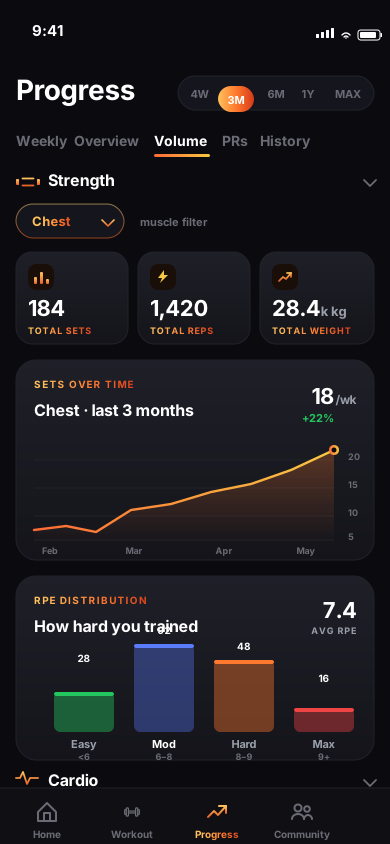
Log any set — reps, weight, RPE — and watch your top sets and estimated maxes climb over time. Free on iOS.
Download on theApp StoreFree to start · No interruptive ads · 14-day Hero trial
This guide is educational and not medical advice. Consult a qualified coach or medical professional before starting or changing a training program.
By Meitar Lazimi, founder of LiftHero · Last updated July 9, 2026.