Program Guide

How Starting Strength Works

Starting Strength is the barbell program that made "add weight every session" the default advice for beginners. Here's how the two workouts are built, how to progress, when to deload, and how to run a built-in Starting Strength template free in LiftHero.

By Meitar Lazimi · Updated July 2026

In short: Starting Strength is Mark Rippetoe's novice linear-progression barbell program from the book Starting Strength: Basic Barbell Training. You train three non-consecutive days a week, alternating two full-body workouts. Workout A is squat, bench press and deadlift; Workout B is squat, overhead press and a pull (power clean, or a barbell row as a common swap). Main lifts run three sets of five — you squat every session — and you add a little weight each workout while you can hit all your reps. When you stall you deload about 10% and re-climb; when linear progress ends, you graduate to an intermediate program. LiftHero includes a built-in Starting Strength template you can run free on iOS.

What is Starting Strength?

Starting Strength is a novice linear-progression program built around barbell training, laid out by strength coach Mark Rippetoe in his book Starting Strength: Basic Barbell Training. The whole idea is simple and ruthless: a true beginner can recover from and adapt to a hard full-body session in about 48 hours, so instead of periodizing over weeks, you just add weight to the bar every single workout and keep doing that for as long as your body lets you.

There's no fluff. The program lives on a handful of compound barbell liftssquat, bench press, overhead press, deadlift and the power clean — trained mostly in sets of five. Low variety, high frequency on the big lifts, and relentless progressive overload. That's why it's still the reference point for how a beginner should train.

How Starting Strength works

The engine of the program is linear progression across two alternating full-body workouts. Here's the shape of it, step by step:

  1. Train three days a week on non-consecutive days — Monday, Wednesday, Friday is the classic layout — with a rest day between each session.
  2. Alternate two workouts, A and B. If you did A on Monday, you do B on Wednesday, A again on Friday, then B the next Monday, and so on.
  3. Squat every session for three sets of five, after your warm-up sets. The squat is the backbone of the whole program.
  4. Do the other main lifts in sets of five too — three work sets for the presses, and typically a single heavy set of five for the deadlift so recovery stays manageable.
  5. Add a small increment every workout you complete all your reps — roughly 5 lb / 2.5 kg on the presses, and larger jumps on the squat and deadlift in the early weeks while they climb fast.
  6. When you stall and miss reps over a couple of sessions, deload that lift about 10% and build back up. When even that stops working, linear progression is over and it's time to move to an intermediate program.
This is a plain-English description of the method, not a reproduction of Rippetoe's book. Starting Strength: Basic Barbell Training covers the lift coaching, warm-up schemes and exact loading in far more detail — if you're running the program seriously, the book is the source.

The A/B workout structure

Starting Strength is two workouts you rotate through. Both open with the squat; the difference is the upper-body press and the pull. In the original program the pull is the power clean; many lifters substitute the barbell row, which is a common and reasonable swap when the clean isn't practical to coach or perform.

Workout AWorkout B
Back squat — 3 × 5Back squat — 3 × 5
Bench press — 3 × 5Overhead press — 3 × 5
Deadlift — 1 × 5Power clean — 5 × 3 (or barbell row 3 × 5)

Because bench press and overhead press live on different days, you press overhead one session and bench the next, so both get trained roughly every other workout. You squat in both workouts — that's not a typo, it's the point. High squat frequency is a defining feature of the program.

Sets and reps here are the standard convention people run — the book is the authority on exact loading, warm-ups and progression rates. Treat this table as a map, not the territory.

Who is it for?

Starting Strength is aimed squarely at the novice — someone who can still add weight to the bar every session because they haven't yet exhausted the fast early adaptations of training. If that's you, few programs will build base strength faster, because the whole design is optimized for exactly that window.

Great fitMaybe look elsewhere
Beginners who want raw barbell strength fastLifters chasing mainly hypertrophy or a "pumped" look
People who like simple, low-decision programmingPeople who want lots of exercise variety and machines
Anyone learning the squat, bench, deadlift and pressAdvanced lifters past linear progression

It's a strength-first, barbell-first program with deliberately low variety. When you can no longer add weight every session even after deloading, you've outgrown it — that's the signal to graduate to an intermediate template like 5/3/1.

How to run it in LiftHero

LiftHero ships a built-in Starting Strength program template you can start in a couple of taps. It logs the full vocabulary of serious barbell training — work sets, warm-up sets, RPE and reps — and detects personal records automatically, so your linear progression shows up as a line that climbs instead of a memory you're trying to keep. It's free on iOS, with no routine caps and no interruptive ads.

  1. Get LiftHero free on iOS and open the Programs section.
  2. Pick the built-in Starting Strength template, or save your own A/B workouts as reusable routines (free and unlimited) — the full custom program builder is a Hero feature.
  3. Train each session straight from the app — it walks you through squat, press and pull, and logs your sets, reps and RPE.
  4. Add weight every session you hit all your reps; when you stall, drop about 10% and re-climb.
  5. Watch your squat, bench, press and deadlift trend upward in your progress charts, and graduate when linear progress ends.
LiftHero logs and tracks your training — weights, reps, RPE and PRs — with a custom program builder available in the optional Hero subscription. It doesn't auto-generate or auto-progress the program for you, so you decide when to add weight and when to deload, exactly as the method intends.
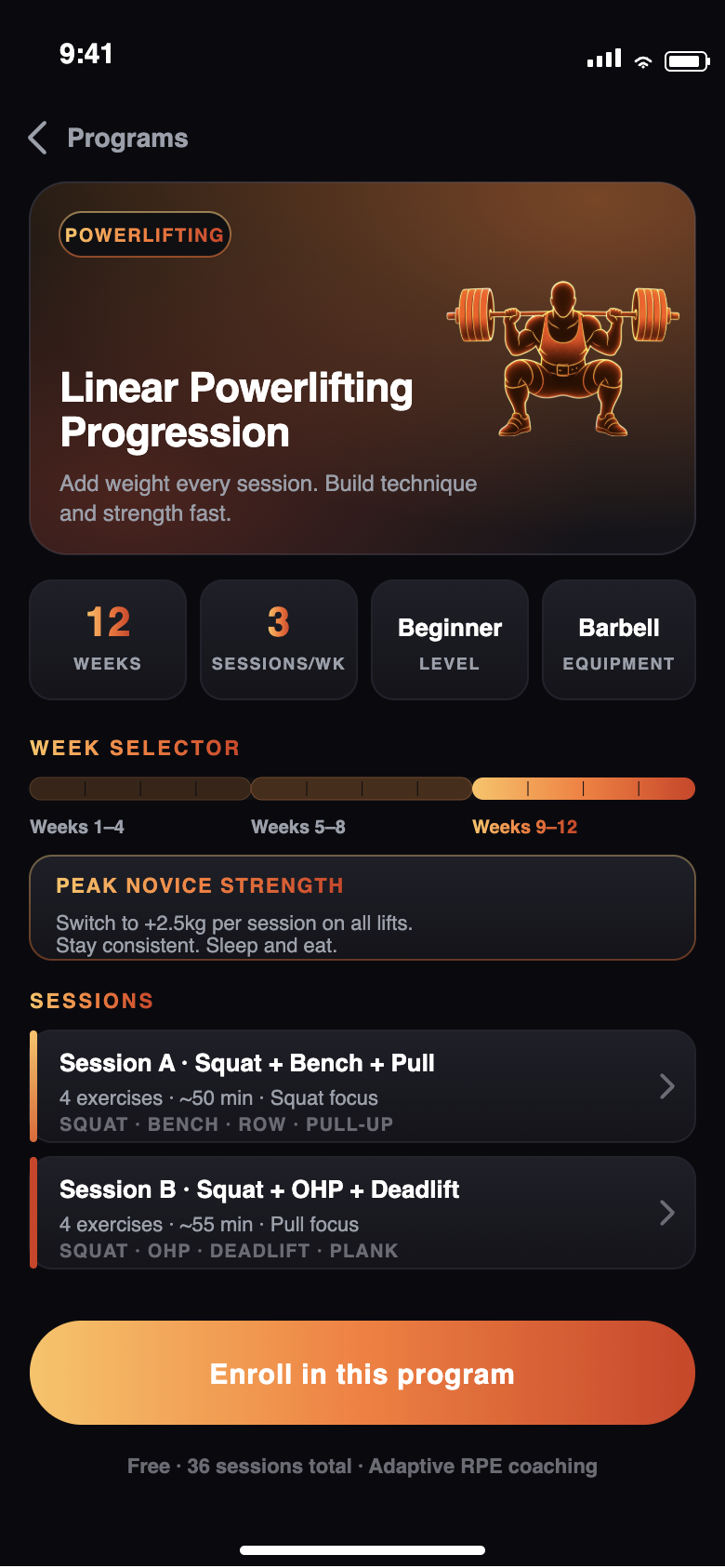
LiftHero built-in Starting Strength program — squat, press and deadlift in the app
A built-in Starting Strength program — free in LiftHero.

Run Starting Strength free

The Starting Strength template — plus 5/3/1 Boring But Big, Push Pull Legs, Texas Method and Madcow 5×5 — built free into LiftHero, with a custom program builder in the optional Hero subscription.

Download on theApp Store

Free to start · No interruptive ads · 14-day Hero trial

Frequently asked questions

What is the Starting Strength program?

It's a novice linear-progression barbell program by Mark Rippetoe, from his book Starting Strength: Basic Barbell Training. You train three non-consecutive days a week, alternating two full-body workouts built on the squat, press, bench press, deadlift and power clean, and add a little weight every session.

What are the Starting Strength workouts A and B?

Workout A is back squat, bench press and deadlift. Workout B is back squat, overhead press and a pull — the power clean in the original, or a barbell row as a common substitution. You squat every session and alternate A and B across the week.

How many days a week is Starting Strength?

Three days a week on non-consecutive days, such as Monday, Wednesday and Friday. The rest day between sessions is what lets a novice recover and add weight to the bar every workout.

How do you progress on Starting Strength?

Add a small increment every workout while you complete all your reps — roughly 5 lb / 2.5 kg on the presses and more on the squat and deadlift early on. When you stall and miss reps, deload about 10% and re-climb; when linear progress runs out, move to an intermediate program.

Is Starting Strength good for beginners?

Yes — it's one of the best-known novice programs precisely because a beginner can add weight every session for months. It's strength- and barbell-focused with low variety, so lifters mainly after hypertrophy or machine work may prefer a different template.

Does LiftHero have a Starting Strength program built in?

Yes — LiftHero includes a built-in Starting Strength template you can start free, alongside 5/3/1 Boring But Big, Push Pull Legs, Texas Method and Madcow 5×5, plus a custom program builder in the optional Hero subscription. LiftHero logs your weights, reps, RPE and personal records so you can watch linear progression climb.

Starting Strength is a training method and registered trademark of The Aasgaard Company / Mark Rippetoe. LiftHero is not affiliated with, endorsed by, or sponsored by Starting Strength or Mark Rippetoe. This guide is educational and not medical advice — consult a qualified professional before starting any program.

By Meitar Lazimi, founder of LiftHero · Last updated July 1, 2026.