Low reps, moderate reps, high reps — each classically biases a different outcome. But the modern picture is more forgiving than the old charts suggested. Here's the traditional framing, the nuance that updates it, and how to pick ranges for your goal and your lifts.
Low reps (about 1–5) bias maximal strength, moderate reps (about 6–12) are the traditional hypertrophy "sweet spot," and higher reps (about 12–20+) bias muscular endurance and metabolic stress. That framing still holds as a rough map. The modern nuance: muscle grows across a wide rep range when sets are taken close to failure, so total hard sets (volume) and effort matter more than hitting a magic number. Strength is the exception — it's more rep- and load-specific, so you must train heavy to get maximally strong. Pick a range that fits your goal and the lift, then push effort and volume over time.
A rep range is simply the band of repetitions you aim to complete per set — say 5 sets of 3, or 3 sets of 8–12. For decades, lifters treated ranges as a dial you set to a specific outcome: keep the reps low and heavy for strength, park them in the middle for size, run them high and light for endurance. That "strength–size–endurance continuum" is a useful starting model, and it's still roughly true at the extremes. What's changed is how rigid we think the middle is: the boundaries between ranges are far blurrier than the classic 6–12 gospel implied, and the effort you bring to a set turns out to matter more than the exact number on the counter.
The traditional rep continuum sorts training into three zones. Low reps (~1–5) at near-maximal loads bias maximal strength and neural adaptation — your nervous system learns to produce force. Moderate reps (~6–12) are the long-standing hypertrophy "sweet spot": enough load to be challenging, enough reps and time-under-tension to accumulate a growth stimulus. Higher reps (~12–20+) at lighter loads bias muscular endurance and metabolic stress — the burn — while still building work capacity. This map isn't wrong; it's a good default for organizing a program. It just gets treated as more precise than it really is.
Here's where current thinking updates the old charts. Widely accepted views in modern hypertrophy training hold that muscle can grow across a wide rep range — from roughly 5 up to 30 reps per set — provided the set is taken close to failure. In other words, a hard set of 8 and a hard set of 20 can both build muscle. What matters most is total hard sets (volume) and effort, not landing on a magic number. That's why the moderate range endures as a practical default: it's time-efficient and lets you accumulate volume without the punishing fatigue of very high reps or the technical demand of very heavy singles. But it's a convenience, not a rule. Where this is debated — the exact upper and lower bounds, how much high-rep training suits beginners — reasonable coaches still disagree, so treat the edges as approximate.
Muscle size is flexible about rep ranges; maximal strength is not. Strength is highly specific to the load and rep scheme you practice — a principle rooted in specificity (the SAID principle). If your goal is to lift the heaviest possible single, you have to train heavy: low reps at high percentages of your max teach your nervous system and connective tissue to handle that load. You can build plenty of muscle with sets of 15, but you won't express a maximal one-rep max unless you've practiced grinding near-limit weights. This is the one place where the old "low reps for strength" rule still holds firmly. For the mechanism behind progressing that load over time, see progressive overload.
A practical map from goal to rep range, with the caveats that make it honest. Treat the numbers as bands, not walls — and remember effort and weekly volume matter more than the exact rep.
| Goal | Rep range (per set) | Notes |
|---|---|---|
| Maximal strength | ~1–5 reps | Heavy loads, longer rest. Load-specific — you must train heavy to get maximally strong. |
| Strength + size | ~4–6 reps | A hybrid zone; builds real strength while still adding muscle. |
| Hypertrophy (default) | ~6–12 reps | The classic sweet spot — time-efficient way to accumulate hard volume. |
| Hypertrophy (extended) | ~12–20 reps | Still builds muscle if taken close to failure; easier on joints. |
| Endurance / metabolic | ~15–30+ reps | Biases muscular endurance and the "burn"; high fatigue per set. |
Ranges aren't one-size-fits-all across a workout. The smart move is to match the range to both your goal and the kind of lift — heavy compounds and isolation work want different treatment. The loop:
That last point is the load-bearing one: a range only "works" if the sets inside it are hard. For how hard, and when to actually push to the limit, see training to failure and how to gauge it with reps in reserve (RIR).
Heavy compound lifts recruit large muscle groups and load the spine and joints heavily, so grinding a set of 20 squats to failure is both dangerous and deeply fatiguing — form breaks down before the target muscles do. That's why compounds usually live in lower-to-moderate ranges (say 3–8 for strength-leaning work, 6–12 for size). Isolation lifts are the opposite: a single joint, light absolute load, minimal injury risk if a rep stalls. That makes them the natural home for higher ranges (12–20+) where you can chase the burn and push close to failure safely. A common template pairs heavy compounds early in the session with higher-rep isolation work after — strength where it's safe, volume where it's cheap.
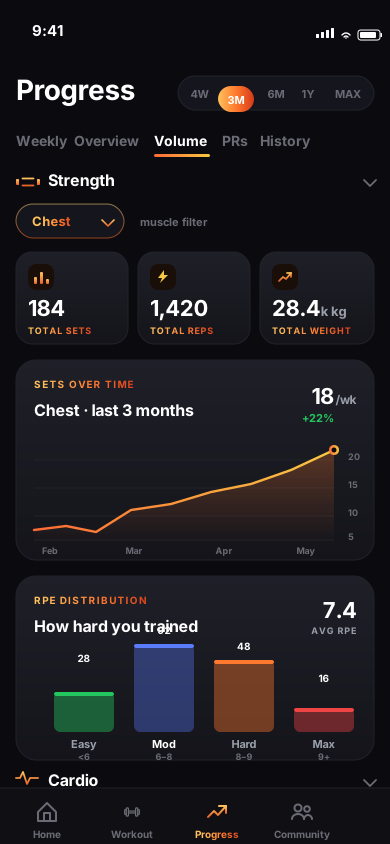
LiftHero logs every set — reps, weight and effort (RPE/RIR) — so you can see the rep ranges you actually train in and how your total hard sets add up over time. Log each set as you lift; over weeks the app charts your reps and volume per exercise, so you can tell whether you're accumulating enough hard work in your chosen ranges or just repeating comfortable sets. To be clear about what it is and isn't: LiftHero is the measurement layer, not a decision engine. It does not auto-generate or adapt your program and won't pick your rep ranges for you — you set the plan, the app records it. Saving a custom plan is an optional Hero feature; logging your sets is free and unlimited. Pair it with a structured plan like 5/3/1 or Push Pull Legs and log every set as you go.
The classic hypertrophy sweet spot is about 6–12 reps, but muscle grows across a wide range — roughly 5 to 30 reps — as long as sets are taken close to failure. Total hard sets per week matter more than any single range.
Maximal strength is more load-specific, so low reps at heavy weights (about 1–5) are the main tool. To get maximally strong you have to practice lifting heavy, not just accumulate reps.
Yes. Higher reps (roughly 12–20+) build muscle well when sets are hard and close to failure. They bias endurance and are often easier on the joints, which makes them useful for isolation work.
No. The modern view is that there is no single magic range. Effort and total volume drive growth, so the moderate range is a convenient default, not a requirement.
Often yes. Heavy compounds are usually kept in lower-to-moderate ranges where technique and safety hold up, while isolation lifts are pushed into higher ranges where going near failure is low-risk.
Log reps, weight and effort per set and review the trend over weeks. LiftHero records every set so you can see your working ranges and total hard sets, and progress deliberately. It doesn't auto-generate your program.
Log every set — reps, weight, RIR/RPE and PRs — in one place, free on iOS.
Download on theApp StoreFree to start · No interruptive ads · 14-day Hero trial
This guide is educational and not medical advice. Consult a qualified coach or medical professional before starting or changing a training program.
By Meitar Lazimi, founder of LiftHero · Last updated July 9, 2026.