Learn · By goal

Building Muscle vs Getting Stronger

"Bigger" and "stronger" get used interchangeably, but they're not the same adaptation — and training for one isn't quite training for the other. They overlap and feed each other, yet the optimal emphasis differs. Here's what actually separates size from strength, and how to train for whichever you want.

Strength is your ability to produce maximal force — part neural, part muscular, trained heavy and low-rep, and very specific to the lift. Muscle size (hypertrophy) is the amount of tissue you build, grown across a wider rep range with enough volume taken close to failure. They overlap: bigger muscles have more strength potential, and getting stronger lets you train with more load — so they feed each other. But the emphasis differs. Chasing strength means heavy loads, low reps and long rest; chasing size means more volume across a broader rep range. Most people, especially beginners, build both at once.

What is strength?

Strength is your capacity to produce maximal force — how much weight you can move on a given lift. It's built from two things: the muscle you have, and how well your nervous system can recruit and coordinate that muscle. That second part, the neural side, is why strength is so specific to the exact movement you practise, and why a lifter can get markedly stronger without getting much bigger. Train heavy and low-rep on the squat, and your squat climbs partly because your body gets better at the skill of squatting heavy — not just because the muscle grew. Strength is a quality you drill.

What is muscle size (hypertrophy)?

Hypertrophy is the growth of muscle tissue itself — literally building bigger muscle fibres. Unlike maximal strength, it isn't tied to lifting your heaviest possible weight; muscle grows across a wider rep range (roughly 5 to 30 reps) as long as sets are taken close to failure and you accumulate enough volume — hard sets per muscle per week — over time. That's why bodybuilding-style training uses moderate weights and higher reps than powerlifting. The goal is to fatigue and challenge the muscle enough, often enough, to force it to grow, rather than to maximise the load on any single rep. Size is an outcome you accumulate.

Side by side: size vs strength

The two goals share the same foundation — hard training and progressive overload — but the way you set the variables differs. Here's how the emphasis changes depending on whether you're chasing size or maximal strength.

VariableBuilding muscle (size)Getting stronger (max force)
Primary goalGrow muscle tissue (hypertrophy)Produce maximal force on a lift
Rep rangeWider, moderate — often ~6–15 (works ~5–30)Low and heavy — about 1–6
Rest between setsModerate — enough to keep sets hardLonger — often ~2–5 min for full recovery
Progression focusTotal volume — reps and sets over timeLoad on the main lifts over time
SpecificityBroad — many exercises and anglesHigh — practise the exact lifts often
Main driverVolume close to failureHeavy load plus neural skill
How you measure itVolume trend, body measurements, the mirrorLoad and estimated max on key lifts

Note that these are emphases, not walls. A strength program still builds muscle, and a hypertrophy program still makes you stronger — the table just shows where each one leans. For the full rep-range reasoning behind these rows, see the rep ranges guide.

How they feed each other

Size and strength aren't rivals — they reinforce each other. Bigger muscles have more strength potential: a larger muscle can produce more force, so building size raises the ceiling on how strong you can get. And getting stronger lets you train with more load, which means you can put more challenging weight on the muscle and drive more growth. That two-way loop is why most lifters — especially beginners — build both at once, and why you shouldn't fully neglect either. Even chasing pure size, keep some heavy work in; even chasing pure strength, keep enough volume in. The overlap is large; the divergence only really matters at the margins, when you're optimising hard for one.

Which should you train for?

It comes down to your goal — and for most people, the honest answer is "both, with an emphasis." Want to look more muscular? Lean toward building muscle: more volume, a wider rep range, moderate rest, and progressing total work over time. Want to move the heaviest possible weight? Lean toward getting stronger: heavy low-rep sets, long rest, frequent practice of the main lifts, and progressing load. If you're new, don't overthink it — a simple program with compound lifts, progressive overload and enough volume builds size and strength together, and you can shift the emphasis later once you know which you care about more.

How to track it (and how LiftHero helps)

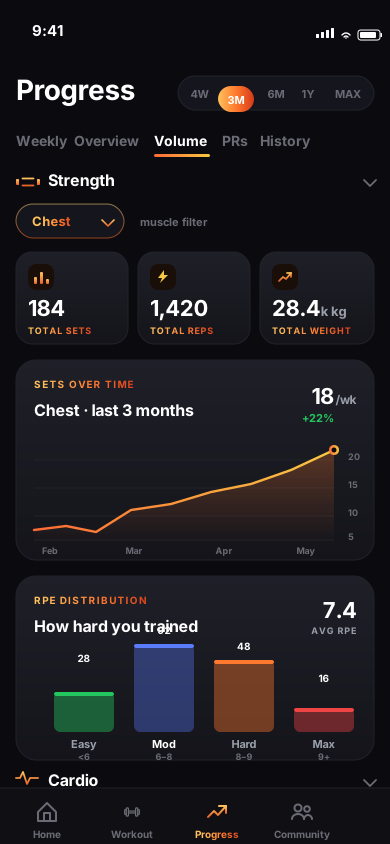
LiftHero logs any set you do for free and charts the numbers that matter for whichever goal you're chasing — load and estimated one-rep maxes on your key lifts for strength, and volume trends over time for muscle. Because the two goals are measured differently, seeing both makes it easy to tell whether your chosen emphasis is actually working. To be clear about what it is and isn't: LiftHero is the measurement layer, not a coach. It does not auto-generate a program and does not auto-progress your weights — you pick the emphasis and the plan, the app measures it. Saving a full custom plan is an optional Hero feature; logging and charting your training is free.

LiftHero charts tracking both load and volume over time
LiftHero charts both load and volume over time, so you can see whether you're gaining strength, size, or both.

Frequently asked questions

Is getting stronger the same as building muscle?

No, though they overlap heavily. Strength is your ability to produce maximal force, which is partly neural and highly specific to the lift you train. Muscle size is the amount of tissue you build. You can gain strength with little size, or build size while getting stronger. They feed each other but aren't identical.

Can you build muscle and strength at the same time?

Yes. Most lifters, especially beginners, build both at once because the two adaptations reinforce each other — bigger muscles have more strength potential, and getting stronger lets you train with heavier loads. The difference is emphasis: how heavy you go, your rep ranges, rest and what you progress.

Why can someone be strong without looking big?

Because much of strength is neural and skill-based, not just muscle size. Training heavy and low-rep improves how efficiently your nervous system recruits and coordinates muscle, so you can produce more force without adding much size. This is common in lifters who train mostly for maximal strength in low rep ranges.

Should a beginner train for muscle or strength first?

Beginners generally gain both quickly at once, so you don't have to choose strictly. A simple program with compound lifts, progressive overload and enough volume builds size and strength together. Pick your emphasis based on your main goal, but early on nearly any consistent, progressive plan works well.

Does more muscle always mean more strength?

More muscle raises your strength potential, but strength also depends on neural factors and skill in the specific lift. A bigger muscle can produce more force, yet realising that potential still takes heavy, specific practice. So size helps, but it doesn't automatically translate into a maximal lift without training for it.

Does LiftHero track both muscle and strength progress?

LiftHero logs any set you do for free and charts the numbers that matter for both goals — load and estimated maxes for strength, and volume trends over time for muscle. Saving a full plan is an optional Hero feature, and the app doesn't auto-generate or auto-progress a program for you.
Track size and strength in LiftHero

Log any set — reps, weight, RPE — and see load, estimated maxes and volume climb over time. Free on iOS.

Download on theApp Store

Free to start · No interruptive ads · 14-day Hero trial

This guide is educational and not medical advice. Consult a qualified coach or medical professional before starting or changing a training program.

By Meitar Lazimi, founder of LiftHero · Last updated July 9, 2026.