Learn · By goal

How to Build Muscle

Building muscle isn't complicated, but it does have a few non-negotiables. Get the basics right — enough hard work per muscle, a rep range you can push and progress, load that climbs over time, and food and sleep to back it up — and growth follows. Here's the whole picture in one place.

To build muscle, train each muscle with enough hard sets per week taken close to failure, using a rep range you can progress in (commonly around 6–15). Apply progressive overload so the demand keeps rising, and train each muscle about twice a week rather than once. Support it with enough protein and a slight calorie surplus, and prioritise sleep and recovery so the muscle you stimulated can actually be built. None of these levers works alone — muscle is what happens when hard training, progression, nutrition and recovery all line up over months.

+ + VOLUMEEFFORTPROGRESSION enough hard setsclose to failureadd over time
Muscle growth comes down to three levers: volume + effort + progression. Everything else is detail.

What actually builds muscle?

Muscle growth — hypertrophy — happens when you challenge a muscle hard enough, often enough, and recover well enough that your body adapts by building more tissue. The training stimulus that drives it is well established: enough hard sets, taken close to failure, progressed over time. Everything else is support and detail. You don't need a secret exercise, a perfect split, or expensive supplements; you need to apply a small number of principles consistently for months. The rest of this guide walks through each one — volume, effort, rep range, progression, frequency, nutrition and recovery — and how they fit together into a routine you can actually run.

Do enough hard sets (weekly volume)

Volume — the number of hard working sets you do per muscle each week — is one of the strongest levers for growth. More stimulus, up to a point, means more growth. A widely used starting point is roughly 10 or more hard sets per muscle group per week, with many lifters doing well somewhere in the 10–20 range. "Hard" is doing the work: sets taken close to failure, not easy warm-up sets. Start on the lower end, add volume gradually as you recover from it, and back off if progress or sleep suffer. More is not automatically better — beyond your recovery capacity, extra sets just add fatigue without extra growth.

Train close to failure

A set only counts as a growth stimulus if it's genuinely challenging. To build muscle you want most working sets taken close to failure — usually within about one to three reps of it. That "reps in reserve" cushion gives you a hard, effective set without the recovery cost of grinding to absolute failure on everything. Going to true failure occasionally is fine, especially on safer isolation movements, but doing it on every set of every session piles up fatigue and can quietly cut into the volume you can recover from. The practical rule: push hard, leave a rep or two in the tank on most sets, and save true failure for the moments it's worth it.

Use a rep range you can progress

Muscle grows across a surprisingly wide rep range — roughly 5 to 30 reps — as long as sets are taken close to failure. That means there's no single magic number. A practical default for most people is around 6 to 15 reps: heavy enough to load the muscle well, but light enough that you can accumulate volume and add reps or weight session to session. The deeper reasoning behind picking a range lives in the rep ranges guide. The key idea for hypertrophy: pick a range you can progress in, and let effort and progression — not the exact rep count — do the heavy lifting.

Apply progressive overload

Doing the same workout forever gets you the results of that workout, then nothing. Muscle adapts to demand and stops once the demand is met, so to keep growing you have to keep asking for a little more — this is progressive overload. The simplest way to apply it is double progression: keep the weight, add reps within your target range week to week, and once you hit the top of the range on every set, add a small increment of load and drop back to the bottom. Over months, that steady climb in reps and weight is the single clearest signal that you're actually building muscle rather than maintaining it.

Train each muscle about twice a week

How you distribute your weekly sets matters. Splitting a muscle's volume across two sessions per week generally works at least as well as — and for most people better than — cramming it all into one brutal session. Two moderate sessions keep the growth stimulus fresh across the week, let you train each set with more quality, and spread the fatigue out. That's why full-body, upper/lower, and push/pull/legs splits are so popular: they naturally hit each muscle roughly twice. The training frequency guide goes deeper, but the headline is simple — total weekly volume is king, and ~2x frequency is a reliable way to deliver it.

Eat enough protein and a slight surplus

Training is the stimulus; food is the raw material. To build muscle you need enough protein — a common, well-supported target is around 1.6 to 2.2 g per kg of bodyweight per day — spread across your meals. You also generally grow fastest in a slight calorie surplus, eating a bit more than maintenance so your body has energy to spare for building tissue. Beginners, returnees and those with higher body fat can build muscle at maintenance or even in a deficit, but for most lifters past the start, a modest surplus makes gaining easier. See the nutrition for lifting guide for the full breakdown, and the bulking guide for how to run a surplus without excess fat gain.

Sleep and recover

Muscle is built while you rest, not while you lift. Training breaks the muscle down and creates the signal to adapt; sleep and recovery are when that adaptation actually happens. Chronically short sleep blunts recovery, drags down performance and can nudge your body toward losing muscle instead of building it, so aim for adequate, consistent sleep most nights. Give each muscle time between hard sessions, manage overall stress, and don't treat rest days as wasted days — they're part of the program. The muscle recovery guide covers how to recover well so the work you put in at the gym actually turns into size.

Putting it together: a simple setup

You don't need a complicated plan to start. Pick a handful of basic exercises covering the whole body, do enough hard sets per muscle each week, take most sets close to failure in a rep range you can progress, hit each muscle about twice a week, and eat and sleep to support it:

  1. Pick a handful of basic exercises. A squat or leg press, a hinge, a horizontal and a vertical push, a horizontal and a vertical pull, plus a little direct arm and calf work.
  2. Do enough hard sets per muscle each week. Start around 10+ hard working sets per muscle group, split across sessions, and adjust from there.
  3. Train close to failure in a progressible rep range. Most sets within a couple of reps of failure, commonly around 6–15 reps.
  4. Train each muscle about twice a week. Two moderate sessions per muscle beats one all-out session for most people.
  5. Progress the work over time. Add reps, then add a small amount of weight and reset — progressive overload.
  6. Eat and recover to support growth. Enough protein, a slight surplus if you want faster size, and consistent sleep.

Run that for a few months, track it honestly, and adjust based on what the numbers and the mirror tell you. Structured splits like Push Pull Legs or an upper/lower split package these principles into a ready-made week.

How to track it (and how LiftHero helps)

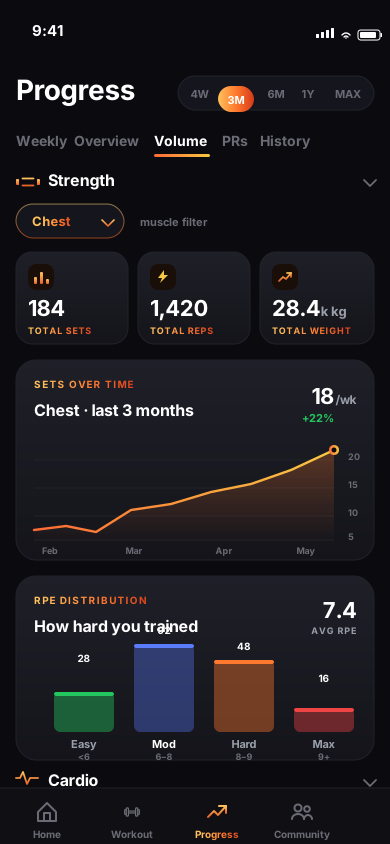
LiftHero logs any set you do for free — reps, weight and RPE — and charts your volume and load per exercise over time, so you can actually see whether you're progressing or just repeating workouts. That trend is how you tell real muscle-building progress from spinning your wheels. To be clear about what it is and isn't: LiftHero is the measurement layer, not a coach. It does not auto-generate a program and does not auto-progress your weights — you decide the plan and the progression, the app measures it. Saving a full custom plan is an optional Hero feature; logging your training and seeing your charts is free.

LiftHero progress chart tracking volume and weight lifted over time
LiftHero charts volume and weight per exercise over time, so real muscle-building progress stands out from a plateau.

Frequently asked questions

How long does it take to build noticeable muscle?

Most people see meaningful changes within a few months of consistent, progressive training and adequate nutrition. Clearly visible muscle usually takes several months to a year, and beginners gain fastest before progress naturally slows. Consistency over months matters far more than any single workout.

Can you build muscle at maintenance calories?

Yes — especially for beginners, people returning after a break, or those with higher body fat. Muscle can be built at maintenance or even in a slight deficit in these cases, but a small calorie surplus generally makes gaining size faster and easier, particularly once you're past the beginner stage.

What rep range is best for building muscle?

Muscle grows across a wide range — roughly 5 to 30 reps — when sets are taken close to failure. A practical default is about 6 to 15 reps because it balances a manageable weight with enough volume and lets you progress. Effort and progression matter more than one magic number. See the rep ranges guide.

How many hard sets per muscle per week do I need?

A common evidence-based starting point is around 10 or more hard sets per muscle group per week, with many lifters doing well in the 10 to 20 range. Start on the lower end, progress it gradually, and let recovery and results guide how much volume you add.

Do I need to train to failure to build muscle?

No, but you do need to train close to failure — usually within about one to three reps. Going to absolute failure on every set isn't required and adds fatigue that can hurt recovery. Leaving a rep or two in reserve on most sets is a sustainable default.

Does LiftHero build a muscle-building program for me?

No. LiftHero logs any set you do for free and charts your reps, weight and volume over time so you can see whether you're progressing. Saving a full plan is an optional Hero feature, and the app doesn't auto-generate or auto-progress a program for you.
Track your muscle-building work in LiftHero

Log any set — reps, weight, RPE — and watch your volume and load climb over time. Free on iOS.

Download on theApp Store

Free to start · No interruptive ads · 14-day Hero trial

This guide is educational and not medical advice. Consult a qualified coach or medical professional before starting or changing a training program.

By Meitar Lazimi, founder of LiftHero · Last updated July 9, 2026.