Program Guide

How nSuns 531 LP Works

nSuns 531 LP is the high-volume, AMRAP-driven spin on 5/3/1 that took off on Reddit. Here's how the nine-set T1 wave is built, how the AMRAP decides your training max, where the T2 lift and accessories fit, and how to build the whole thing in LiftHero.

By Meitar Lazimi · Updated July 2026

In short: nSuns 531 LP is a high-volume linear-progression variant of Jim Wendler's 5/3/1, popularized on Reddit by a user named nSuns. Each main-lift day runs a nine-set T1 wave — ascending then descending percentages of a training max — with one AMRAP set in the middle that decides how much you add to next week's training max. After the wave you run a T2 secondary lift for volume plus accessories. There are 4, 5 and 6 day versions. It's an intermediate program with demanding volume. LiftHero doesn't ship it built in, but you can build it with the optional Hero subscription's custom program builder and log every set.

What is nSuns 531 LP?

nSuns 531 LP is a high-volume, linear-progression variant of Jim Wendler's 5/3/1. It was put together and popularized by a Reddit user known as nSuns, who took Wendler's training-max-and-percentages framework and turned the dial way up: more sets, more frequency, and a switch from 5/3/1's slower monthly cycle to weekly linear progression.

The name nods to its 5/3/1 roots, but the day-to-day feel is different. Where classic 5/3/1 gives a main lift a handful of top sets, nSuns gives it a nine-set T1 wave anchored by an AMRAP, then stacks a T2 secondary lift and accessories on top. It's built for the intermediate lifter who has stalled on simpler linear programs and can recover from a lot of weekly work.

How nSuns works

The engine is a training max, a big T1 wave, and an AMRAP that steers everything. Here's the shape of it, step by step:

  1. Set a training max for each main lift — squat, bench, deadlift and overhead press — at roughly 85–90% of your estimated one-rep max. Every percentage in the program is calculated from this number, so start conservative.
  2. Pick a 4, 5 or 6 day version that matches your schedule. Each training day is built around one primary T1 lift and a secondary T2 lift.
  3. Run the nine-set T1 wave. You work up through ascending percentages, hit a peak, then come back down — nine sets in total for the main lift.
  4. Hit the AMRAP set. One set inside the wave is an AMRAP — as many quality reps as possible. This is the measurement that drives progression.
  5. Add the T2 lift and accessories. After the T1 wave, run a T2 secondary lift for extra volume, then accessory work for weak points and the muscles you want to grow.
  6. Progress by the AMRAP. The reps you got on the AMRAP set map to how much you add to next week's training max — a lot of reps earns a bigger jump, just the target earns a small one, and missing the target means you hold or drop the training max.
This is a plain-English description of the method as it circulated on Reddit, not an official product. The original nSuns spreadsheets lay out the exact percentages, wave order and progression increments in far more detail — if you're running it seriously, work from the source spreadsheet.

The T1 / T2 structure

Every nSuns day is organized in tiers. T1 is your heavy, high-set main lift with the AMRAP; T2 is a secondary lift run for volume at lighter percentages; accessories fill in the rest. The exact percentages come from the spreadsheet — this is the pattern, not the precise loading.

TierRoleTypical shape
T1 — main liftHeavy, drives progression9-set wave up and down, one AMRAP set
T2 — secondary liftVolume for the same or paired patternMultiple sets at lighter percentages of a training max
T3 — accessoriesWeak points, hypertrophy, balanceHigher-rep work you choose to suit your goals

Because T1 lifts are spread across the week — squat, bench press, deadlift and overhead press — each main lift gets its own dedicated wave, while T2 slots add extra exposure to the patterns you most want to build.

Set counts and tier roles here are the common convention people run. The spreadsheet is the authority on the exact percentages, the AMRAP set position and the progression table. Treat this as a map, not the territory.

Who is it for?

nSuns is aimed at the intermediate lifter who has run out of easy gains on session-to-session linear progression and can handle — and recover from — a lot of weekly volume. The nine-set T1 waves plus T2 work several days a week are a big jump in workload.

Great fitMaybe look elsewhere
Intermediates who stalled on a simpler linear programTrue novices still adding weight every session
Lifters who thrive on high volume and AMRAP pushPeople short on recovery, sleep or training time
Those who like a self-adjusting, number-driven planLifters who want minimal, low-fatigue sessions

If you're still a beginner, you'll likely gain faster on Starting Strength or a plain 5×5 first. If you want a gentler intermediate step, classic 5/3/1 asks for far less weekly volume than nSuns.

How to build it in LiftHero

LiftHero doesn't ship nSuns as a built-in program — but with the optional Hero subscription's custom program builder you can lay the whole thing out and log every set. Build each day as a reusable routine with its T1 wave, T2 lift and accessories, and LiftHero records your weights, reps, RPE and — crucially — the exact reps on each AMRAP, so you always know what to do with next week's training max.

  1. Get LiftHero free on iOS, then start the optional Hero trial to unlock the custom program builder.
  2. Build each training day as a routine — the nine-set T1 wave, the T2 secondary lift, and your accessories.
  3. Train straight from the app; it walks you through every set and logs your weights, reps and RPE.
  4. Log the AMRAP reps each session — that's the number that decides your next training max.
  5. Bump each lift's training max per the progression table, update the routine, and watch your progress charts climb.
LiftHero logs and tracks your training — weights, reps, RPE and PRs — and the custom program builder in the optional Hero subscription lets you assemble nSuns yourself. It doesn't auto-generate or auto-progress the program, so you set the training max and apply the AMRAP-based jumps exactly as the method intends.
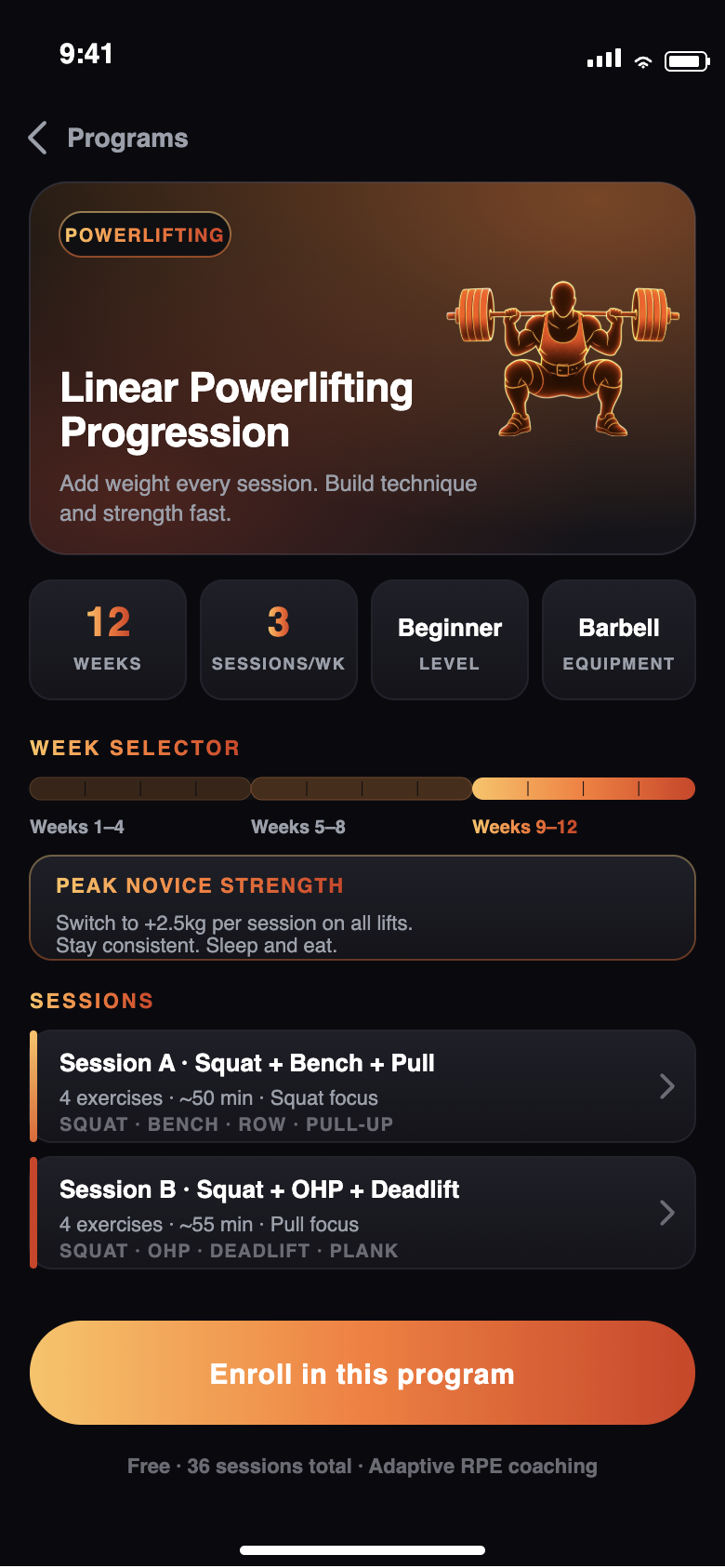
Building an nSuns 531 LP T1 wave as a custom program in LiftHero
Build the T1 wave, T2 lift and accessories as a custom program in LiftHero.

Build nSuns in LiftHero

Lay out the T1 wave, T2 lift and accessories with the custom program builder in the optional Hero subscription, and log every set and AMRAP — so your next training max is never a guess.

Download on theApp Store

Free to start · No interruptive ads · 14-day Hero trial

Frequently asked questions

What is nSuns 531 LP?

It's a high-volume, linear-progression variant of Jim Wendler's 5/3/1, popularized on Reddit by a user named nSuns. Each main-lift day runs a nine-set T1 wave that ends in an AMRAP set, plus a T2 secondary lift and accessories. It's designed for intermediates who can recover from a lot of weekly volume.

How is nSuns different from 5/3/1?

It borrows Wendler's training-max and percentage framework but replaces the slower monthly cycle with weekly linear progression and far more volume per session. Instead of a few main sets, each T1 lift gets a nine-set wave, and your AMRAP result adjusts the training max every week rather than by a fixed monthly increment.

How many days a week is nSuns?

There are 4, 5 and 6 day versions. More days spread the main lifts and accessories across the week and add volume; fewer days pack more into each session. Pick the version you can consistently recover from.

How does progression work on nSuns?

The AMRAP set in the T1 wave drives it. The number of reps you complete on that set maps to how much you add to next week's training max — hit a lot of reps and the training max jumps more, hit only the target and it moves up a little, and miss the target and you hold or reduce it.

Is nSuns good for beginners?

It's usually recommended for intermediates. The volume is demanding, and a true novice will progress faster and recover more easily on a simpler linear program before taking on nine T1 sets per lift plus a T2 lift and accessories several days a week.

Can I run nSuns in LiftHero?

You can build it. LiftHero doesn't ship nSuns as a built-in program, but with the optional Hero subscription's custom program builder you can lay out the T1 wave, T2 lift and accessories as reusable routines and log every set, rep and AMRAP so you can see exactly what to do with next week's training max.

This guide is educational and not medical advice. Consult a qualified coach or medical professional before starting or changing a training program.

By Meitar Lazimi, founder of LiftHero · Last updated July 10, 2026.