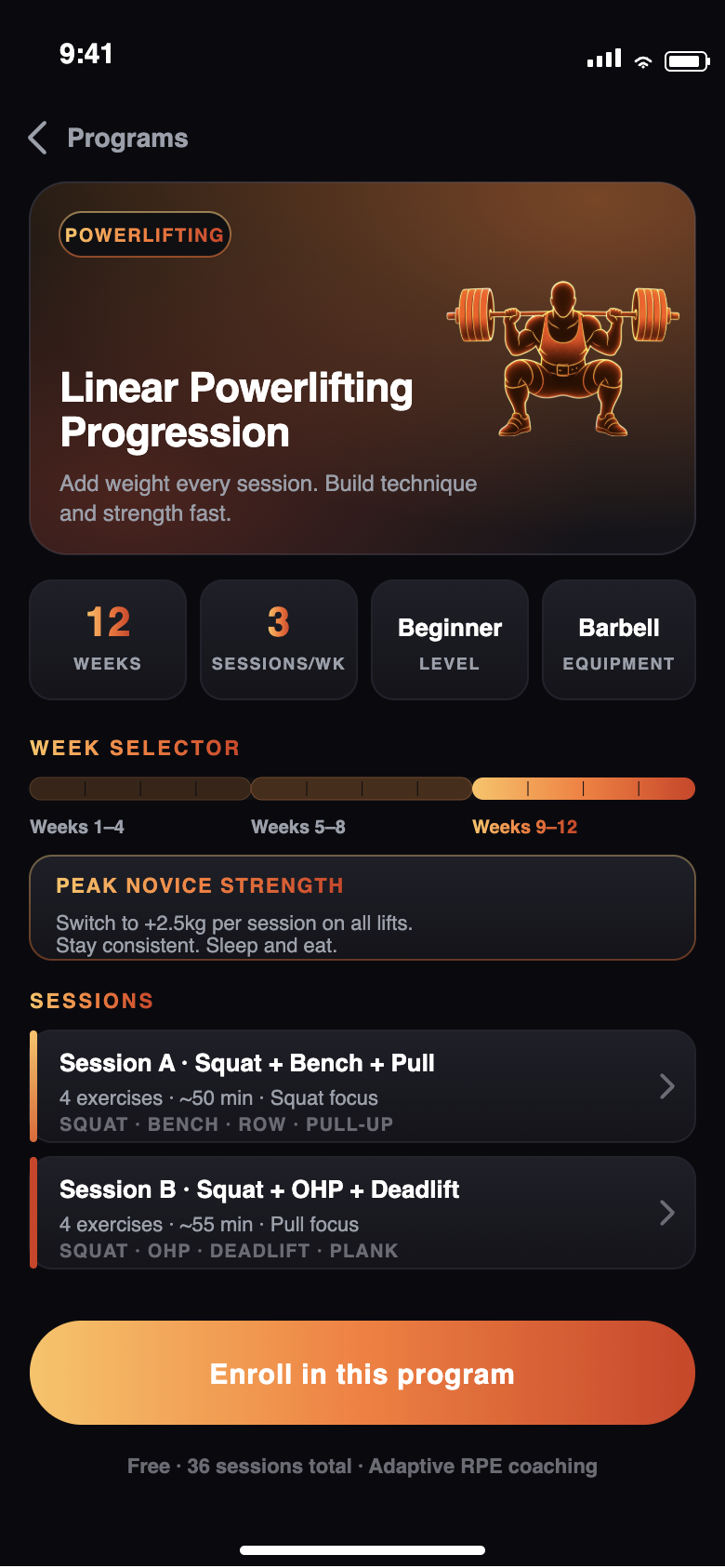
GZCLP is the beginner-friendly, linear-progression version of the GZCL method — three tiers of work in every session. Here's how T1, T2 and T3 are built, how the stage-based progression works, and how to build the whole thing in LiftHero.
By Meitar Lazimi · Updated July 2026
In short: GZCLP is the linear-progression beginner version of the GZCL method, created by powerlifter Cody Lefever (Reddit username GZCL). Every session is built in three tiers: T1 is the heavy main lift (e.g. 5×3+ building to a top set), T2 is a volume lift (e.g. 3×10), and T3 is accessory work (e.g. 3×15+). You add weight each session you hit your reps; when a lift stalls, you move that tier to the next rep-scheme stage rather than just deloading. It's a beginner-to-early-intermediate program. LiftHero doesn't ship it built in, but you can build it with the optional Hero subscription's custom program builder and log every set.
GZCLP is the beginner, linear-progression application of the GZCL method — a training framework created by powerlifter Cody Lefever, whose Reddit username, GZCL, gives both the method and the program their names. The broader GZCL method is a way of organizing any training session into tiers of intensity and volume; GZCLP is the stripped-down, add-weight-every-session version built as an on-ramp for newer lifters.
The appeal is that it keeps the fast progressive overload a beginner gets from programs like Starting Strength, but layers in more structured volume and accessory work through its tier system. You get heavy main-lift work, dedicated volume, and targeted accessories in every session — not just a handful of top sets.
The engine is session-to-session linear progression across three tiers, with a stage system that kicks in when you stall. Here's the shape of it:
GZCLP's signature is the tier system. Each session moves from the heaviest, lowest-rep work down to the lightest, highest-rep work — main strength, then volume, then accessories.
| Tier | Role | Typical rep scheme |
|---|---|---|
| T1 — main lift | Heavy strength, drives progression | e.g. 5×3+ building to a top set |
| T2 — volume lift | Hypertrophy and secondary strength | e.g. 3×10 |
| T3 — accessories | Weak points, isolation, higher volume | e.g. 3×15+ |
The "+" on the last set of a tier usually means an AMRAP — as many reps as you can with good form — which both drives progression and tells you when a stall is coming. Rep schemes shown here are the common convention; the exact stages and top-set rules live in the source material.
GZCLP is aimed at beginners and early intermediates who want the fast linear progression of a novice program but with more built-in volume and accessory work than the most minimal templates offer.
| Great fit | Maybe look elsewhere |
|---|---|
| Beginners who want structure plus extra volume | Lifters who want the simplest possible novice plan |
| People who like accessory work and some variety | Advanced lifters well past linear progression |
| Novices transitioning toward the broader GZCL method | Those wanting a fixed, no-decisions template forever |
If you want something even simpler to start, Starting Strength or a basic 5×5 strips things back further. When you outgrow GZCLP's linear progression, the more advanced GZCL templates — or an intermediate program like 5/3/1 — are the natural next steps.
LiftHero doesn't ship GZCLP as a built-in program — but with the optional Hero subscription's custom program builder you can set up all three tiers and log every set. Build each session as a reusable routine with its T1, T2 and T3 work, and LiftHero records your weights, reps, RPE and AMRAP counts, so you always know when to add weight and when to move a tier to the next stage.
Set up the T1, T2 and T3 tiers with the custom program builder in the optional Hero subscription, and log every set — so you always know when to add weight and when to move to the next stage.
Download on theApp StoreFree to start · No interruptive ads · 14-day Hero trial
It's the linear-progression beginner version of the GZCL method, created by powerlifter Cody Lefever, whose Reddit username GZCL gives the method its name. It organizes every session into three tiers — T1 heavy main work, T2 volume, and T3 accessories — and adds weight session to session like a classic novice program.
T1 is the heavy main lift, done for something like 5 sets of 3 building to a top set. T2 is a secondary lift for volume, done for higher reps such as 3 sets of 10. T3 is accessory work done for high reps, such as 3 sets of 15 or more. The tiers move from heaviest and lowest-rep to lightest and highest-rep.
You add weight to a lift every session you complete its required reps. When you can no longer hit the reps, you don't just deload — you move that tier to the next stage, which uses fewer reps across more sets. When you fail the final stage, you reset the weight and climb again or graduate to a more advanced GZCL program.
The GZCL method was created by Cody Lefever, a powerlifter who posted it under the Reddit username GZCL. GZCLP is the beginner, linear-progression application of that broader method, designed as an entry point before the more advanced GZCL templates.
Yes. It's a beginner-to-early-intermediate program that keeps the fast session-to-session progression novices thrive on, while adding structured volume and accessory work through its tier system. That extra volume makes it a popular alternative to more minimal novice programs.
You can build it. LiftHero doesn't ship GZCLP as a built-in program, but with the optional Hero subscription's custom program builder you can set up the T1, T2 and T3 tiers as reusable routines and log every set and rep, so you always know when to add weight and when to move to the next stage.
This guide is educational and not medical advice. Consult a qualified coach or medical professional before starting or changing a training program.
By Meitar Lazimi, founder of LiftHero · Last updated July 10, 2026.