Starting from zero is simpler than the internet makes it look. You need a basic full-body routine, a handful of movements, and the patience to add weight slowly. Here's exactly how to begin — and how to make your first month count.
To start lifting weights, run a simple full-body routine 2–3 times a week, learn the main compound lifts — squat, bench press, deadlift, row and overhead press — and start light, adding weight gradually with linear progression. Prioritise form over ego, apply progressive overload by doing a little more over time, and above all be consistent. Support your training by eating enough protein and getting adequate sleep, since muscle is built during recovery. You don't need a complicated plan — you need a proven one you'll actually follow, tracked set by set so you can see real progress.
The best beginner routine is the one you can repeat without burning out, and for most people that's full-body training 2–3 times a week on non-consecutive days. Hitting your whole body each session means every muscle gets trained roughly twice weekly — a common, effective target — while the rest days in between let you recover and come back stronger. You don't need a five-day bodybuilding split yet; those are built for people who've already earned a training base. Two solid options to start are a beginner full-body program or the classic Starting Strength linear-progression plan.
Compound lifts are multi-joint movements that train the most muscle per exercise, and they're the backbone of every good beginner program. Spend your first weeks learning five of them: the squat, the bench press, the deadlift, the row, and the overhead press. Together they cover pushing, pulling, hinging and squatting — nearly every pattern your body uses. Isolation work like curls and extensions has its place later as accessories, but early on your time is far better spent grooving these big lifts. If you're unsure how these differ from single-joint moves, read compound vs isolation exercises.
Begin with an empty bar or a light weight and rehearse the movement until it's smooth and controlled — there is no prize for starting heavy. Once a weight moves well for all your working sets with good form, add a small increment next session: this is linear progression, the beginner-friendly form of progressive overload. Lower-body lifts tolerate bigger jumps (often 2.5–5 kg); upper-body and isolation work climbs in smaller steps (1.25–2.5 kg). Beginners can often add a little most sessions, riding the fast early adaptation people call "newbie gains." To go deeper on the principle, see progressive overload and the full menu of progression methods.
The single biggest mistake new lifters make is chasing weight before they've earned it. A clean rep at a lighter load builds more strength and far less injury risk than a heavy, ragged one. Keep the movement controlled, move through a full range of motion, and stop a set before your technique falls apart. If the bar starts moving your body rather than the reverse, the weight is too heavy — drop it and rebuild. Ego-lifting doesn't just risk your back and shoulders; it also masks real progress, because a workout you can't repeat with good form isn't overload, it's a one-off. Form first, weight second, every session.
Consistency beats every clever program on paper. Three sessions a week, every week, for months will take you further than an ambitious six-day split you abandon after a fortnight. The way to stay consistent — and to know your training is actually working — is to log every set: weight, reps and sets per exercise. A record turns "I think I'm getting stronger" into a visible trend, and it tells you exactly when a weight is ready to go up. Without a log, progress is guesswork; with one, progressive overload becomes obvious. This is where an app earns its keep, which we'll get to below.
You don't build muscle in the gym — you build it recovering from the gym, and that recovery runs on food and sleep. Eat enough protein spread across the day to give your body the raw material to repair and grow; a common general target is roughly 1.6–2.2 g of protein per kg of bodyweight, though your exact needs vary. Get adequate sleep, since that's when most repair and hormonal recovery happen. You don't need a perfect diet or a supplement stack to start; you need enough protein, enough total food to support training, and consistent sleep. Nail those and your lifting does the rest.
Here's the whole thing as a simple loop you can start this week:
Once you've got a month of consistent training behind you, the natural next questions are how many days a week to lift and how to keep progressing — both linked here for when you're ready.
LiftHero is where you track your lifts — you can log any set for free with unlimited history, and the app charts weight and volume per exercise so your first month of progress is easy to see. It records what you log; it does not auto-generate a program or add weight for you — you decide the progression, the app measures it. Saving a full custom plan is the optional Hero upgrade, but logging your sets and watching the numbers climb is free. Pair it with a beginner plan like Starting Strength or a simple full-body routine and log every set as you go.
You'll usually feel stronger and more coordinated within 2 to 4 weeks as your nervous system adapts. Visible muscle and strength gains typically show over roughly 8 to 12 weeks of consistent training and enough protein. Individual results vary with genetics, diet, sleep and effort, so use your training log — not the mirror — to confirm you're progressing week to week.
Yes — a structured beginner program removes guesswork and makes progress measurable. A simple full-body routine or a proven plan like Starting Strength tells you exactly which lifts to do and when to add weight. You don't need anything complicated; you need something you'll follow consistently and can track set by set.
Both work, and you can use either. Free weights like barbells and dumbbells build coordination and let you train the main compound lifts, which is why most beginner programs favour them. Machines are beginner-friendly for learning a movement pattern safely and for accessory work. A sensible start is compound barbell or dumbbell lifts first, with machines to fill in.
Start lighter than you think — often just the empty bar or a light dumbbell — so you can practise clean form. Once the weight feels easy for all your sets with good technique, add a small increment. Progressing from a light, controlled start is far safer and more effective than starting heavy and breaking down.
Yes, resistance training is safe for most healthy adults when you start light, learn proper form and progress gradually. Injuries usually come from ego-lifting, poor technique or adding weight too fast. If you have an existing injury or medical condition, check with a qualified coach or medical professional before you begin.
For most beginners, 2 to 3 full-body sessions a week on non-consecutive days is the sweet spot. It's enough to train each muscle roughly twice weekly and drive progress, while leaving recovery days between sessions. You can add days later as you adapt, but consistency at 3 days beats an ambitious plan you can't sustain. See how many days a week you should lift.
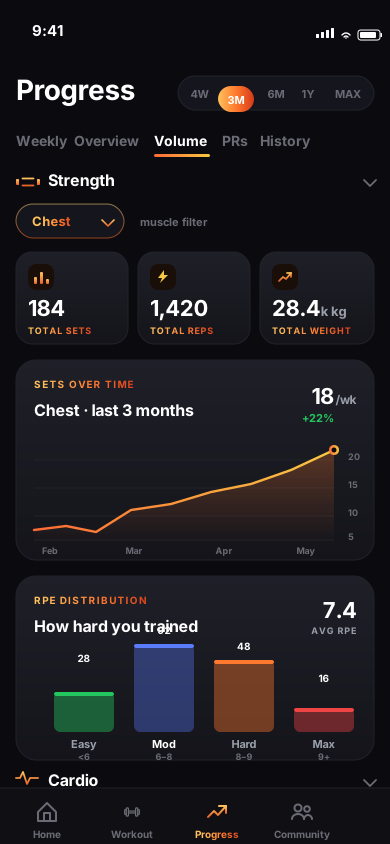
Log any set free with unlimited history — free on iOS.
Download on theApp StoreFree to start · No interruptive ads · 14-day Hero trial
This guide is educational and not medical advice. Consult a qualified coach or medical professional before starting or changing a training program.
By Meitar Lazimi, founder of LiftHero · Last updated July 9, 2026.