There's no single magic number — the right training frequency depends on your goals, your schedule and how well you recover. But for most people the honest, practical answer lands in a narrow band. Here's how to find yours.
For most people, 3–4 days a week is a practical sweet spot — enough to train each muscle group about twice weekly (a common effective target) while still fitting a real schedule and allowing recovery. The right frequency depends on your goals, schedule and recovery: beginners often thrive on full-body training 2–3x a week, while more advanced lifters may run an upper/lower or push/pull/legs split at 4–6x. More isn't automatically better — extra days only help if you can recover from them.
Before reaching for a number, anchor on three things. Your goal shapes the plan — general strength and muscle can be built across a wide range of frequencies, so this matters less than people assume. Your schedule is the real constraint: the best frequency is one you can hit week after week, not your best-case week. And your recovery — driven by sleep, nutrition, stress and training experience — sets the ceiling on how much you can usefully do. A plan that ignores any of these looks great on paper and falls apart in real life. Start from what you can sustain, then build the training around it.
For the majority of lifters, 3 to 4 days a week hits the best balance of results and sustainability. It's enough volume and frequency to train each muscle around twice weekly and keep making progress, yet it leaves room in the week for recovery and the rest of your life — which is exactly why people actually stick to it. Fewer than three days can still work, especially for pure maintenance or a busy season, but you'll usually progress more slowly. Five or six days can absolutely work too, but they raise the recovery demand and the odds you'll miss sessions. Three to four is where most people find the most return for the least friction.
Your frequency should decide your split, not the other way round. Here's how the common structures map to how many days you can train — each arranged to hit most muscles about twice a week.
| Days per week | Best structure | Who it suits |
|---|---|---|
| 2–3 days | Full-body — whole body each session | Beginners; busy schedules; high frequency per muscle from few days |
| 4 days | Upper/lower — upper and lower each twice | Intermediates wanting more volume per session |
| 5–6 days | Push/pull/legs — run twice through | Experienced lifters with time and solid recovery |
Notice the pattern: whether you train 2 days or 6, a well-arranged plan aims to hit each muscle about twice a week. The split just changes how you slice the same weekly work across the days you have.
If there's one frequency guideline worth internalising, it's this: training each muscle group roughly twice a week is a common, effective target, and it tends to edge out hitting a muscle just once. The reason is practical rather than magical — spreading your weekly volume across two sessions usually lets you accumulate more quality sets than cramming everything into a single punishing workout. That said, the bigger driver of progress is the total quality volume you accumulate over the week, paired with progressive overload. Twice a week is a reliable default, not a rigid rule — once, twice or three times can all work if the weekly volume is there.
Adding days feels like adding progress, but it only helps if you can recover from the extra work. Recovery is when adaptation actually happens; pile on sessions faster than you can recover and you get diminishing returns at best, stalled lifts and nagging injuries at worst. Watch the honest signals: lingering soreness that never clears, lifts that stop climbing, disrupted sleep, dread before training. Those mean pull back, not push through. And when fatigue accumulates over a training block, a planned deload week restores your capacity so the next block can progress. The goal isn't the most days you can cram in — it's the most you can consistently recover from and repeat.
Turn all of the above into a decision with four steps:
Recovery is the hinge the whole thing turns on — if you want to go deeper, read about muscle recovery and when to deload.
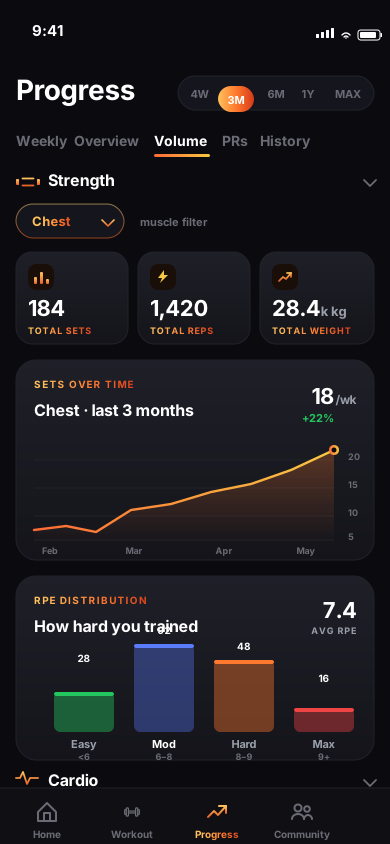
LiftHero helps you track your training frequency — log any set free with unlimited history, and the app records which muscles you've trained and how your lifts trend over the week, so you can see whether your chosen frequency is actually recovering and progressing. It records what you log; it does not auto-generate a split or decide your frequency for you — you make the plan, the app measures it. Saving a full custom program is the optional Hero upgrade, but logging sessions and watching the trend is free. Pair it with a full-body, upper/lower or PPL plan and log every set.
For most people, 3 to 4 days a week is a practical sweet spot — enough to train each muscle roughly twice weekly and drive progress, while still fitting a normal schedule and allowing recovery. Beginners often do best with 3 full-body days; more advanced lifters may run 4 to 6 days on a split. The right number is the most you can consistently recover from, not the most you can squeeze in.
Yes. Three full-body sessions a week can train every muscle about twice weekly, which is a common effective target for growth and strength. What matters more than the raw number of days is total quality volume over the week and applying progressive overload. Many people build plenty of muscle on three well-structured, consistent sessions.
No. More sessions only help if you can recover from them. Adding days that leave you constantly sore, sleep-deprived or stalling on your lifts works against you — recovery is when adaptation happens. Beyond a point, extra frequency mostly spreads the same weekly volume across more sessions rather than adding a magic bonus. Match frequency to your recovery, not to an ideal on paper.
Training each muscle group about twice a week is a common, effective target and often edges out hitting it just once, largely because it lets you distribute your weekly volume more manageably. You can achieve this with full-body sessions or a well-arranged split. Whether you train a muscle once, twice or more, the bigger driver is accumulating enough quality volume across the week.
Choose based on how many days you'll train. Full-body works best at 2 to 3 days a week and is ideal for beginners. An upper/lower split suits 4 days, and a push/pull/legs split suits 5 to 6 days for those with more time and training experience. All of them can train each muscle about twice a week when arranged well — pick the one that fits your schedule.
Yes. Rest days let your muscles and nervous system recover and adapt, which is when you actually get stronger. On a 3-day full-body plan, training on non-consecutive days is a simple, effective approach. Higher-frequency splits work rest around muscle groups instead of the whole body. If lifts stall or fatigue builds up, a lighter deload week can restore recovery before you push again.
Log any set free with unlimited history — free on iOS.
Download on theApp StoreFree to start · No interruptive ads · 14-day Hero trial
This guide is educational and not medical advice. Consult a qualified coach or medical professional before starting or changing a training program.
By Meitar Lazimi, founder of LiftHero · Last updated July 9, 2026.