The full-body workout is the simplest 3-day split there is — every session trains your whole body, run three non-consecutive days a week. Here's how to structure each day, why three days is enough to grow, how to program it, and how to run it free in LiftHero.
By Meitar Lazimi · Updated July 2026
In short: A full-body workout trains your whole body in one session — a squat or hinge, a push, a pull, and some core — rather than splitting the week by body part. Run it roughly three non-consecutive days a week (say Monday, Wednesday, Friday) and every major muscle group gets trained about three times weekly — an excellent frequency for building muscle, and the reason full-body is the go-to for beginners and anyone short on training days. In LiftHero you can save your Day A / B / C as reusable routines and rotate through them — free and unlimited — or start from a built-in beginner program like Starting Strength — free on iOS, unlimited logging, no interruptive ads.
A full-body workout is exactly what it sounds like: each session trains your whole body rather than one region. Instead of a "chest day" or a "leg day," every workout covers the major movement patterns — a squat or a hinge, a push, a pull, and some core — so nothing gets left for tomorrow.
Because compound lifts do double duty, this is easier than it sounds. A bench press trains chest, shoulders and triceps; a barbell row hits your back and biceps; a squat loads quads, glutes and hamstrings. Four or five well-chosen movements cover the whole body in one session.
The payoff is frequency. Run it three non-consecutive days a week and every muscle group gets trained about three times weekly — and research on training frequency tends to favour hitting each muscle around three times a week over once, even when weekly volume is matched. That high frequency also means no single area gets hammered too hard in one session, so soreness stays manageable and you get more practice on the core lifts.
The cleanest way to run full-body is three rotating sessions — Day A, Day B, Day C — trained on non-consecutive days like Monday, Wednesday and Friday. Each day still hits the whole body, but you rotate lift variations so pushing and pulling stay balanced across the week. Here's a sample week:
| Day A | Day B | Day C |
|---|---|---|
| Back squat | Deadlift | Front squat |
| Bench press (horizontal push) | Overhead press (vertical push) | Incline bench (horizontal push) |
| Barbell row (horizontal pull) | Pull-up (vertical pull) | Seated cable row (horizontal pull) |
| Plank / core | Hanging leg raise / core | Ab wheel / core |
The structure is the skeleton; progression is what makes you bigger and stronger. Full-body programming is refreshingly simple:
If you're new, you don't even need to design this yourself — full-body pairs naturally with linear beginner programs like Starting Strength, which is a full-body routine that adds weight to the bar every session.
Full-body isn't the only way to organize a week. The right choice mostly comes down to how many days you can train and how experienced you are:
| Approach | Days/week | Best for |
|---|---|---|
| Full-body | 3 | Beginners, busy schedules, rebuilding after a layoff; every muscle ~3× a week |
| Upper / Lower | 4 | Balanced frequency on a 4-day week; more per-session volume than full-body |
| Push Pull Legs | 5–6 | Intermediates who can train 5–6 days and want maximum volume per muscle |
Full-body wins on frequency and simplicity — each muscle trained about three times a week, no session too long, easy to stay consistent. Splits add more per-session volume per muscle, but only pay off if you can train more days. If you can train 4 days, look at Upper/Lower; at 5–6, Push Pull Legs. For three days a week, full-body is hard to beat.
You can run a full-body routine in LiftHero for free a few ways: save each of your Day A / B / C sessions as reusable routines — unlimited, with no caps — and rotate through them, start from a built-in beginner program like Starting Strength — a linear, full-body program you can begin in a couple of taps — or copy a program shared by a Hero member. Either way you get the full vocabulary of serious training — supersets, warm-up sets, drop sets, tempo — plus automatic personal-record detection, so every session stacks into a progress trend you can actually see. If you'd rather build a multi-week program from scratch, the custom program builder is part of the optional Hero subscription.
LiftHero also ships 5/3/1, Push Pull Legs, Texas Method and Madcow 5×5. It's free on iOS (Android coming), with no routine caps and no interruptive ads. LiftHero logs and tracks your training and lets you build routines — it doesn't auto-program for you or connect to wearables; the training decisions stay yours.
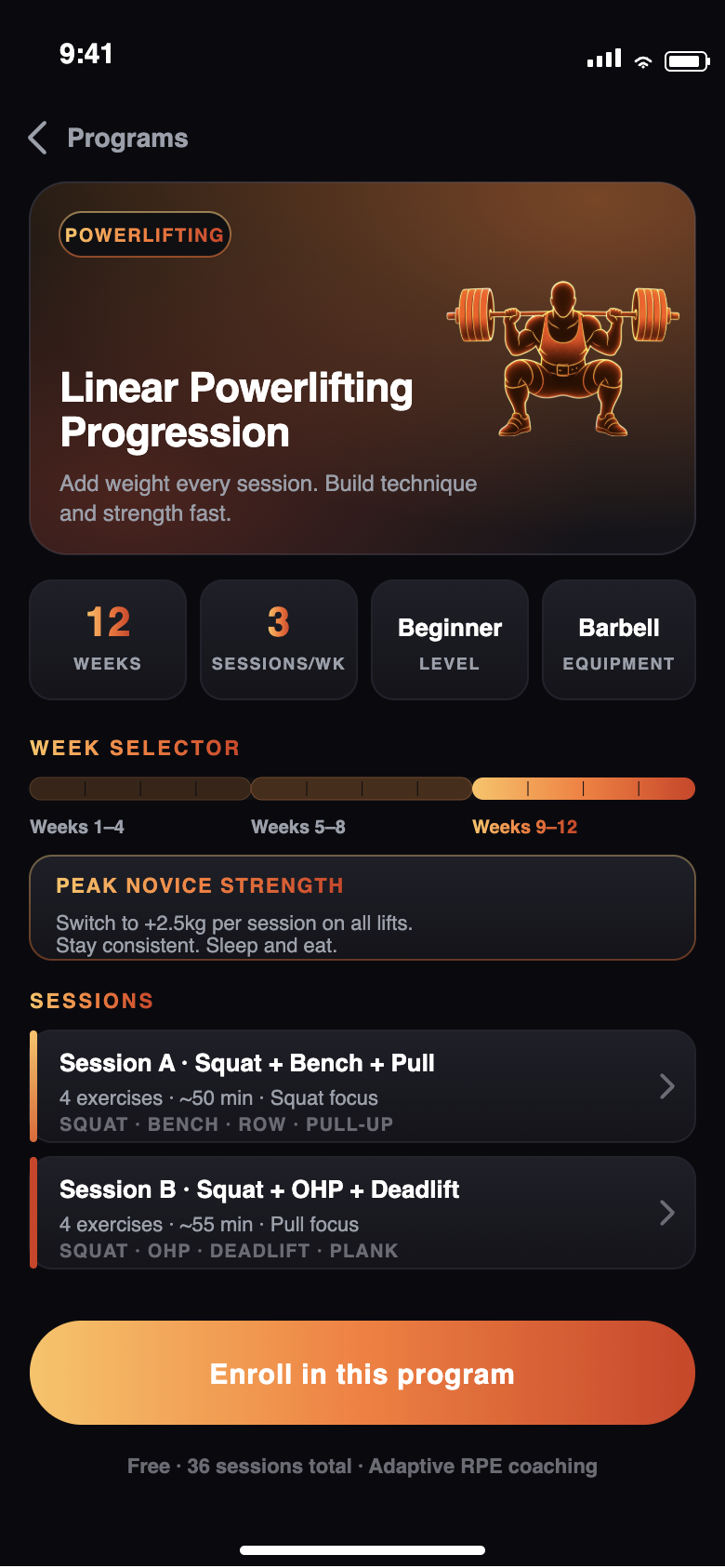
Save your own full-body week as routines, or start from Starting Strength — plus 5/3/1, Push Pull Legs and more, built into LiftHero.
Download on theApp StoreFree to start · No interruptive ads · 14-day Hero trial
It trains your whole body in a single session — a squat or hinge, a push, a pull and some core — instead of splitting the week by body part. Run it about three non-consecutive days a week and every major muscle group gets trained roughly three times weekly.
Yes. On a full-body plan, three non-consecutive days trains every muscle group about three times weekly — an excellent frequency for building muscle and strength, especially for beginners. Progress comes from progressive overload and consistency, not from adding more days.
Full-body wins on frequency and simplicity: each muscle trained ~3× a week, no session too long, easy to stick to. Splits like Push Pull Legs or Upper/Lower add more per-session volume per muscle and suit lifters who train 5–6 days. Pick full-body for three days, a split for five or six.
Use three rotating sessions — Day A, B and C — each with a squat or hinge, a push, a pull and core. Spread horizontal and vertical pushing and pulling across the three days so patterns stay balanced, and train on non-consecutive days like Monday, Wednesday and Friday.
It's one of the best starting points. The high frequency gives more practice on the core lifts each week, no single area gets hammered too hard, and it pairs naturally with linear beginner programs like Starting Strength. It's also ideal for rebuilding after a layoff or when you're short on days.
You can save your Day A / B / C as reusable routines and rotate through them — free and unlimited — start from a built-in beginner program like Starting Strength (a linear, full-body program), or copy a program shared by a Hero member. LiftHero also ships 5/3/1, Push Pull Legs, Texas Method and Madcow 5×5, free on iOS with unlimited logging and no interruptive ads. Building your own multi-week program from scratch is part of the optional Hero subscription.
The full-body workout is a widely used training convention, not a proprietary program. LiftHero's built-in programs are independent templates adapted from standard training conventions and credited on the Program Credits page. This guide is educational and not medical advice — consult a qualified professional before starting any program.
By Meitar Lazimi, founder of LiftHero · Last updated July 1, 2026.