Learn

RIR: How to Use Reps in Reserve

RIR is the simplest honest answer to "how hard was that set?" — counted in the reps you left on the table. It's the everyday tool for training close to failure without living there. Here's what RIR is, how it maps to RPE, and how to use it to autoregulate load day to day.

RIR — reps in reserve — is how many more reps you could have done before failure. Stop a set at 8 when you had 2 clean reps left, and that set was 2 RIR. It's a practical autoregulation gauge: aim for roughly 1–3 RIR on most working sets so they're genuinely hard but not maximally fatiguing. RIR is the flip side of RPE — RPE ~8 ≈ 2 RIR, and RPE 10 = 0 RIR (true failure). It takes practice, because most people underestimate how many reps they have left and stop early. Used well, RIR lets you push or back off load based on how you actually feel that day.

most working sets 5 4 3 2 1 0 easy failure RIR = reps in reserve · RPE 8 ≈ 2 RIR · RPE 10 = 0 RIR (failure)
Leave 1–3 reps in reserve on most working sets — hard, but not grinding to failure every time.

What is RIR (reps in reserve)?

Reps in reserve is exactly what it sounds like: at the moment you end a set, it's the number of additional reps you believe you could have completed with good form before reaching failure. A set taken to the absolute last clean rep is 0 RIR. Stop with two good reps still in the tank and it's 2 RIR. The value is that it turns a vague feeling — "that was pretty hard" — into a concrete number you can target, log, and adjust against. Instead of a fixed weight-and-reps prescription that ignores how you feel, RIR anchors your training to effort, which is what actually drives adaptation. It's the everyday language of training close to failure.

What RIR should you train at?

For the large majority of your working sets, aim for roughly 1–3 reps in reserve. That band keeps sets genuinely hard — close enough to failure to drive growth — while leaving enough in the tank to preserve your form, protect later sets, and keep fatigue manageable across the week. Going to 0 RIR (true failure) is a tool, not a default: reserve it mainly for the last set of isolation lifts, where a stalled rep is low-risk. On heavy compound lifts, err toward the higher end of the range (2–3 RIR) to protect technique. The point isn't to grind everything to the wall; it's to make most sets reliably hard while spending your fatigue budget wisely. For the full case on that, see training to failure.

How RIR maps to RPE

RIR and RPE are two readings of the same dial. RPE rates perceived effort from 1–10; RIR counts the reps you left. On the modern lifting scale they line up cleanly.

RPERIR (reps in reserve)What it feels like
100 RIRTrue failure — no more reps possible
9.5~0–1 RIRMaybe one more, maybe not
91 RIRDefinitely one clean rep left
82 RIRTwo solid reps in the tank — a common target
73 RIRHard but three reps remain
5–64–5+ RIRComfortable — warm-up or speed work

Because they're interchangeable, use whichever feels natural — many lifters find counting reps left (RIR) more concrete than rating effort on a 1–10 scale. Read the full effort side in the RPE guide.

Why people underestimate reps left

Here's the honest caveat: RIR takes practice, and most lifters are bad at it at first — specifically, they underestimate how many reps they have in reserve. A set feels like 1 RIR when three or four clean reps actually remained. The discomfort of a hard set gets mistaken for the true limit, so people stop well short of their target effort without realizing it, and train easier than they think. The fix is calibration: every so often, take an isolation set to genuine failure and count how many reps you got past where you'd normally stop. That resets your internal gauge, and over weeks your RIR estimates get noticeably more accurate. Expect the learning curve — it's normal, and it's why logging matters.

How to assign RIR targets and autoregulate load

The real power of RIR is autoregulation — letting the day dictate the load instead of a rigid number. The loop:

  1. Assign an RIR target to each set. For example 2 RIR on working sets, 3–4 RIR on early ramps. Now each set has a defined effort.
  2. Estimate your RIR at the end of each set. As bar speed slows, ask honestly how many more clean reps you had. That's your reps in reserve.
  3. Compare estimate to target. Hit your reps with more in reserve than planned? The weight was light. Fell short of the target reps? It was heavy.
  4. Autoregulate the load. Add weight when RIR runs high; hold or reduce it when RIR runs low — so effort stays on target on strong days and rough days alike.

This is how RIR keeps training honest across the ups and downs of sleep, stress and fatigue. It pairs naturally with progressive overload and structured progression methods — RIR tells you when a jump is earned, and progression tells you how to take it.

Common RIR mistakes

How to track RIR (and how LiftHero helps)

LiftHero logs RIR or RPE on every set alongside reps and weight, so you can set effort targets, autoregulate load, and watch your estimates get sharper over time. Log each set as you lift; over weeks the app charts your effort and volume per exercise, so you can see whether you're hitting your RIR targets or drifting too easy or too hard. To be clear about what it is and isn't: LiftHero is the measurement layer, not a decision engine. It records the RIR you enter and doesn't auto-generate or adapt your program or pick your loads — you autoregulate, the app tracks it. Saving a custom plan is an optional Hero feature; logging your sets is free and unlimited. Pair it with a structured plan like 5/3/1 and log every set as you go.
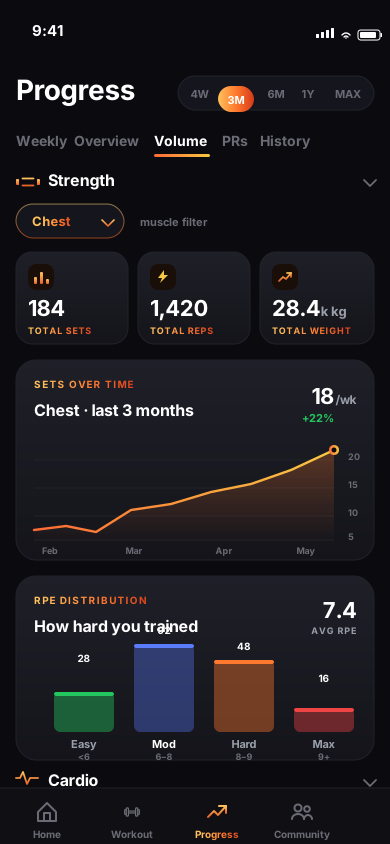
LiftHero chart tracking RIR/RPE, reps and weight per set over time
LiftHero logs RIR or RPE per set, so you can autoregulate load and see your effort trend over time.

Frequently asked questions

What does RIR mean?

RIR stands for reps in reserve — how many more reps you could have completed with good form before hitting failure. If you stopped at 8 and could have done 2 more, that set was 2 RIR.

What RIR should I train at?

For most working sets, aim for roughly 1–3 reps in reserve. That keeps sets genuinely hard and effective while managing fatigue. Save 0 RIR (true failure) mainly for the last set of isolation lifts.

How does RIR relate to RPE?

They're two sides of the same gauge. RPE 10 equals 0 RIR (true failure). RPE 9 is about 1 RIR, RPE 8 is about 2 RIR, and RPE 7 is about 3 RIR. RIR counts reps left; RPE rates effort.

How do I use RIR to autoregulate?

Pick an RIR target for your sets, then adjust load to hit it. If a weight leaves more reps in reserve than planned, add load; if it leaves fewer, hold or reduce. This keeps effort steady across good and bad days.

Is RIR accurate?

It takes practice. Most people underestimate how many reps they have left, so they think they're closer to failure than they are. Occasionally taking a set to true failure helps recalibrate your estimates.

How do I track RIR?

Log an RIR or RPE value next to reps and weight on each set, then review the trend. LiftHero lets you record RIR or RPE per set so you can autoregulate and see your effort over time. It doesn't auto-generate your program.

Track RIR on every set

Log reps, weight, RIR/RPE and PRs in one place — free on iOS.

Download on theApp Store

Free to start · No interruptive ads · 14-day Hero trial

This guide is educational and not medical advice. Consult a qualified coach or medical professional before starting or changing a training program.

By Meitar Lazimi, founder of LiftHero · Last updated July 9, 2026.