Grinding every set to the last possible rep feels productive — and it does guarantee effort. But failure carries real costs, and the modern consensus lands somewhere more nuanced than "always" or "never." Here's what failure is, what it buys you, what it costs, and how to use it wisely.
Training to failure means continuing a set until you can't complete another rep with good form. It guarantees a high-effort, high-stimulus set and calibrates how hard "hard" actually feels. But it's expensive: much more fatigue, longer recovery, a higher chance of form breakdown and injury, and it can cut into your total quality volume because you're too gassed for later sets. The modern consensus is to take most working sets close to failure — a few reps in reserve — and save true failure mainly for the last set of isolation exercises, where a stalled rep is low-risk. Effort matters; you just don't need to hit the wall every time.
Muscular failure is the point in a set where you can no longer complete another repetition through a full range of motion with good form. It's not the point where the set gets uncomfortable, and it's not where your form starts to wobble — those come earlier. True failure is when the muscle, having done the work, simply can't produce one more clean rep. This is worth defining precisely because "going to failure" gets used loosely. Grinding out ugly, half-range reps with a hitched back isn't training to failure; it's training past good form. Genuine failure is the last quality rep, and everything after it is a different, riskier activity.
Failure has two real virtues. First, it guarantees a high-effort, high-stimulus set: you cannot leave meaningful reps on the table if you physically couldn't do another one. For a muscle to grow, the set needs to be genuinely hard, and failure removes all doubt about whether it was. Second, and underrated, failure calibrates your sense of effort. Most lifters badly underestimate how many reps they have left — they stop at what feels like the limit while three or four reps remained. Occasionally taking a set to true failure recalibrates that internal gauge, so your "close to failure" sets actually land close. In that sense, failure is as much a measuring tool as a training method.
The costs are why failure isn't a free lunch. Going to true failure creates much more fatigue per set and demands longer recovery — both for the muscle and the nervous system — which can bleed into your next sessions. It raises the risk of form breakdown and injury, since the last desperate reps are exactly when technique falls apart, and that's especially dangerous under a heavy bar. And counterintuitively, it can reduce your total quality volume: if you smash your first set to failure, sets two through four suffer, so you accumulate fewer good, hard reps across the workout. Since total hard sets are a primary driver of growth, trading three solid sets for one heroic one is often a bad deal.
Widely accepted practice today isn't "always" or "never" — it's a middle path that keeps effort high while managing fatigue.
| Situation | How close to failure | Why |
|---|---|---|
| Most working sets | Close to failure (~1–3 reps in reserve) | Hard enough to grow, repeatable, manageable fatigue |
| Heavy compound lifts | Stay further from failure | Technique breaks down first; injury risk is highest |
| Isolation lifts (last set) | True failure is fine | Single joint, light load — a stalled rep is low-risk |
| Deload / high-fatigue weeks | Leave more in reserve | Prioritize recovery; effort can dip briefly |
The through-line: keep most sets close to failure so they're genuinely hard, and use true failure surgically — mainly on the final set of low-risk isolation work. This gives you the stimulus and the calibration without paying the full fatigue and injury tax on every set.
Putting the consensus into practice comes down to gauging effort and choosing your moments. The loop:
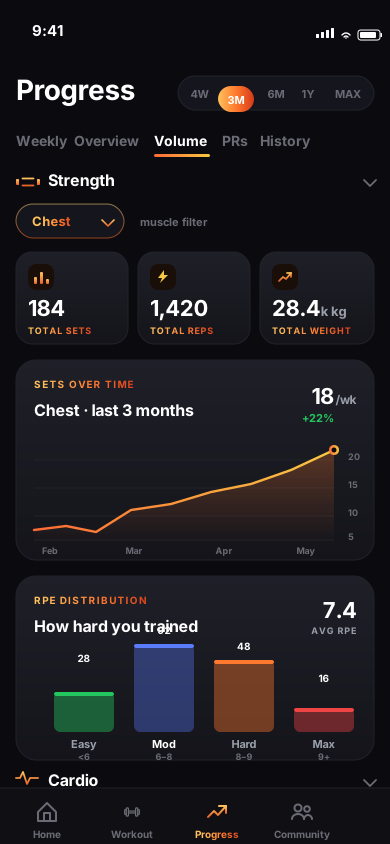
The practical tool for all of this is reps in reserve (RIR), often expressed through RPE. Aim for roughly 1–3 RIR on most sets, and pick your rep range to suit the lift — see rep ranges.
Failure is the doorway to a family of intensity techniques — drop sets, rest-pause, myo-reps and the like — that all extend a set past the first point of failure to squeeze out extra reps. They can add stimulus efficiently, but they multiply the same costs discussed here: fatigue, recovery demand and, if abused, form risk. The sensible way to use them mirrors the consensus on failure itself: apply them sparingly, mostly on isolation lifts and the tail end of a session, not as the default treatment for every exercise. Effort is a resource you spend, not a virtue you maximize — and intensity techniques spend it fast.
LiftHero logs every set with its effort — reps, weight and RIR or RPE — so you can see how close to failure you actually trained, not just how it felt in the moment. Log each set as you lift; over weeks the app charts your volume and effort per exercise, so you can tell whether your sets are genuinely close to failure or drifting easy. To be clear about what it is and isn't: LiftHero is the measurement layer, not a decision engine. It won't tell you to go to failure and it doesn't auto-generate or adapt your program — you decide the effort, the app records it. Saving a custom plan is an optional Hero feature; logging your sets is free and unlimited. Pair it with a structured plan like Push Pull Legs and log every set as you go.
Training to failure means continuing a set until you can no longer complete another rep with good form. The point where the next full-range rep is impossible is muscular failure.
No. The modern consensus is to keep most working sets close to failure with a few reps in reserve, and reserve true failure mainly for the last set of isolation exercises. Constant failure adds fatigue without much extra benefit.
No. What matters is that sets are genuinely hard and close to failure. Training a few reps short still drives growth, and it lets you accumulate more quality volume with less fatigue.
It creates much more fatigue, needs longer recovery, raises the risk of form breakdown and injury, and can reduce your total quality volume because you're too fatigued for later sets.
Mainly on the last set of isolation exercises like curls or leg extensions, where a failed rep is low-risk. Avoid true failure on heavy compounds where technique breaks down first.
Use reps in reserve (RIR) or RPE to gauge effort. Aim for roughly 1–3 reps in reserve on most sets. LiftHero lets you log RIR or RPE per set so you can see how hard you actually trained.
Log every set — reps, weight, RIR/RPE and PRs — in one place, free on iOS.
Download on theApp StoreFree to start · No interruptive ads · 14-day Hero trial
This guide is educational and not medical advice. Consult a qualified coach or medical professional before starting or changing a training program.
By Meitar Lazimi, founder of LiftHero · Last updated July 9, 2026.