Program Guide

PHAT: Power Hypertrophy Adaptive Training

PHAT is Dr. Layne Norton's five-day answer to "should I train like a powerlifter or a bodybuilder?" — do both. Here's how the two power days and three hypertrophy days are built, who it suits, and how to build it as a custom program in LiftHero.

By Meitar Lazimi · Updated July 2026

In short: PHAT — Power Hypertrophy Adaptive Training — is a 5-day-a-week program created by natural bodybuilder and researcher Dr. Layne Norton. It blends powerlifting and bodybuilding: two power days (upper and lower, heavy low reps) and three hypertrophy days (back and shoulders, legs, and chest and arms, higher reps and more volume). It's a high-volume program best suited to intermediate and advanced lifters. LiftHero doesn't ship PHAT built in, but you can build it as a custom program with Hero and log every set.

What is PHAT?

PHAT stands for Power Hypertrophy Adaptive Training. It was designed by Dr. Layne Norton — a natural pro bodybuilder, powerlifter and PhD in nutritional sciences — to answer a question a lot of lifters get stuck on: do you train heavy like a powerlifter, or high-volume like a bodybuilder? Norton's answer with PHAT is to do both within the same week.

The program runs five days a week: two power days that use heavy, lower-rep work on the big compound lifts, and three hypertrophy days that pile on higher-rep, higher-volume work targeting the whole body across back and shoulders, legs, and chest and arms. The idea is that the strength you build on the power days lets you move more weight on the hypertrophy days, which in turn drives more muscle growth.

PHAT was created by Dr. Layne Norton. LiftHero is not affiliated with or endorsed by him — this is an independent, plain-English explanation of the program's structure.

How PHAT works

PHAT is five sessions: two power-focused and three hypertrophy-focused. Here's the shape of it, step by step:

  1. Train five days a week — two power days and three hypertrophy days, arranged with rest days across the week to manage the high total volume.
  2. Upper Power day. Heavy compound presses and pulls in lower rep ranges — roughly 3 to 5 reps — followed by some higher-rep accessory work.
  3. Lower Power day. Heavy squats and deadlifts in low rep ranges, plus accessory work.
  4. Back and Shoulders Hypertrophy day. Moderate weight and higher reps — often speed or rep work on a main lift, then volume isolation for back and delts.
  5. Lower Hypertrophy day. The legs again with higher-rep volume for quads, hamstrings and calves.
  6. Chest and Arms Hypertrophy day. Higher-rep volume for chest, biceps and triceps. Across the whole program, progress by adding load to the power days and reps or sets to the hypertrophy days, chasing progressive overload.
This is a plain-English description of the PHAT structure, not a reproduction of Norton's exact template. The original specifies particular exercises, set counts and rep schemes in more detail — treat the layout here as a map, not the source.

The 5-day PHAT layout

PHAT's week is front-loaded with two heavy power days and then three higher-volume hypertrophy days that split the body across back/shoulders, legs, and chest/arms. Power days lean on heavy compounds; hypertrophy days chase volume.

DayFocusEmphasis
Day 1 — Upper PowerHeavy bench, rows, overhead press, pullsStrength · ~3–5 reps
Day 2 — Lower PowerHeavy squat, deadlift, leg accessoriesStrength · ~3–5 reps
Day 3 — Back & Shoulders HypertrophyRep/speed work + isolation for back and deltsSize · higher reps
Day 4 — Lower HypertrophyHigher-rep volume for quads, hams, calvesSize · higher reps
Day 5 — Chest & Arms HypertrophyHigher-rep volume for chest, biceps, tricepsSize · higher reps

Because three of the five days are dedicated to hypertrophy, PHAT carries a lot of weekly volume — that's what makes it effective for size, and also what makes recovery and consistency the deciding factors in whether it works for you.

Rep ranges and the exact split here reflect the common way PHAT is run. Norton's original template is the authority on precise loading and exercise selection.

Who is it for?

PHAT is generally aimed at the intermediate-to-advanced lifter who wants both strength and serious size and can handle — and recover from — five high-volume days a week. It's not a beginner program; the workload assumes you already have a training base and know the main lifts.

Great fitMaybe look elsewhere
Intermediate/advanced lifters who want strength and sizeBeginners still adding weight every session
People who can train and recover across five days a weekPeople limited to two to four days a week
Lifters who thrive on high volume and structureLifters who need a low-volume, minimalist program

If five days is too much or you're earlier in your training, a lower-volume option fits better — a 4-day PHUL split, a standard upper/lower, or push/pull/legs. Browse all programs to compare.

How to build it in LiftHero

LiftHero doesn't ship PHAT as a built-in program — but you can build it as a custom program with the Hero subscription's program builder, then log every session. With five high-volume days, tracking matters: LiftHero records work sets, warm-ups, RPE and reps, and detects personal records automatically, so you can actually manage the volume instead of guessing. It's free to start on iOS, with no routine caps and no interruptive ads.

  1. Get LiftHero free on iOS and open the Programs section.
  2. Use the custom program builder (a Hero feature) to lay out the five PHAT sessions — two power days and three hypertrophy days.
  3. Save each session as a reusable routine (routines are free and unlimited) so it's ready in a couple of taps.
  4. Train each session straight from the app — it logs your sets, reps and RPE across both the heavy and the high-volume work.
  5. Use your progress charts to watch strength and volume trend upward, and dial back if recovery starts slipping.
LiftHero logs and tracks your training — weights, reps, RPE and PRs — with a custom program builder available in the optional Hero subscription. It doesn't auto-generate or auto-progress PHAT for you, so you control the loading, volume and progression yourself.
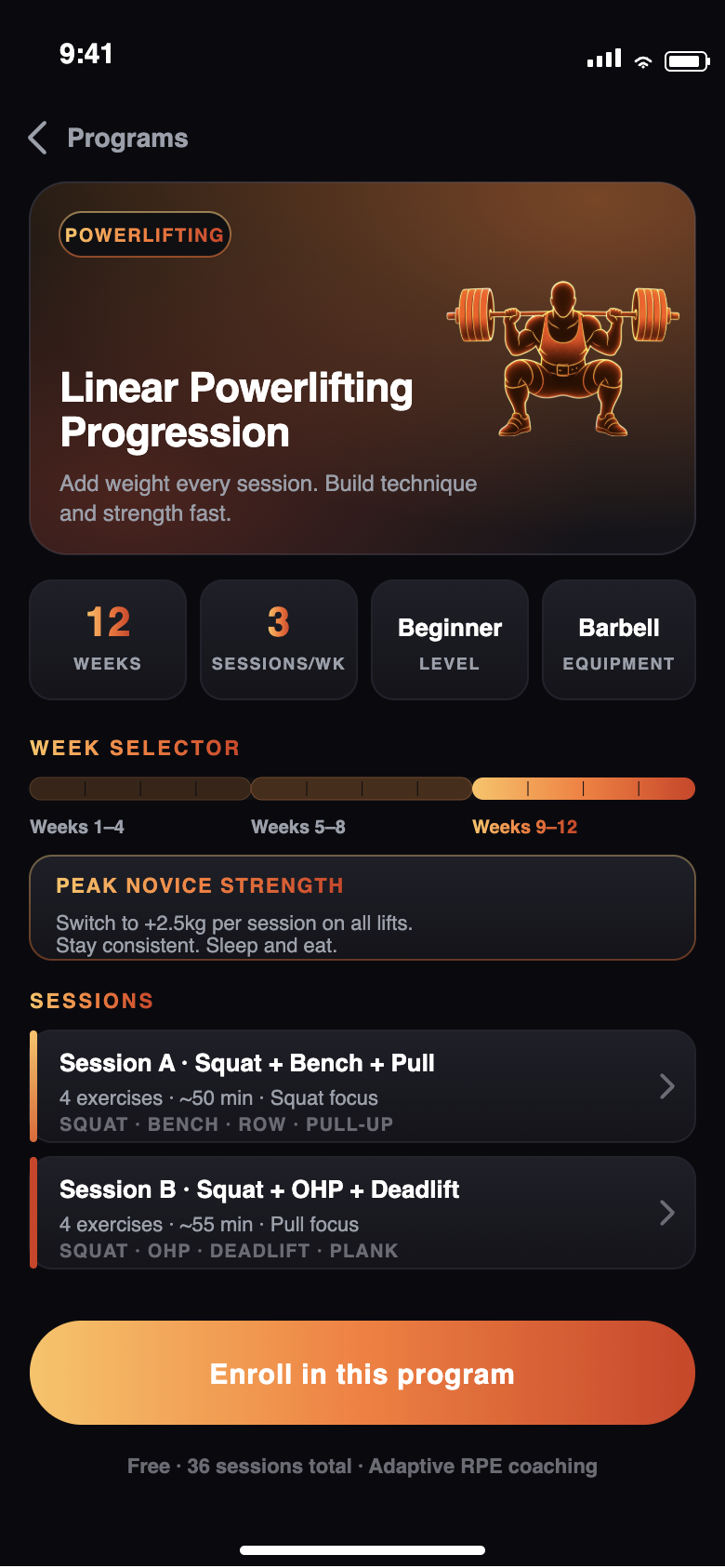
LiftHero custom program builder — building a PHAT 5-day split in the app
Build a custom PHAT program and log every set in LiftHero.

Build PHAT in LiftHero

Lay out all five PHAT sessions with the custom program builder in the optional Hero subscription, save them as reusable routines, and log every set free on iOS.

Download on theApp Store

Free to start · No interruptive ads · 14-day Hero trial

Frequently asked questions

What is the PHAT program?

PHAT stands for Power Hypertrophy Adaptive Training. It's a 5-day-a-week program created by natural bodybuilder and researcher Dr. Layne Norton that blends powerlifting and bodybuilding — two heavy power days and three higher-rep hypertrophy days.

Who created PHAT?

PHAT was created by Dr. Layne Norton, a natural pro bodybuilder, powerlifter and PhD in nutritional sciences. He designed it to combine the strength benefits of powerlifting-style training with the volume of bodybuilding.

How many days a week is PHAT?

Five days a week — typically two power days (upper and lower) and three hypertrophy days (back and shoulders, legs, and chest and arms), arranged with rest days to manage the high total volume.

Is PHAT good for beginners?

Not really — PHAT is a high-volume, five-day program generally suited to intermediate and advanced lifters who can recover from the workload. Beginners are usually better served by a simpler program before taking on this much volume and frequency.

What's the difference between PHAT and PHUL?

Both blend power and hypertrophy, but PHAT is a 5-day program with two power days and three hypertrophy days and more total volume, while PHUL is a 4-day upper/lower split with two power days and two hypertrophy days. PHAT is the higher-volume, more advanced of the two.

Can I build PHAT in LiftHero?

Yes — LiftHero doesn't ship PHAT as a built-in program, but you can build it as a custom program with the Hero subscription's program builder, save the five sessions as reusable routines, and log every set, rep and RPE so you can manage the volume and track progress.

This guide is educational and not medical advice. Consult a qualified coach or medical professional before starting or changing a training program.

By Meitar Lazimi, founder of LiftHero · Last updated July 10, 2026.