Your own bodyweight is a full gym you carry everywhere. Push-ups, squats, dips, rows and pull-ups train every major muscle group — and with the right progressions they keep building muscle for a long time. Here's how to structure it and how to keep it getting harder.
You can build real muscle with no equipment at all. The core moves cover every pattern: push-ups, bodyweight squats, lunges, dips, rows (under a table or on rings), pull-ups and chin-ups, and planks. You progress by adding reps, slowing the tempo, shortening rest, or moving to harder variations — incline to standard to decline to one-arm progressions — and by using unilateral (single-limb) moves. Bodyweight training is highly effective for building muscle, especially for beginners and intermediates. The honest limit is maximal strength: it's harder to keep overloading at the very top end than it is with a loaded barbell.
Yes. Muscle grows in response to challenging, progressive tension — and your bodyweight supplies plenty of it. A hard set of push-ups, dips or single-leg squats takes a muscle near failure just as effectively as a machine, and near-failure effort with rising demand over time is what drives growth. This is especially true for beginners and intermediates, who see fast progress from bodyweight work alone. The one thing you can't skip is progressive overload: if every session is the same number of easy reps, the muscle has no reason to grow. The whole game in bodyweight training is finding ways to keep the demand climbing without a bar to load.
A complete routine needs one move from each pattern. Here's the toolkit, grouped by what it trains.
| Pattern | Moves | Trains |
|---|---|---|
| Push | Push-ups, dips, pike push-ups | Chest, shoulders, triceps |
| Squat | Bodyweight squats, split squats, single-leg squats | Quads, glutes |
| Lunge | Forward, reverse and walking lunges | Quads, glutes, balance |
| Pull | Rows under a table or on rings, pull-ups and chin-ups | Back, biceps |
| Core | Planks, side planks, hollow holds | Abs, obliques, stability |
When you can't just load a heavier bar, you overload other variables — and there are more of them than people think. Add reps at the same difficulty until a set feels easy. Slow the tempo — a three-second lowering phase turns an easy push-up into a hard one. Shorten rest to raise density. And most powerfully, move to a harder variation: incline push-up to standard to decline to archer to one-arm progressions, or two-leg squats to split squats to pistol squats. Unilateral (single-limb) moves are the cleanest way to add difficulty — a single-leg squat puts nearly all your bodyweight on one leg. These are the same levers laid out in progression methods, applied without a barbell.
Here's a simple session that hits every pattern with nothing but the floor and, ideally, a bar or sturdy table to pull from. Run it two to four times a week:
When a move feels easy for all sets, apply the progressions above — more reps, slower tempo, or a harder variation. If you have a couple of dumbbells too, blend in the dumbbell-only workout; for the full picture of training at home, see home workouts.
Bodyweight training is superb for building muscle and general strength, but it's worth being straight about where it slows down. Once you can perform many reps of the hardest variation you can safely do, it becomes difficult to keep overloading maximal strength the way a loaded barbell allows — a bar lets you add small, precise increments almost indefinitely, while your bodyweight is fixed. Advanced trainees chasing peak strength usually add external load eventually. But that ceiling is high, and most people never reach it: for building muscle and staying strong, bodyweight moves plus smart progression carry you a very long way.
LiftHero logs any exercise you enter — push-ups, pull-ups, dips, planks — free and unlimited, and charts your reps over time so you can see progress. Because bodyweight progress usually shows up as more reps or a harder variation rather than a bigger number on a plate, a record matters even more here: it's how you tell a real upward trend from repeating the same easy sets. Saving a reusable routine is the optional Hero upgrade; the logging and charts are free. And to be clear: LiftHero measures your training — it doesn't auto-generate a program or pick your next variation for you.
Yes. Bodyweight training builds real muscle, especially for beginners and intermediates. Push-ups, squats, dips, rows and pull-ups provide plenty of stimulus as long as you keep the demand rising through more reps, slower tempo, or harder variations over time.
A complete routine covers push (push-ups, dips), squat and lunge (bodyweight squats, lunges, split squats), pull (rows under a table or rings, pull-ups and chin-ups), and core (planks). Together these train every major muscle group with no equipment.
Add reps at the same difficulty, slow the tempo and add pauses, shorten your rest between sets, or move to a harder variation — incline to standard to decline to one-arm push-up progressions. Unilateral moves like single-leg squats load one limb at a time to raise difficulty.
It's excellent for building muscle and general strength, particularly for beginners and intermediates. The honest limit is maximal strength: once you can do many reps of the hardest variation you can safely perform, it gets difficult to keep overloading the way a loaded barbell allows.
Rep ranges of roughly 8 to 20 work well for most bodyweight moves. Pick a variation hard enough that the last few reps are challenging, then add reps or progress to a harder version once you comfortably exceed the top of your range.
Yes. LiftHero logs any exercise you enter, including bodyweight moves like push-ups, pull-ups and planks, for free and unlimited, and charts your reps over time. Saving a reusable routine is the optional Hero upgrade. It tracks your work; it doesn't auto-generate a program.
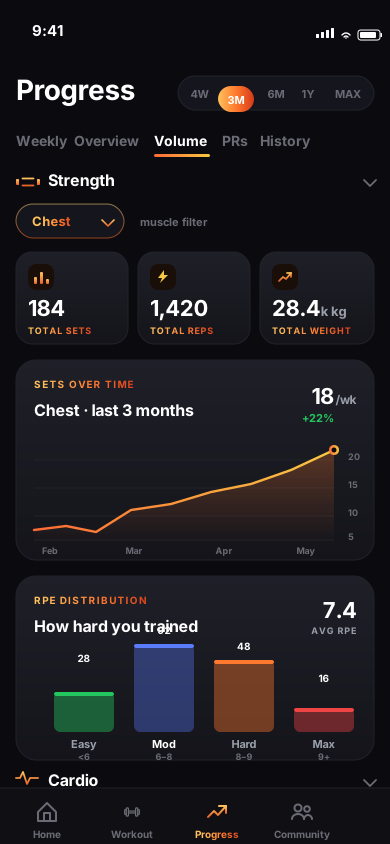
Log push-ups, pull-ups and any bodyweight move — free and unlimited on iOS.
Download on theApp StoreFree to start · No interruptive ads · 14-day Hero trial
This guide is educational and not medical advice. Consult a qualified coach or medical professional before starting or changing a training program.
By Meitar Lazimi, founder of LiftHero · Last updated July 9, 2026.