Program Guide

The Texas Method: How It Works

The Texas Method is the classic answer to "my beginner gains stopped — now what?" Instead of adding weight every session, you progress once a week. Here's how the volume, light and intensity days fit together, who it suits, and how to build it as a custom program in LiftHero.

By Meitar Lazimi · Updated July 2026

In short: The Texas Method is a classic intermediate barbell program — popularized through the strength circle around Mark Rippetoe, commonly credited to Rippetoe and coach Glenn Pendlay, and detailed in writing by Justin Lascek. It's structured across the week: a volume day (for example 5×5 across), a light recovery day, and an intensity day where you hit a new top set or five-rep max. You progress weekly rather than each session, which is why it's a common next step once novice linear progression stalls. LiftHero doesn't ship it built in, but you can build it as a custom program with Hero.

What is the Texas Method?

The Texas Method is a well-known intermediate barbell program. It exists because of a simple problem every lifter eventually hits: on a novice program you add weight to the bar every session, but at some point your body can no longer recover fast enough to do that. The Texas Method solves it by stretching the progression out over a whole week instead of a single workout.

The program was popularized through the strength-training circle around coach Mark Rippetoe, and is commonly credited to Rippetoe and Glenn Pendlay, with the details later written up by Justin Lascek. Rather than the invention of a single author, it's best thought of as a widely used intermediate template. It keeps the same big compound lifts a novice program uses, but reorganizes the week so you can keep getting stronger past the beginner stage.

This is a plain-English explanation of the method. The published sources — Rippetoe's writing and Justin Lascek's detailed treatment — are the authorities on exact loading and variations.

How the Texas Method works

The whole program turns on a three-day weekly rhythm: accumulate volume, recover, then express strength with a new record. Here's the shape of it, step by step:

  1. Train three days a week — the classic layout is Monday, Wednesday, Friday, with a rest day between each session.
  2. Volume day (Monday). High-volume work — for example five sets of five across on the main lifts at a challenging but sub-maximal weight — to accumulate the week's training stress.
  3. Light day (Wednesday). Reduced volume and intensity to recover from the volume day while keeping movement quality, often with some accessory work added.
  4. Intensity day (Friday). Work up to a single heavy top set — for example a new five-rep max — to express the strength the week's volume built.
  5. Progress weekly. Add a small amount of weight to your intensity-day top set each week, rather than adding weight every session as a novice would.
  6. Adjust when you stall. If weekly progress stops, tweak volume, intensity or recovery — or reset the intensity day and re-climb — instead of abandoning the program.
This describes the standard structure; exact set/rep schemes, exercise choices and how the light day is run vary between versions. Treat it as a map, not a fixed prescription.

The weekly structure

The Texas Method is best understood as one repeating week: heavy volume early, recovery in the middle, and a new record at the end. The volume you do on Monday is what earns the record on Friday.

DayRoleTypical work
Monday — VolumeAccumulate stressHigh volume, e.g. 5×5 across, sub-maximal
Wednesday — LightRecoverReduced load and volume, quality reps, accessories
Friday — IntensityExpress strengthOne heavy top set, e.g. a new 5-rep max

This weekly rhythm is the key difference from a novice program. Instead of trying to beat the bar three times a week, you only chase a record once a week — and the volume and light days are built to make sure you can.

The 5×5 volume-day scheme is the best-known version, but people run the Texas Method with different volume and intensity schemes. The written sources cover the variations.

Who is it for?

The Texas Method is aimed at the intermediate lifter — specifically, someone who has stalled on a novice linear-progression program like Starting Strength and can no longer add weight to the bar every session. The weekly progression gives you more recovery time between hard efforts, which is exactly what an intermediate needs.

Great fitMaybe look elsewhere
Intermediates who stalled on session-to-session progressTrue beginners still adding weight every workout
Lifters who want to keep a strength-first, barbell focusLifters chasing mainly hypertrophy and machine variety
People who like a simple, repeating weekly structurePeople who want frequent exercise rotation and novelty

If you're still a novice, stay on linear progression until it genuinely runs out — the Texas Method is a tool for after that. If you want a more size-focused intermediate route, compare an upper/lower split or browse all programs.

How to build it in LiftHero

LiftHero doesn't ship the Texas Method as a built-in program — but you can build it as a custom program with the Hero subscription's program builder, then log every session. Because you only chase a record once a week, accurate logging matters: LiftHero records work sets, warm-ups, RPE and reps, and detects personal records automatically, so your weekly intensity-day top set shows up as a climbing line. It's free to start on iOS, with no routine caps and no interruptive ads.

  1. Get LiftHero free on iOS and open the Programs section.
  2. Use the custom program builder (a Hero feature) to lay out the three sessions — Volume, Light and Intensity.
  3. Save each day as a reusable routine (routines are free and unlimited) so it's ready in a couple of taps.
  4. Train each session from the app — it logs your volume-day sets, light-day work and intensity-day top set with reps and RPE.
  5. Add a little weight to your intensity-day top set each week and watch it trend upward in your progress charts.
LiftHero logs and tracks your training — weights, reps, RPE and PRs — with a custom program builder available in the optional Hero subscription. It doesn't auto-generate or auto-progress the Texas Method for you, so you decide the weekly loading and when to adjust, exactly as the method intends.
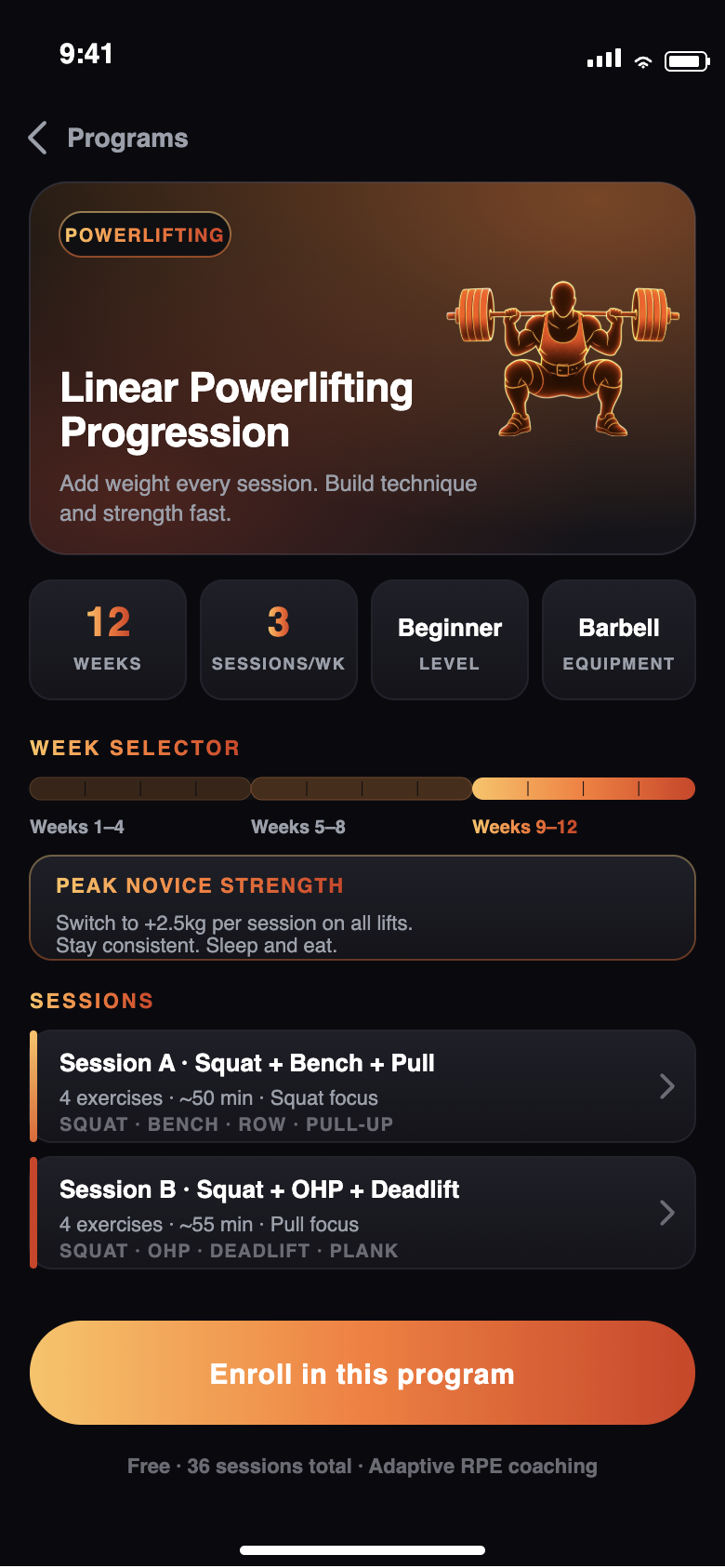
LiftHero custom program builder — building a Texas Method weekly structure in the app
Build a custom Texas Method program and log every set in LiftHero.

Build the Texas Method in LiftHero

Lay out the Volume, Light and Intensity days with the custom program builder in the optional Hero subscription, save them as reusable routines, and log every set free on iOS.

Download on theApp Store

Free to start · No interruptive ads · 14-day Hero trial

Frequently asked questions

What is the Texas Method?

It's a classic intermediate barbell program structured across a training week — a high-volume day, a light recovery day and an intensity day where you set a new top set or rep max. You progress weekly rather than every session, which makes it a common next step after novice linear progression stalls.

Who created the Texas Method?

The Texas Method was popularized through the strength-training circle around Mark Rippetoe and is commonly credited to Rippetoe and coach Glenn Pendlay, with the program later detailed in writing by Justin Lascek. It's a well-known intermediate template rather than the work of a single author.

How is the Texas Method structured?

Across a typical Monday, Wednesday, Friday week: Monday is a high-volume day such as 5×5 across, Wednesday is a light recovery day, and Friday is an intensity day where you hit a single heavy top set like a new five-rep max. The volume earlier in the week drives the record at the end of it.

Who is the Texas Method for?

It's aimed at intermediate lifters who have stalled on a novice linear-progression program like Starting Strength and can no longer add weight every session. The weekly progression model gives more time to recover between hard efforts.

How do you progress on the Texas Method?

You progress weekly, not each session — adding a small amount of weight to your intensity-day top set every week. The high-volume day and light day are structured to let you recover enough to set a new record each week.

Can I build the Texas Method in LiftHero?

Yes — LiftHero doesn't ship the Texas Method as a built-in program, but you can build it as a custom program with the Hero subscription's program builder, save the volume, light and intensity days as reusable routines, and log every set, rep and RPE so you can track weekly records.

This guide is educational and not medical advice. Consult a qualified coach or medical professional before starting or changing a training program.

By Meitar Lazimi, founder of LiftHero · Last updated July 10, 2026.