Most people think about how much weight is on the bar and how many reps they do — but how fast each rep moves is a variable too. Controlling your tempo turns a light weight into a hard set, cleans up your technique, and adds stimulus without adding load. Here's how to read a tempo and when it's worth using.
Tempo training is deliberately controlling how fast each phase of a rep moves, usually written as a four-number code like 3-1-1-0. The numbers are seconds for four phases in order: the eccentric (lowering), the pause at the bottom, the concentric (lifting), and the pause at the top. Slowing the reps adds control, sharpens technique, and increases time under tension without adding weight — a way to make a light load feel genuinely hard. It's a great tool for learning form, building control, and breaking plateaus. The main trade-off: a slow tempo forces a lighter weight, so it's not the tool for maximal strength.
Tempo training means putting a deliberate speed on each part of a rep instead of just heaving the weight up and letting it drop. Every rep has phases — you lower the load, you may pause, you lift it, you may pause again — and tempo assigns each phase a target time. The point is control: instead of momentum doing the work, your muscles stay under tension through the whole range. That control is what makes tempo useful for learning a movement, feeling the right muscles, and adding stimulus without piling on plates. It's the same lift you already do — you're just deciding how fast, rather than letting the weight decide for you.
A tempo is written as four numbers, and reading them in the right order is the whole trick. The convention starts with the eccentric — the lowering phase — because that's usually where a rep begins from the top. Take 3-1-1-0 on a squat as an example: lower for 3 seconds, pause 1 second at the bottom, lift for 1 second, and take 0 seconds (no pause) at the top before the next rep. A larger number means slower and more controlled; a 0 means no pause; some coaches write an X in the lifting slot to mean "move it as explosively as you can." Add up the numbers and you'll see why a slow tempo is humbling: 3-1-1-0 is five seconds per rep, so a set of eight is 40 seconds of continuous work.
| Position | Phase | What it controls |
|---|---|---|
| 1st number | Eccentric (lowering) | How slowly you lower the weight |
| 2nd number | Pause at the bottom | Killing momentum in the stretched position |
| 3rd number | Concentric (lifting) | How fast you raise the weight (X = as fast as possible) |
| 4th number | Pause at the top | Any hold or squeeze before the next rep |
Tempo gives you several things a heavier bar can't, which is exactly why coaches reach for it when load isn't the answer.
Tempo shines when the goal is control and quality: when you're learning a new movement and need to groove the pattern, when you want rehab-adjacent control around a sensitive joint (with professional guidance), or when you've hit a plateau and a fresh stimulus helps more than piling on weight you can't yet handle. In all of those, slowing down is a feature. The flip side is just as important: because a slow tempo forces you to use a lighter weight, it's the wrong tool when the goal is maximal strength or heavy top sets. If you want to get stronger, you need to move challenging loads, not artificially slow light ones. Use tempo as one tool in the box — reach for it deliberately, and set it down when raw load is what the goal demands.
Here's the honest version. Controlled time under tension is a real part of the muscle-building picture, and cleaning up your execution with tempo can make each rep more effective — so tempo can help. But it is not automatically superior to lifting at a normal, controlled speed, and the evidence here is more nuanced than "slower is better." Grinding every rep extremely slowly backfires: it forces the load and total reps way down, and past a point you're trading productive work for the feeling of difficulty. The practical read is that a controlled eccentric and honest reps matter, absurdly slow reps don't add magic, and tempo is best used purposefully rather than as a blanket rule for growth. For the bigger picture on stimulus, see how to build muscle and how rep ranges fit in.
A tempo only works if you actually apply it every set, and that means writing it down. LiftHero lets you log your sets and reps and add a tempo note per exercise for free, so the "3-1-1-0" you decided on doesn't get lost by set three. Keeping the tempo attached to the lift also makes your logs honest: a set of eight at a slow tempo is very different work from a set of eight thrown up fast, and noting the tempo is what keeps those comparable over time. As always, LiftHero is the measurement layer — it logs sets, reps, rest and tempo notes and doesn't auto-generate your program or pick your tempo for you. You choose the tempo; the app keeps the record. Saving a full plan is an optional Hero feature.
Tempo training means deliberately controlling how fast each phase of a rep moves — the lowering, pauses and lifting — instead of just moving the weight. It's usually prescribed as a 4-number code such as 3-1-1-0.
The four numbers are seconds for four phases in order: eccentric (lowering), pause at the bottom, concentric (lifting), and pause at the top. So 3-1-1-0 is a 3-second lower, 1-second bottom pause, 1-second lift, and no pause at the top.
It improves control and technique, adds time under tension without adding load, and can make a lighter weight feel much harder — useful when you want more stimulus or better position without loading a joint heavily.
It can help by adding controlled time under tension and improving your execution, but it isn't automatically better than normal-tempo lifting. Grinding every rep extremely slowly reduces the load and reps you can do, so use tempo as a tool, not a rule.
Skip strict slow tempos when the goal is maximal strength or heavy top sets, because a slow tempo forces you to use a lighter weight. For raw strength you want to move challenging loads, not artificially slow light ones.
Write the tempo next to the exercise and note it with each set so you apply it consistently. In LiftHero you can log sets and reps and add a tempo note per exercise for free.
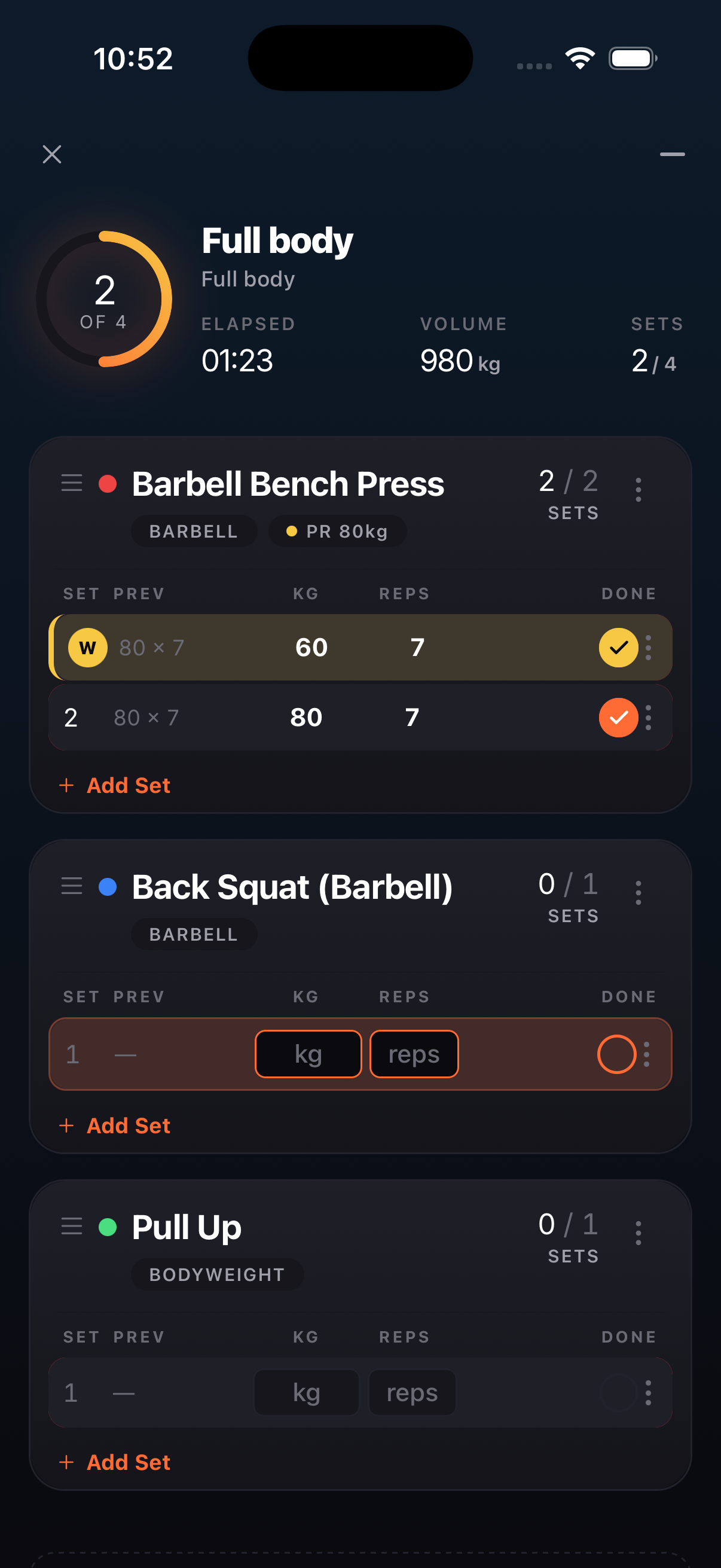
Track sets, reps, rest and tempo notes in one place — free on iOS.
Download on theApp StoreFree to start · No interruptive ads · 14-day Hero trial
This guide is educational and not medical advice. Consult a qualified coach or medical professional before starting or changing a training program.
By Meitar Lazimi, founder of LiftHero · Last updated July 10, 2026.