Rest is a training variable, not dead time. Get it roughly right and every set stays productive; get it wrong and you either sandbag your strength or drag the session out. Here's how long to rest, why it depends on the lift, and the one rule that covers almost every case.
Rest longer for heavy compound lifts and strength — roughly 2 to 5 minutes — so you can repeat the effort with good technique. For isolation and hypertrophy accessories, roughly 1 to 2 minutes is usually enough because the fatigue is more local. The rule that covers everything else: rest long enough to perform the next set well. A modern nuance worth knowing is that longer rests can actually help your total volume and muscle growth, so don't cut a heavy set's rest short just to chase the "burn." Consistent rest also makes your week-to-week comparisons meaningful, which is why a rest timer beats guessing.
There's no single magic number, but the ranges are well established. For heavy compound lifts — squats, deadlifts, presses, rows — and for pure strength, plan on roughly 2 to 5 minutes, and sometimes more on a top set. Those lifts tax a lot of muscle and your nervous system, and they need real recovery before you can repeat a near-maximal effort with clean technique. For isolation and hypertrophy accessories — curls, lateral raises, leg extensions, cable work — roughly 1 to 2 minutes is usually plenty, because the fatigue is local and clears faster. These are guidelines, not laws; use them as a starting point and adjust to how the next set actually feels.
If you remember nothing else, remember this: rest long enough to perform the next set well. Rest exists so you can repeat quality work, so the honest test is the set itself. If your reps fall off a cliff, your bar speed slows dramatically, or your form starts to break because you're still gassed, you rested too little — extend it. If you're standing around fully recovered and cold, you can trim it. This self-checking rule scales across every lift and every goal, and it quietly explains why heavy compounds need more time (they take longer to recover from) while small isolation moves need less. Let the next set, not the clock alone, be the referee.
These are widely used starting points. Where you land inside a range depends on how heavy the lift is, how much muscle it involves, and how recovered you feel — always defer to the "next set well" rule.
| Goal / lift type | Typical rest | Why |
|---|---|---|
| Heavy compounds (strength) | ~2–5 min (more on top sets) | Full recovery to repeat a near-maximal, technical effort |
| Compound hypertrophy | ~2–3 min | Keeps reps and load up so volume doesn't collapse |
| Isolation / accessories | ~1–2 min | Local fatigue clears fast; less systemic cost |
| Power / explosive work | ~2–5 min | Quality and speed matter more than fatigue |
| Conditioning / density | ~30–60 sec | Short rest is the point — raises density and heart rate |
A common myth is that shorter rests build more muscle because they feel harder and produce a bigger pump. The pump feels great, but the current evidence points the other way for many lifters: longer rests let you keep more reps and more load on your later sets, so you accumulate more quality volume — and volume at challenging weights is a primary driver of growth. If you slash your rest on a heavy compound, set two and set three fall apart, and you end up doing less real work, not more. The burn is a sensation, not a goal. Rest enough to make each working set count, especially on your biggest lifts. This is one area where the research shifted in the last decade, so if you learned "keep rest short for growth," it's worth updating.
Rest doesn't stand alone — it works with your rep range and your goal. Low-rep heavy sets aimed at getting stronger demand the longest rests, because each set is a maximal-quality effort you need to repeat cleanly. Moderate-rep sets aimed at building muscle sit in the middle — long enough to protect your volume, short enough to keep the session moving. High-rep isolation work tolerates the shortest rests. Match the three together: the heavier and more systemic the lift, the more rest it earns.
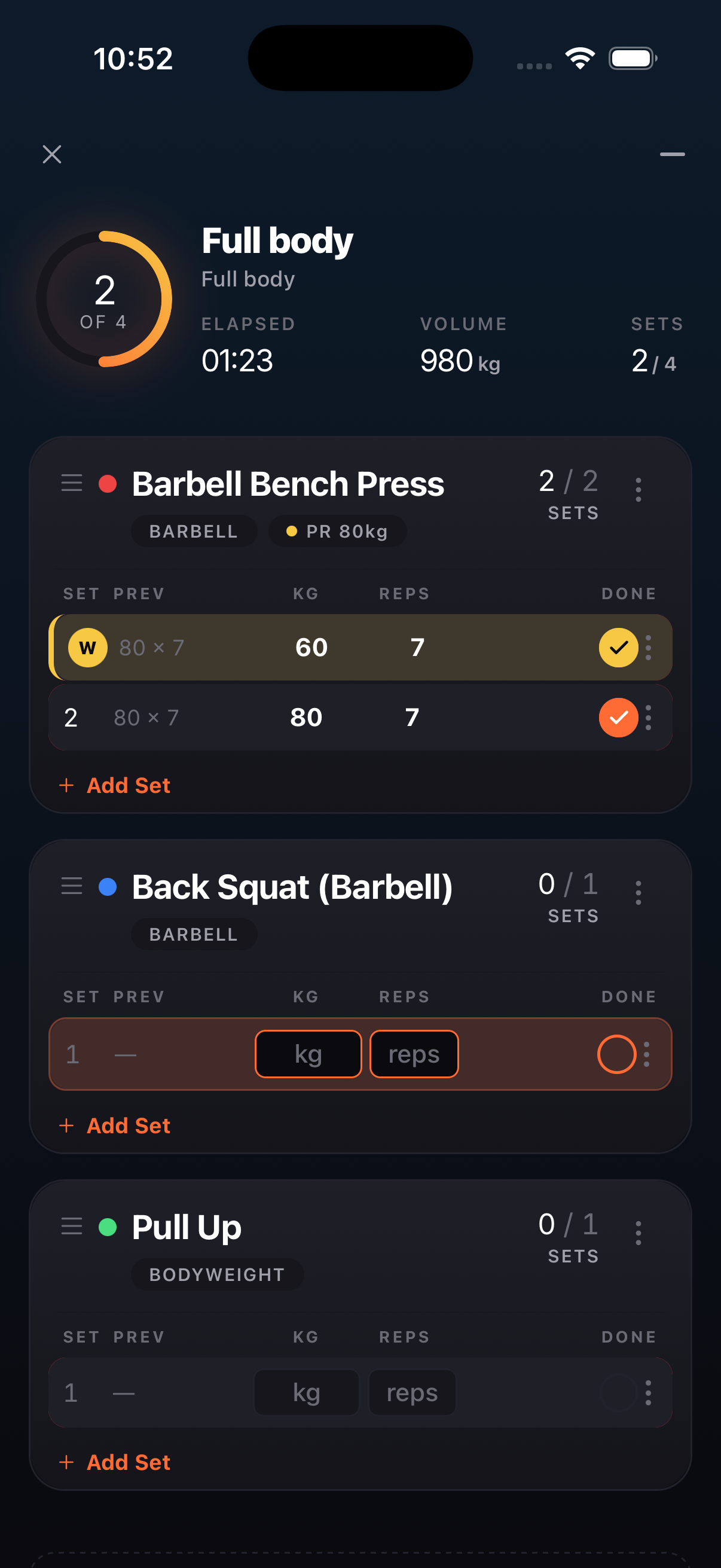
LiftHero has a built-in rest timer so you rest the same way every session instead of guessing. Log a set and the timer starts; when it's up, you're ready for the next set — no watching the clock, no drifting to five minutes because you got distracted. Consistent rest matters because it makes your set-to-set and week-to-week numbers comparable: if last week's third set was strong on two minutes of rest and this week it's weak on the same two minutes, that's real signal, not noise from inconsistent rest. To be clear about what the app does and doesn't do: it logs your sets, reps, rest and tempo notes for free and times your rest for you — it does not auto-generate your program or decide your rest for you. You pick the rest; LiftHero keeps it honest. Saving a full plan is an optional Hero feature.
It depends on the lift and goal. Heavy compounds and strength work generally call for roughly 2 to 5 minutes; isolation and hypertrophy accessories usually do fine with roughly 1 to 2 minutes. The practical rule: rest long enough to perform the next set well.
No. The modern view is the opposite for many lifters: longer rests let you keep more reps and load on later sets, so you accumulate more quality volume, which supports hypertrophy. Don't rush heavy sets just to feel a burn.
For heavy, low-rep strength work, longer rests of roughly 2 to 5 minutes (sometimes more on top sets) let your nervous system and muscles recover enough to repeat a near-maximal effort with good technique.
Roughly 1 to 3 minutes works well for most hypertrophy work. Shorter rests on isolation moves are fine because the fatigue is local; on bigger lifts, err toward the longer end so your volume doesn't collapse.
Yes. A rest timer keeps your rest consistent so your set-to-set and week-to-week comparisons are meaningful. Guessing tends to drift toward too-short rests when you're eager or too-long when you're distracted.
Shorter rests raise the heart rate and training density, which can add a conditioning effect, but fat loss is driven mainly by your overall energy balance. Don't sacrifice training quality on your main lifts just to shorten rest.
Track sets, reps, tempo notes and a built-in rest timer in one place — free on iOS.
Download on theApp StoreFree to start · No interruptive ads · 14-day Hero trial
This guide is educational and not medical advice. Consult a qualified coach or medical professional before starting or changing a training program.
By Meitar Lazimi, founder of LiftHero · Last updated July 10, 2026.