Learn · Technique

Mind-Muscle Connection: Does It Work?

"Feel the muscle working" is one of the oldest cues in the gym — and one of the most debated. Is consciously focusing on a muscle a real advantage, or just bodybuilding folklore? The honest answer is: it depends what you're doing. Here's what the evidence actually says and how to use it well.

The mind-muscle connection is consciously focusing on the target muscle as you lift — thinking about that muscle working rather than just moving the weight. The honest state of the evidence is split by exercise type. For isolation exercises, there's some support that this internal focus can increase activation of the target muscle and may help hypertrophy. For heavy compound lifts, an external focus — on moving the weight or the outcome — tends to be better for performance and output. So it's a genuinely useful tool, not magic: reach for the internal focus on curls and raises, and let go of it on heavy squats and deadlifts.

What is the mind-muscle connection?

The mind-muscle connection is the practice of deliberately directing your attention to the muscle you're trying to train while you lift — actively feeling it shorten and lengthen through the rep, rather than treating the exercise as just getting the weight from A to B. Sports scientists call this an internal attentional focus: your mind is "inside" the working muscle. Its opposite is an external focus, where your attention is on the outcome or the object you're moving — pushing the floor away, driving the bar to the ceiling. Both are real, trainable ways of paying attention, and the interesting part is that they don't do the same thing. Which one helps depends heavily on the exercise and the goal.

Internal focus and isolation exercises

This is where the mind-muscle connection has the most support. On isolation exercises — a biceps curl, a lateral raise, a leg extension — consciously focusing on the target muscle can increase its activation in the moment, and there's reasonable evidence it may translate into more growth over time in that muscle. The logic fits: on a single-joint move with a manageable load, there isn't much else to think about, so "feeling" the muscle genuinely changes how you recruit it. It won't override the basics — you still need enough load, volume and reps in a productive range — but as a way to make an isolation set more effective, an internal focus is a legitimate, low-cost edge. The word to keep, though, is may: the effect is promising, not guaranteed.

External focus and heavy compounds

On big compound lifts — squats, deadlifts, presses, rows loaded heavy — the research flips. Here an external focus, where you concentrate on moving the weight or the outcome ("drive the floor away," "explode the bar up"), tends to produce better performance: more force, better coordination, cleaner reps. Trying to consciously isolate one muscle in the middle of a heavy, multi-joint effort usually gets in the way, because these lifts are about the whole system working together, not one muscle you can single out. So when the goal is moving load well — the essence of getting stronger — an external focus is the better default. That's not a contradiction of the isolation finding; it's the same principle showing that attentional focus is context-dependent.

Which focus should you use when?

The practical takeaway is to match your focus to the exercise and the goal, rather than applying one cue to everything.

SituationBetter focusWhy
Isolation / hypertrophy workInternal (feel the muscle)Can raise target-muscle activation; may aid growth
Heavy compound liftsExternal (move the weight)Improves force output and performance
Learning a lagging muscleInternal, lighter loadsBuilds the skill of recruiting that muscle
Testing max strengthExternal (the outcome)You want maximum output, not muscle-by-muscle attention

Is it a game-changer, or overrated?

The honest answer is neither — it's a useful tool, not magic. The mind-muscle connection can make your isolation work a bit more effective and it's the right mindset for feeling a lagging muscle, but it sits on top of the things that drive most of your results: enough load, enough volume, and progressive overload over time. If you have those handled, dialing in your focus is a sensible refinement. If you don't, no amount of "feeling the muscle" will substitute for showing up and adding work over weeks. It's also worth being clear that this is an area where the research is still developing and some findings are debated, so treat the internal-focus benefit as promising rather than proven, and use it where it costs you nothing: light, controlled isolation work.

How to practice it (and how LiftHero helps)

Building a mind-muscle connection is a skill, and skills improve with deliberate, tracked practice. On isolation moves, use a controlled load, slow the reps down, consciously focus on the target muscle, and squeeze at peak contraction — then switch to an external focus when you move to heavy compounds. LiftHero supports the practice by giving you a clean record: you can log your sets and reps and jot a focus cue or tempo note per exercise for free, so you remember which cue you're drilling on which lift and can keep it consistent week to week. As always, the app is the measurement layer — it logs sets, reps, rest and tempo notes and does not auto-generate your program or coach your form for you. You bring the focus; LiftHero keeps the record. Saving a full plan is an optional Hero feature.
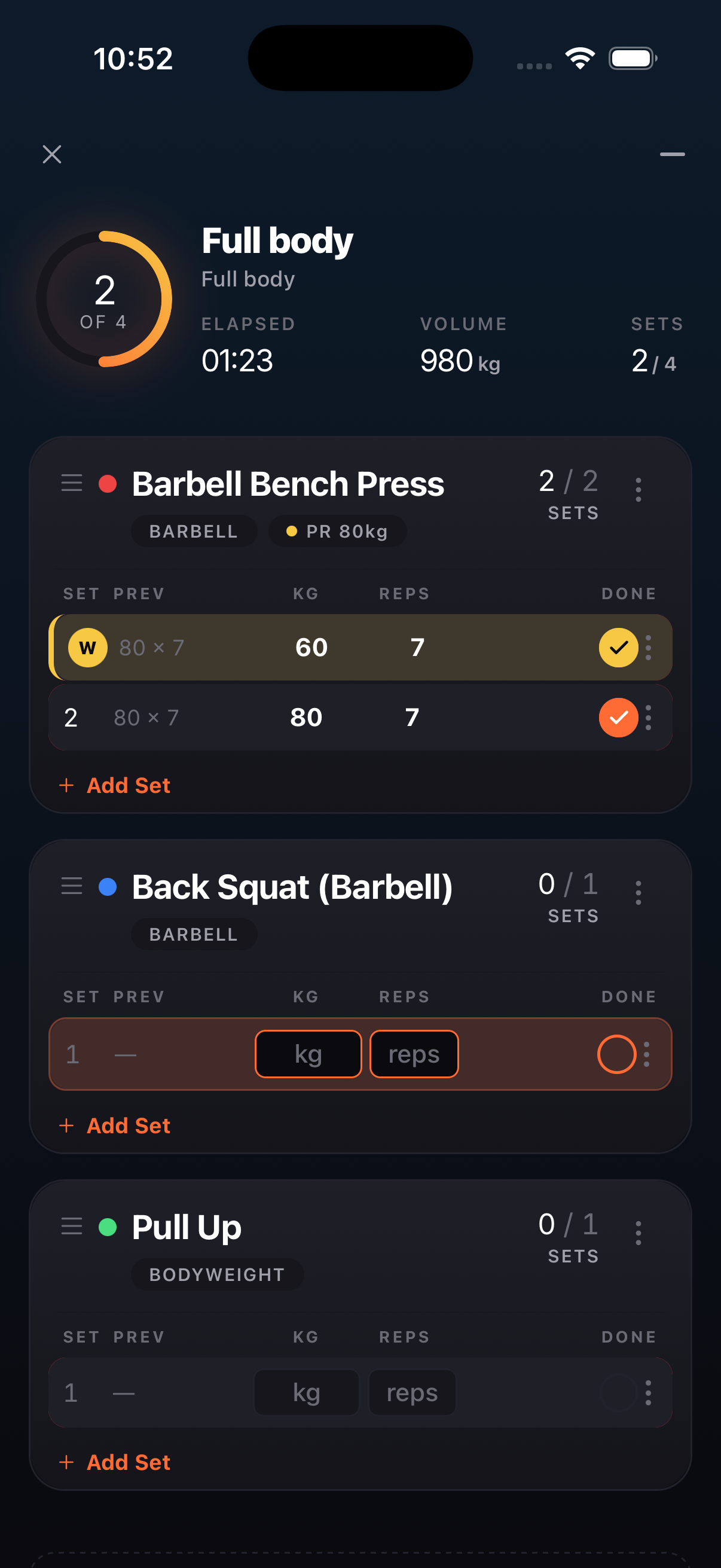
LiftHero active workout screen for logging sets, reps and focus cues
Log each set and note the focus cue you're practicing, so your approach stays consistent across sessions.

Frequently asked questions

What is the mind-muscle connection?

It's consciously focusing on the target muscle as you lift — thinking about that muscle working through the rep rather than just moving the weight from A to B. It's a form of internal attentional focus.

Does the mind-muscle connection actually work?

For isolation exercises there is some support that an internal focus can increase activation of the target muscle and may help hypertrophy. For heavy compound lifts an external focus on moving the weight tends to be better for performance. It's a useful tool, not magic.

Internal vs external focus — which is better?

It depends on the goal. An internal focus (feeling the muscle) suits isolation and hypertrophy work; an external focus (on the weight or the outcome) usually improves performance and output on heavy compound lifts.

Does the mind-muscle connection build more muscle?

The evidence is promising but not absolute. Some studies suggest an internal focus can increase growth in isolation work, but load, volume and progressive overload remain the bigger drivers. Treat it as a helpful addition, not a replacement.

How do I improve my mind-muscle connection?

Use lighter, controlled loads on isolation moves, slow the reps down, consciously focus on the target muscle, and squeeze at peak contraction. It's a skill that improves with practice.

Should I use it on every exercise?

No. Save the internal focus for isolation and hypertrophy work. On heavy compounds where the goal is performance, an external focus on moving the load is usually the better choice.

Train with intent

Track sets, reps, rest and focus cues in one place — free on iOS.

Download on theApp Store

Free to start · No interruptive ads · 14-day Hero trial

This guide is educational and not medical advice. Consult a qualified coach or medical professional before starting or changing a training program.

By Meitar Lazimi, founder of LiftHero · Last updated July 10, 2026.