It's the oldest fear in the gym: run a few miles and watch your hard-won muscle melt away. The honest answer is more boring and more useful than the myth — cardio doesn't kill gains for most people. Here's what the "interference effect" really is, and how to fit conditioning around lifting.
No — for most lifters, cardio doesn't kill gains. There's a real phenomenon called the interference effect, where doing a lot of hard endurance work close to lifting can modestly blunt strength and muscle gains, especially in the legs. But it's exactly that: modest and manageable, not a hard ceiling on your progress. It mostly matters at high volumes of intense cardio, and it shrinks to almost nothing when you keep lifting the priority, separate hard cardio from leg day, and lean on lower-impact steady work. Meanwhile cardio buys you real benefits — heart health, better recovery and work capacity, and help with fat loss. The trade-off is easy to win.
For the vast majority of people, no. The gym-bro fear that a jog undoes your leg day is wildly overstated. What does exist is the interference effect — a tendency for large amounts of intense endurance training to slightly reduce strength and muscle adaptations when it's stacked on top of lifting. The key words are large amounts and slightly. A couple of moderate cardio sessions a week won't stall a well-run lifting program; if anything, the improved recovery and work capacity can help. The people who actually run into meaningful interference are training for endurance and strength hard at the same time — think high-mileage runners who also want a big squat. For everyone else, the honest framing is: cardio is a tool with a small, controllable cost.
The interference effect describes how heavy endurance training can partly compete with the adaptations you're chasing from lifting. The rough idea is that strength and endurance ask the body to adapt in somewhat different directions, and a big dose of one can slightly dilute the other when they're trained together and fatigue overlaps. Two things about it deserve honesty rather than hype: it's modest — a small dent, not a collapse — and it's dose-dependent, growing with the volume, intensity and frequency of hard cardio, and with how close that cardio sits to your lifting. At the low-to-moderate doses most lifters use, the effect is small enough that sensible scheduling erases most of it. It's a reason to be thoughtful about how you program cardio, not a reason to avoid it.
The interference effect is the cost. Here's the return — and for most people it clears the price easily.
| Benefit | What it does for you |
|---|---|
| Heart health | Regular aerobic work supports cardiovascular fitness — the kind of health base that lifting alone doesn't fully build |
| Recovery & work capacity | A bigger aerobic base helps you recover between sets and sessions and handle more total training over time |
| Fat loss | Cardio adds to daily energy burn, making the deficit for fat loss easier to reach while you keep lifting to hold muscle |
| Everyday stamina | Stairs, walks and busy days feel easier when your conditioning isn't an afterthought |
Note the honest framing on fat loss: diet does most of the work, cardio helps. Cardio isn't a license to skip the kitchen, and it isn't required to lose fat — but it's a useful, health-positive lever. The main point stands: the benefits are real and, for typical training doses, they outweigh a small interference cost.
You don't have to choose between conditioning and strength. A few scheduling rules keep the interference cost near zero while you collect the benefits:
A quiet, underrated option is simply walking more. Daily steps raise your energy burn with almost no recovery cost — the low-fatigue lever covered in NEAT & daily steps.
There's no magic threshold, and honesty means admitting the line moves with the person. Interference grows as hard cardio gets longer, harder and more frequent — and as it creeps closer to your lifting sessions. For nearly everyone, a few moderate sessions a week sits comfortably below any level that would dent your lifting. Problems tend to appear when someone stacks frequent long, intense sessions right up against heavy training and never lets fatigue clear. If you're chasing serious endurance and serious strength at once, expect some give-and-take and periodize the two. If you just want to be healthy, lean and conditioned while you lift, you have enormous room before cardio becomes a problem. When in doubt, watch your recovery and your logged lifts rather than a number on a calculator.
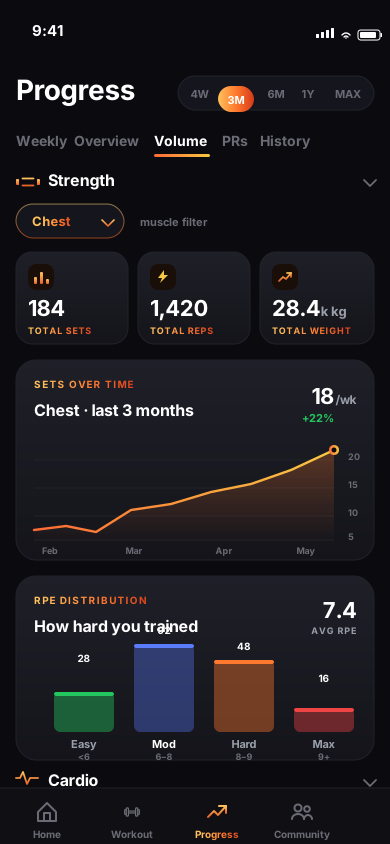
LiftHero is a strength-training tracker — it logs your lifts, sets, reps, weight and RPE and detects personal records. To be completely clear: it does not track cardio, steps, heart rate or calories burned. There's no run tracker or step counter inside it. So it won't manage the cardio side of this for you. Where it earns its place is on the other half of the equation: when you add conditioning, LiftHero shows whether your strength is holding. If your logged squat and bench trend keeps climbing while you run and walk more, the interference effect isn't hurting you. If the numbers stall, that's your cue to trim cardio or recover more. Pair it with a structured plan like Push Pull Legs and let your lifting data referee the balance.
No, not for most people. There's a real but modest interference effect when you do a lot of hard cardio close to lifting, especially for the legs. Kept sensible, cardio doesn't stop you building strength or muscle.
It's the tendency for lots of intense endurance work to slightly blunt strength and muscle gains when the two are trained together. It's real but modest, mostly matters at high cardio volumes, and is manageable with sensible scheduling.
There's no fixed number, but interference grows as hard cardio volume and intensity rise. A few moderate sessions a week is fine for nearly everyone; problems tend to show up with frequent long, intense sessions near lifting days.
If lifting is the priority, do it first or on a separate day so cardio fatigue doesn't compromise your working sets. Light cardio as a warm-up is fine; save hard cardio for after lifting or another day.
Yes. Cardio adds to the energy you burn, which helps create the deficit needed for fat loss while you keep lifting to hold onto muscle. Diet still does most of the work — see the cutting guide.
No. LiftHero is a strength-training tracker — it logs your lifts, sets and reps, not cardio or steps. It's useful here for watching whether your strength holds while you add conditioning.
LiftHero logs your lifts, sets, reps, RPE and PRs so you can see whether added cardio is affecting your gains. It tracks strength training — not cardio or steps. Free on iOS.
Download on theApp StoreFree to start · No interruptive ads · 14-day Hero trial
This guide is general education, not medical advice. Check with a doctor before starting a new exercise program, especially with a heart condition.
By Meitar Lazimi, founder of LiftHero · Last updated July 10, 2026.