The most underrated fat-loss tool isn't a cardio machine — it's the movement you barely notice. All the walking, standing and pottering around that fills your day quietly burns energy, and nudging it upward is one of the gentlest, most sustainable ways to lean out while you keep lifting.
NEAT — non-exercise activity thermogenesis — is all the movement outside your workouts, like walking, chores, standing and fidgeting. It can burn a meaningful amount of energy across a day, and because it's low intensity it's an underrated, low-fatigue lever for fat loss that won't hurt your lifting recovery. Unlike hard cardio, more walking barely competes with your training, so you can add it freely. The simplest way to raise NEAT is a daily step target — a single, easy-to-track number that pulls all that incidental movement up together. It's not a replacement for diet, which still does most of the work, but it's one of the easiest levers to pull. Pair it with a sensible cutting approach.
NEAT stands for non-exercise activity thermogenesis — a technical name for a simple idea: the energy you burn through everything that isn't deliberate exercise. Walking to the shop, taking the stairs, cooking, cleaning, pacing on a phone call, standing instead of sitting, even fidgeting — it all adds up. NEAT sits alongside the other parts of your daily energy burn: your resting metabolism, the small cost of digesting food, and your actual workouts. What makes NEAT interesting is that it's both large and flexible. For many people the movement outside the gym burns more across a week than their formal training does, and unlike your resting metabolism it's something you can consciously nudge up or down. That flexibility is precisely why it matters for body composition — it's a big lever hiding in plain sight.
Fat loss comes down to energy balance — burning more than you take in over time, a topic covered in calories and energy balance. Most people try to widen that gap in only two ways: eat less or do more punishing cardio. NEAT is the quiet third option, and it has a rare combination of advantages. It can contribute a meaningful share of daily energy burn, it costs almost nothing in recovery, and it doesn't spike hunger the way brutal training sessions can. There's also a subtle trap it helps you avoid: when people diet, NEAT tends to drift down without them noticing — they move less, take fewer steps, sit more — which quietly stalls progress. Deliberately keeping your steps up defends against that slowdown. It won't out-run a poor diet, but as a low-effort, low-fatigue lever, NEAT is one of the best-value tools a lifter has.
The whole appeal is fatigue cost. Here's how a daily-steps habit stacks up against leaning on intense cardio while you're trying to hold your strength.
| Factor | Daily steps (NEAT) | Hard cardio |
|---|---|---|
| Recovery cost | Very low — barely competes with lifting | Higher — can eat into recovery |
| Interference with lifting | Minimal | More, especially near leg day |
| Effect on hunger | Gentle — easy to manage | Can spike appetite |
| Sustainability | High — fits into normal life | Depends — easy to skip when tired |
| Energy burn | Adds up steadily over the day | Concentrated in the session |
This isn't an argument that cardio is bad — see cardio for lifters for the full picture. It's that steps carry almost none of cardio's recovery cost, which makes them the natural first lever when your priority is keeping the strength you've built.
You don't need a program — just a target and a few habits that let movement ride on top of your normal day:
The point isn't to hit a heroic number once; it's to raise your average and keep it there. Consistency beats intensity for NEAT every time.
Honestly, there's no universal magic number — the famous "10,000 steps" figure started as a marketing slogan, not a law of physiology. What the evidence broadly supports is simple: more movement is better than less, and the biggest gains come from getting off the low end. A practical target for most people sits somewhere around 7,000 to 10,000 steps a day, but the best goal is one set a little above your own baseline and hit consistently. If you currently average 4,000, jumping to 8,000 is a real, sustainable win; chasing 15,000 and burning out isn't. Treat the step count as a dial you can turn up when fat loss stalls and ease back when life gets busy — a flexible tool, not a rigid rule. Match it to your cutting phase and let it do quiet, steady work in the background.
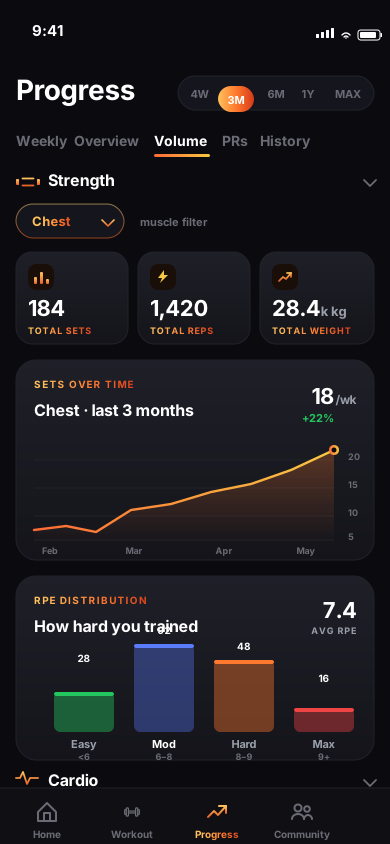
Let's be direct: LiftHero does not count your steps. It's a strength-training tracker — it logs your lifts, sets, reps, weight and RPE and detects personal records. It has no step counter, no walking tracker and no calorie-burn estimate, so for the NEAT side of the equation you'll use your phone or watch. Where LiftHero matters is the goal all this careful, low-fatigue activity is meant to protect: your muscle and strength while you cut. The reason you favor steps over brutal cardio is to keep your lifts intact in a deficit — and LiftHero is what tells you it's working. If your logged strength holds steady while the scale moves, you're losing fat and keeping muscle, which is the entire point. Pair it with a plan like Push Pull Legs and let your lifting data confirm the diet is doing its job.
NEAT stands for non-exercise activity thermogenesis — the energy you burn through all the movement that isn't formal exercise: walking, fidgeting, chores, standing and general daily activity. It's a real, often overlooked part of your daily energy burn.
Yes. NEAT can account for a meaningful share of daily energy burn, and raising it adds to the deficit that drives fat loss — with almost no recovery cost. Diet still does most of the work, but NEAT is an easy lever to pull.
There's no magic number. A common, practical target is somewhere around 7,000 to 10,000 steps a day, but the best goal is one a bit above your own baseline that you can hit consistently.
No. Walking is low intensity and easy to recover from, so it barely competes with your lifting. That's exactly why steps are such a useful, low-fatigue way to add activity while you train for strength.
It's not better or worse — it's lower fatigue. Steps add energy burn without the recovery cost of hard cardio, so they stack neatly with lifting. Many lifters use daily steps as their main conditioning while cutting.
No. LiftHero is a strength-training tracker — it logs your lifts, sets and reps, not steps, cardio or calories. Use your phone or watch to track steps; use LiftHero to make sure your strength holds while you cut.
Steps handle the burn; LiftHero handles the strength. It logs your lifts, sets, reps, RPE and PRs so you know you're keeping muscle in a deficit. It tracks strength training — not steps or cardio. Free on iOS.
Download on theApp StoreFree to start · No interruptive ads · 14-day Hero trial
This guide is general education, not medical advice. Check with a doctor before starting a new exercise program, especially with a heart condition.
By Meitar Lazimi, founder of LiftHero · Last updated July 10, 2026.