One of the most stubborn gym myths is that lifting weights stunts a teenager's growth. It doesn't. Here's what the broad consensus actually says about young lifters — and how a teen can start training safely, with the right people involved.
Supervised, well-coached resistance training is widely considered safe and beneficial for teenagers. The old warning that lifting stunts growth is a myth — by broad consensus, properly coached training does not stunt growth. Growth-plate injuries come from bad technique or reckless maxing out, not from sensible training. What makes it safe is straightforward: qualified coaching and supervision, learning technique before adding load, no ego-lifting or one-rep maxes, and a focus on form and gradual progression. Just as important, a young lifter should have a parent or guardian on board and a doctor's clearance before starting. Done that way, lifting is a genuinely positive thing for teens.
By broad consensus among coaches and sports-medicine bodies, supervised and well-coached resistance training is safe and beneficial for teenagers. The safety isn't automatic — it comes from how the training is done. A qualified coach, technique taught before weight is added, no maxing out, and steady, gradual progression are what turn lifting into one of the more positive things a young person can take up. This is general education rather than medical advice, and every young lifter is different, so a parent or guardian and a doctor should be part of the picture from the start. But the headline is reassuring: with the right supervision, teens and the weight room mix well.
No — this is a myth, and a persistent one. The worry traces back to concern about growth plates, the areas of developing bone near the ends of long bones. But by broad consensus, properly coached resistance training does not stunt growth. Growth-plate injuries in young athletes are associated with bad technique and reckless maxing out — lifting far too heavy, with poor form, without supervision — not with sensible, well-taught training. In other words, the danger isn't the barbell; it's ego-lifting without coaching. When a teen learns movement first, progresses gradually, and skips the one-rep-max heroics, the growth-stunting fear simply doesn't hold up.
Safety for young lifters comes down to a short, non-negotiable list. Get these right and the risks drop dramatically.
| Key | What it means | Why it matters for teens |
|---|---|---|
| Qualified coaching & supervision | A knowledgeable coach watching and guiding each session | The single most important safety factor for young lifters |
| Technique before load | Master the movement light before adding weight | Good form is what prevents most injuries |
| No ego-lifting or maxing | Avoid one-rep maxes and weight beyond good form | Reckless maxing is where growth-plate injuries come from |
| Gradual progression | Small, controlled load increases over time | Lets a growing body adapt without overreaching |
| Parent / guardian involved | A trusted adult on board and informed | Support, oversight, and shared decisions |
| Doctor's clearance | A check-up before starting | Individual medical guidance comes first |
The safe on-ramp for a young lifter is careful and unhurried — the goal is skill and good habits, not big numbers. The sequence:
Done right, resistance training gives teens more than muscle. It can help build strength and movement skills, support bone and joint health, and — maybe most valuable — instill the habit of showing up, training with good technique, and progressing patiently. Those habits carry far beyond the gym. The same principles that guide any beginner apply here: progressive overload, compound movements, and consistency, just dialed to a young lifter's experience and always under supervision. The point isn't to chase heavy weight early; it's to learn how to train well, safely, and for the long run.
There's no single universal age that fits every child — readiness depends more on maturity and the ability to follow instructions than on a birthday. Some young people are ready to learn basic, supervised resistance training earlier than others. Because this is genuinely individual, the honest answer is to defer to a qualified coach and a doctor to decide when and how a particular young person should begin. They can weigh the child's development, attention, and readiness in a way a general article never can. When in doubt, start lighter, keep it supervised, and let the professionals set the pace.
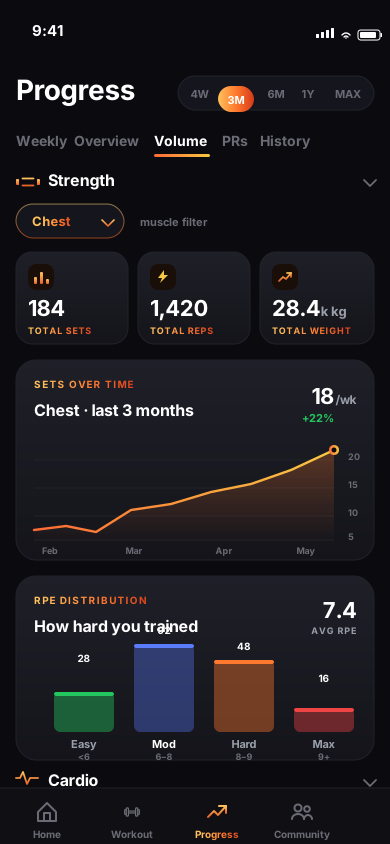
LiftHero logs sets, reps and weight over time and charts the trend, which suits a young lifter's focus on gradual, controlled progression — you can see small, steady increases rather than guessing or chasing big jumps. Used alongside a coach, a simple log helps keep the emphasis where it belongs: on form and patience, not on ego. To be clear about what it is and isn't: LiftHero is the measurement layer, not a decision engine. It does not auto-add weight and does not auto-generate or adapt your program — the coach and lifter decide the progression, the app records it. For young lifters, that coaching and supervision come first; the app is just the notebook.
By broad consensus, supervised and well-coached resistance training is considered safe and beneficial for teenagers. The keys are qualified coaching, learning technique before load, avoiding maxing out, and involving a parent and doctor.
No. The idea that lifting stunts growth is a myth. By broad consensus, properly coached resistance training does not stunt growth. Growth-plate injuries come from bad technique or reckless maxing, not from proper training.
There's no single universal age — it depends on the child's maturity and ability to follow instructions. Defer to a qualified coach and a doctor to decide when and how a young person should start.
Well-coached resistance training can help teens build strength, learn movement skills, support bone and joint health, and develop good habits. Benefits depend on proper coaching and sensible progression.
No. Maxing out and ego-lifting are exactly where injury risk rises. Teens should focus on technique and gradual progression, not on how much they can lift for one rep.
Yes. Young lifters should train under the guidance of a qualified coach and with a parent or guardian on board, plus a doctor's clearance before starting.
Log sets, reps and weight and watch steady progress over time — free on iOS.
Download on theApp StoreFree to start · No interruptive ads · 14-day Hero trial
This guide is general educational content, not medical advice. Check with a doctor before starting a new training program. Young lifters should train under the guidance of a parent/guardian and a qualified coach.
By Meitar Lazimi, founder of LiftHero · Last updated July 9, 2026.