Comparison

LiftHero vs Fitbod

Two strength apps with opposite ideas about who should plan your training. Fitbod's algorithm builds each session for you. LiftHero gives you proven programs to run and a deep log to own. Here's an honest, up-to-date look so you can choose.

Short answer: Fitbod uses an algorithm to generate each workout based on your recovery, equipment and history, and runs on a subscription. LiftHero instead gives you proven, human-authored programs — 5/3/1, Starting Strength, Push Pull Legs and more — plus a custom program builder (in Hero), deep set logging (supersets, drop sets, tempo, warm-ups), and a community tab, free on iOS with a 14-day Hero trial. Pick Fitbod if you want the app to decide your session for you. Pick LiftHero if you'd rather follow a real program, log it deeply, and train with a community — without a subscription wall.

What is the Fitbod app best at?

Fitbod's whole identity is algorithmic workout generation. Tell it your equipment and goal and it builds today's session, auto-adjusting for muscle recovery and your training history. It has a large exercise library — over 1,000 moves with hi-res demo videos — runs on iOS and Android, and has an Apple Watch app for logging sets and rest timers from your wrist. If you want to show up and have a smart app hand you a session, Fitbod is the benchmark.

What is LiftHero best at?

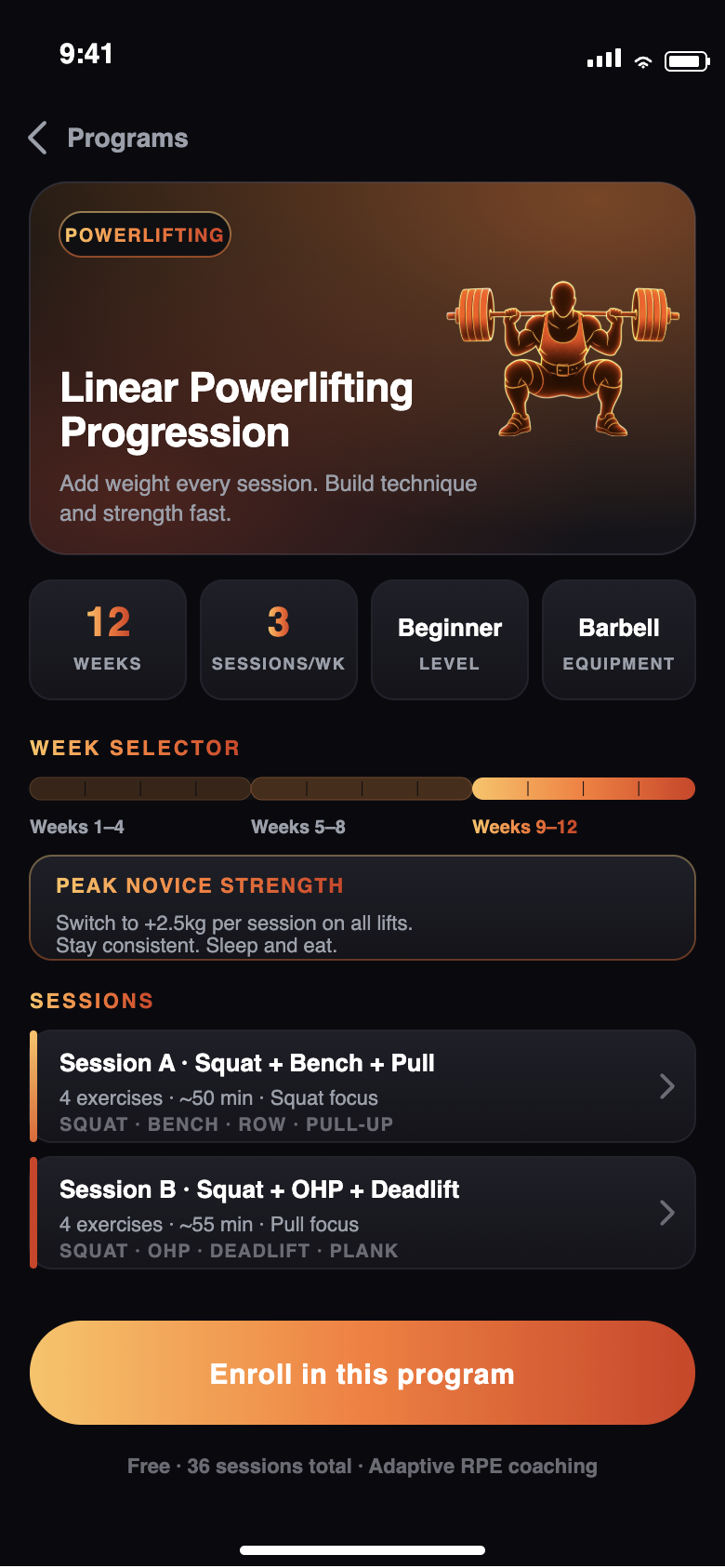
LiftHero starts from a different question: not "what should the algorithm pick today," but "which proven program do you want to run?" It ships adaptations of well-known programs — 5/3/1 Boring But Big, Starting Strength / novice linear progression, Texas Method, Madcow 5×5, Greyskull LP, Push Pull Legs, hypertrophy splits and more — plus a custom program builder (in Hero). Every source is credited on the Program Credits page. It pairs that with deep logging (supersets, warm-ups, drop sets, tempo, unusual equipment) and a full community tab. Free on iOS.

LiftHero built-in training program list including 5/3/1 and Starting Strength
LiftHero ships proven, human-authored programs — fully credited.

LiftHero vs Fitbod: feature comparison

FeatureLiftHeroFitbod
Price / free tierFree on iOS · 14-day Hero trial · no interruptive ads~3 free workouts, then subscription (~$15.99/mo or $95.99/yr)
Workout creationBuilt-in proven programs + custom program builder (in Hero)AI auto-generates each session
Named programs (5/3/1, Starting Strength, PPL)Yes — credited on /creditsNo — algorithmic, not program-based
Deep set logging (supersets, drop sets, tempo)YesLogging plus algorithmic adjustments
Community / social feedYes — full community tabNo — solo (Strava export)
Exercise demo videosNo — on the roadmapYes — 1,000+ with video
Apple Watch appNo — on the roadmapYes
PlatformsiOS (Android on the way)iOS + Android
Progress analyticsCharts + PRs (deep analytics & full history in Hero)History + muscle-recovery view

As of 2026. Feature sets and pricing change — check each app's App Store listing for the latest.

Better for following a structured program?

LiftHero. It includes named, proven programs you run start to finish — pick 5/3/1 or Starting Strength and progress through it. Fitbod generates a fresh algorithmic session each time, which is great for variety, but it isn't the same as following a fixed program to completion. If you came here because you want to run a real program, that's LiftHero's lane.

Better if you want the app to decide your workout?

Fitbod, clearly. If you want to show up and have the app hand you a recovery- and equipment-aware session, that generation is a genuine strength — and LiftHero does not do this yet. LiftHero's AI Coach (which would adapt your program week to week) is on the roadmap, not shipped, and we won't pretend otherwise. Today, LiftHero gives you proven programs to choose from rather than an algorithm choosing for you.

Which costs less — is there a free alternative to Fitbod?

LiftHero is that free alternative: free on iOS, programs included, no interruptive ads, with a 14-day Hero trial for premium analytics. Fitbod gives you a few free workouts and then requires a subscription (about $15.99/month or $95.99/year as of 2026) — there's no permanent free tier. If you want built-in programs and a community without paying a monthly fee, LiftHero is the free option.

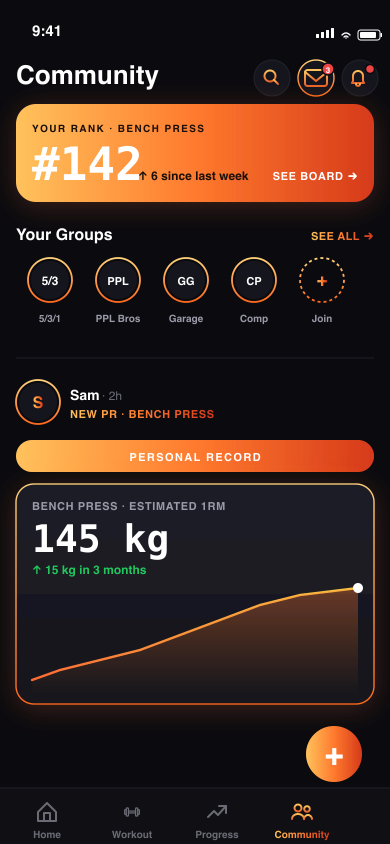
LiftHero community feed showing posted workouts
A community for accountability — Fitbod is solo by design.

Does either app work on Apple Watch?

Fitbod has an Apple Watch app — log sets and rest timers from your wrist (finishing a workout and demo videos still use the iPhone). LiftHero does not support wearables yet; Apple Watch and Garmin sync are on the roadmap, in development. If wrist logging today matters, Fitbod wins this one.

Which should you pick?

Choose LiftHero if…

  • You want proven programs like 5/3/1 or Starting Strength built in.
  • You'd rather own your plan than have an algorithm guess your session.
  • You log advanced set types — supersets, drop sets, tempo, warm-ups.
  • You want a community for accountability and free-with-trial on iOS.

Choose Fitbod if…

  • You want the app to generate your workout for you each day.
  • You value constraint-aware equipment selection and recovery tracking.
  • You want a demo video for every exercise.
  • You rely on its Apple Watch app and don't mind a subscription.

Fitbod is a trademark of Fitbod Inc. LiftHero is not affiliated with Fitbod. This comparison is maintained by LiftHero and reflects publicly available information about both apps as of 2026; it is not endorsed by Fitbod. Verify current pricing and features on each app's App Store listing.

Frequently asked questions

Is LiftHero a good alternative to Fitbod?

Yes. Instead of auto-generating sessions, LiftHero gives you proven built-in programs (5/3/1, Starting Strength, Push Pull Legs and more), deep set logging and a community — free on iOS, without a subscription wall.

Is Fitbod free?

Fitbod gives you a few free workouts (around three) and then requires a subscription — roughly $15.99/month or $95.99/year as of 2026. There's no permanent free tier. Check the App Store for current pricing.

Does LiftHero generate workouts with AI like Fitbod?

Not today. LiftHero gives you human-authored programs and a custom program builder (in Hero) rather than algorithmic generation; an AI Coach that adapts your program week to week is on LiftHero's roadmap, not shipped. AI workout generation is Fitbod's core feature.

Does LiftHero have built-in named programs like 5/3/1 and Starting Strength?

Yes — 5/3/1 (Boring But Big), Starting Strength / novice linear progression, Texas Method, Madcow 5×5, Greyskull LP, Push Pull Legs, hypertrophy splits and more, plus a custom program builder (in Hero). Every source is credited on the Program Credits page. Fitbod is algorithmic and does not follow fixed named programs.

Does LiftHero work on Apple Watch?

Not yet — wearables (Apple Watch, Garmin, Suunto) are on the roadmap. Fitbod has an Apple Watch app for logging sets and rest timers from your wrist.

Which app is better value?

LiftHero is free on iOS with a 14-day Hero trial and no interruptive ads; Fitbod is subscription-based (about $15.99/month or $95.99/year) after a few free workouts.

Does LiftHero have a community like a social feed?

Yes — post workouts, follow friends, copy templates and climb leaderboards. Fitbod is focused on solo, algorithm-generated training.
Train like a hero

Free on iOS. Real programs, deep logging, and a community that shows up.

Download on theApp Store

Free to start · No interruptive ads · 14-day Hero trial

More comparisons: LiftHero vs Hevy · LiftHero vs Strong

Last updated: June 20, 2026.